
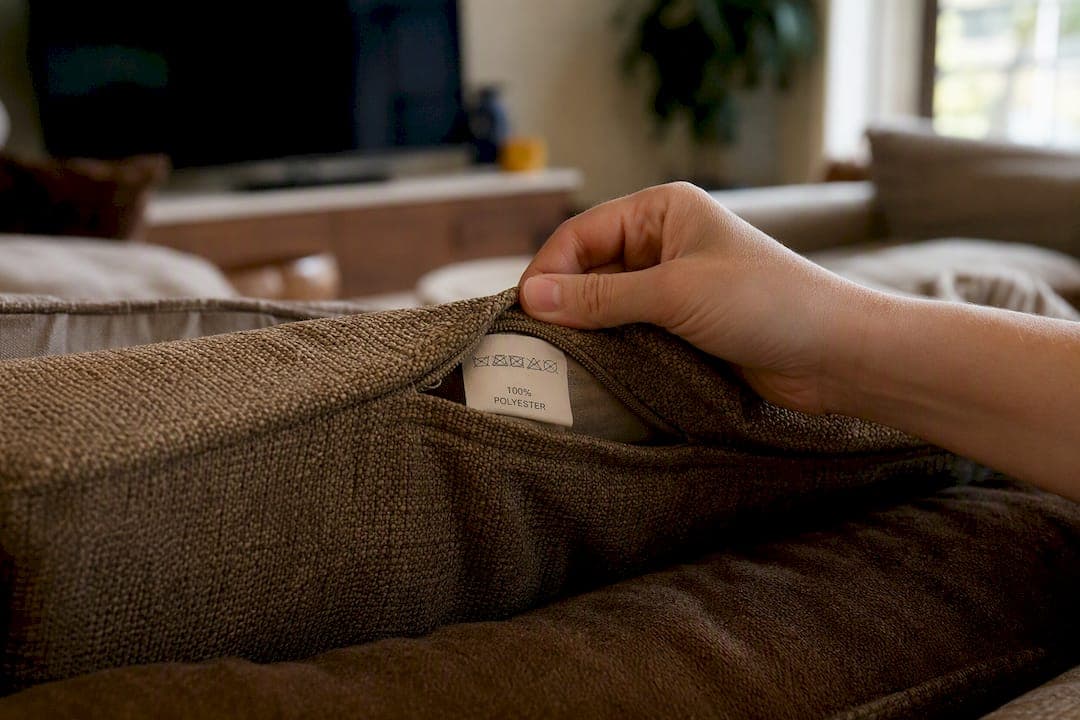
Silk, wool, linen, rayon, bouclé, and luxury velvet are the fabrics most likely to earn the label "delicate," and the moment one of them meets a spill, the only correct first move is to blot, never rub. Rubbing drives liquid deeper into the pile and spreads the stain outward. Before you reach for any cleaner, check the manufacturer's cleaning code, usually a small tag under the cushion marked W, S, WS, or X, and test any product in a hidden spot first.
If a spill just happened: stop more liquid from soaking in, blot gently with a clean white microfiber cloth, and skip water entirely on anything coded S or X. If the piece is valuable, antique, or you can't find the tag, stop and call a professional rather than guess.
- Blot from the outer edge of the stain toward the middle, never the reverse.
- Never apply a spot cleaner before you've located and read the cleaning code.
- Treat unlabelled or high-value furniture as "test first, treat never" until a pro looks at it.
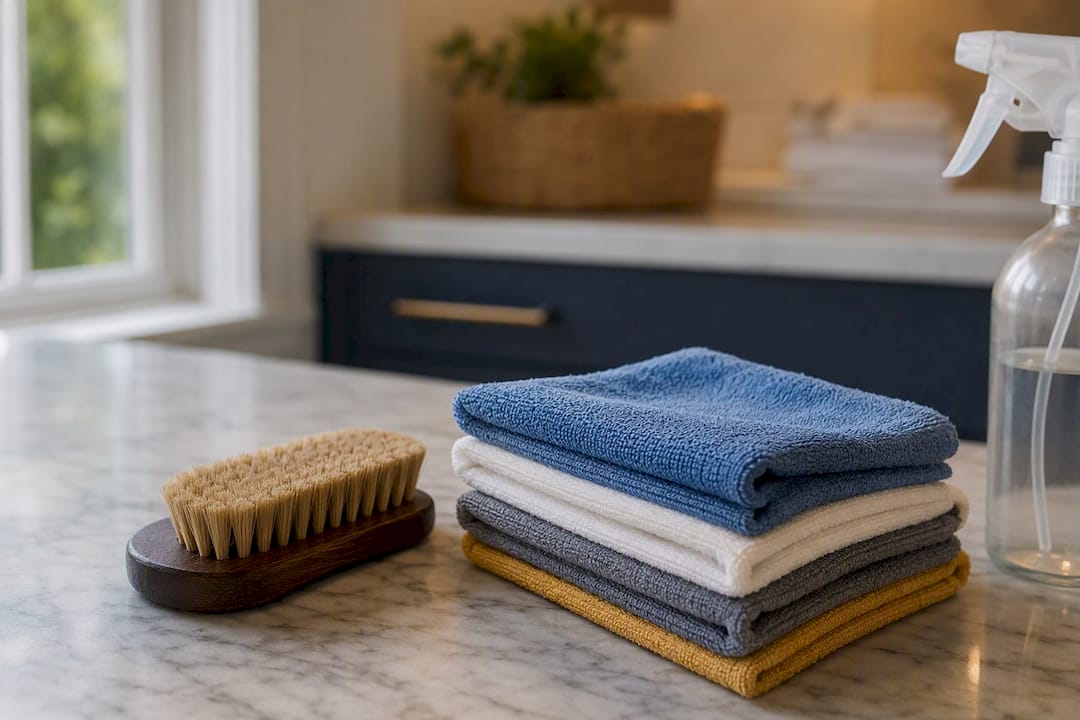
Pro Tip: Keep a stack of plain white microfiber cloths near any room with delicate upholstery. Coloured or patterned cloths can transfer dye onto damp fabric, turning a spill into a two-part problem.
Key Takeaways
Delicate upholstery fabrics require checking the manufacturer's cleaning code and testing a hidden area before any treatment, because the wrong method causes permanent, irreversible damage.
| Point | Details |
|---|---|
| Identify before treating | Check the tag for fibre content and cleaning code, then confirm with a hidden-area test. |
| Blot, never rub | Lift fresh spills with a clean white microfiber cloth from the outside in. |
| Match method to code | W allows water, S needs solvent only, WS allows either gently, X means vacuum only. |
| Maintain weekly | Soft vacuuming, cushion rotation, and pile grooming reduce the need for deep cleaning. |
| Call a pro for S or X | High-value, antique, or restricted-code fabrics need professional assessment, not guesswork. |
Table of Contents
- How to identify delicate upholstery fabrics in the home
- What do W, S, WS, and X cleaning codes actually mean?
- What to do the moment a stain happens
- Building a routine maintenance schedule for delicate fabrics
- Which stains and cleaners are safe for each fabric type?
- How performance finishes like Sunbrella and Crypton change the care equation
- What to expect when you call a professional upholstery cleaner
- Choosing delicate-looking fabric without signing up for constant upkeep
- How long does professional cleaning and drying actually take?
- Why identification comes before every other decision
- Sources
How to identify delicate upholstery fabrics in the home
Start with the tag. A cleaning code and fibre content label are usually stapled or sewn under the cushion or along the frame's underside, and that single tag tells you more than any visual guess. When the tag is missing or worn away, you're working from touch and sight instead.
Run your palm across the surface. Silk and fine rayon feel cool, slick, and almost slippery, with a sheen that shifts as light hits it from different angles. Wool and true velvet have a dense, springy pile that flattens under pressure and slowly rebounds. Bouclé is loopy and textured, often unevenly woven, which makes it prone to snagging and pulling. Fine cotton blends sit in between; they resist moisture reasonably well but crush and mark more easily than heavier canvas weaves.
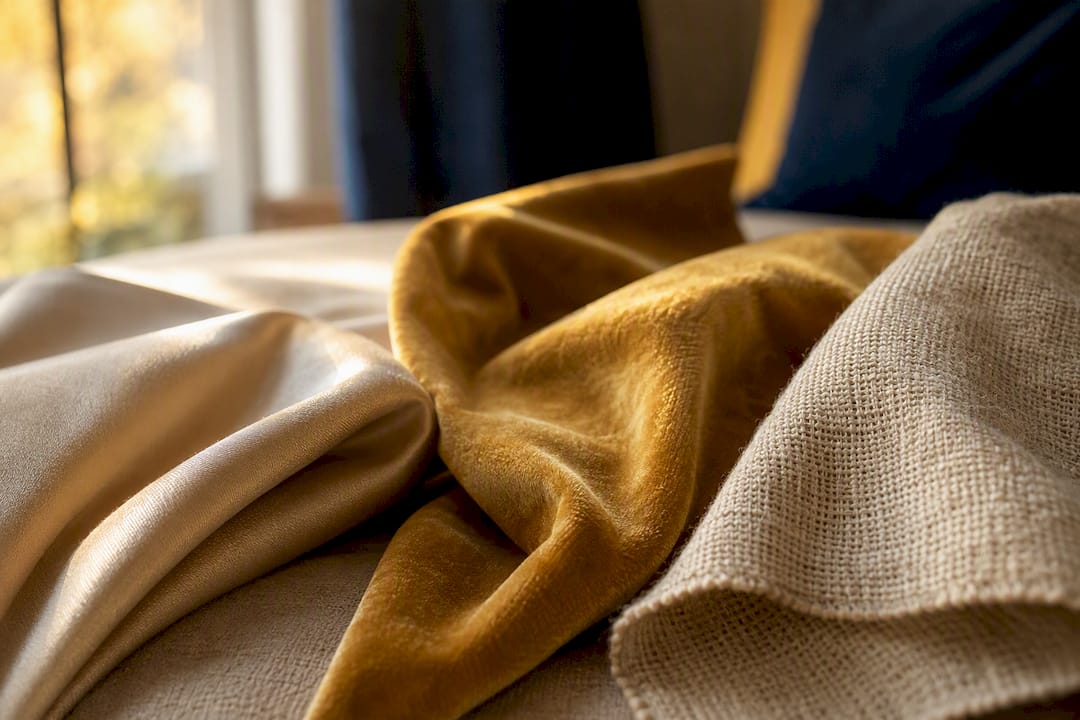
Check the weave tightness and backing. Loosely woven or unbacked fabrics let liquid pass through fast, which spreads a stain toward the padding underneath. Look for coatings, trims, or hand embroidery too. Those extras often can't tolerate the solvents or moisture that the base fabric might otherwise handle.
The most reliable test isn't a checklist of fibre names. It's a hidden-area trial: dab a damp cloth on an inside seam and watch for dye bleed, colour crocking on the cloth, or a pile texture change. That pre-cleaning inspection approach is standard practice among upholstery professionals for good reason.
Pro Tip: If a hidden test shows any dye transfer at all, stop. That result means the fabric's dye isn't fully set, and a full-surface cleaning attempt could leave permanent blotching.
What do W, S, WS, and X cleaning codes actually mean?
These letters aren't decoration. They're the manufacturer's chemistry limits, and ignoring them is the single most common way delicate fabric gets ruined. A cleaning-code guide breaks them down clearly: W means water-based cleaners are safe, S means solvent only (no water at all), WS means either works but you start with the gentlest option, and X means vacuum or brush only, no liquid or solvent of any kind.
Water swells natural fibres like silk and wool at the cellular level, which can cause shrinkage, puckering, or dye migration that no amount of careful drying will reverse. Solvents work differently. They dissolve oils and soil without introducing moisture, which is exactly why S-coded fabrics depend on them.
| Code | What it allows | What to avoid |
|---|---|---|
| W | Water-based cleaning products | Harsh solvents or excessive saturation |
| S | Solvent-based cleaning only | Any water, including damp cloths |
| WS | Either water or solvent, gentlest first | Skipping the pretest step |
| X | Vacuum or soft brush only | Any liquid, water, or solvent |
Pro Tip: Most furniture made in the last twenty years for everyday family rooms carries a W or WS code, so if your sofa cleans easily with a damp cloth, it's likely one of these. Delicate decorative pieces are far more often S or X.
What to do the moment a stain happens
Blot from the outside of the stain toward the centre with a clean, dry microfiber cloth, and never rub. Rubbing pushes the contaminant deeper into the pile and widens the mark, while blotting lifts it out.
- Scrape or lift off any solid material first, using a dull edge rather than your fingers.
- Press a clean white cloth against the wet area, moving inward, and swap to a fresh section of cloth as it absorbs liquid.
- Hold off on any spray, cleaner, or water until you've confirmed the cleaning code.
- If the fabric is S or X coded, or the spill is ink, wine, or oil, stop there and book a professional.
A small water-based test on a W or WS fabric is usually fine once you've pretested a hidden spot. Anything beyond that, especially on a fabric you can't confidently identify, calls for a technician's assessment rather than a guess.
Pro Tip: Keep a "spill kit" of dry microfiber cloths and a dull plastic scraper in a hallway closet. The first ninety seconds after a spill do more to prevent a permanent stain than any product you could buy later.
Building a routine maintenance schedule for delicate fabrics
A weekly vacuum with a soft brush or horsehair attachment removes grit before it works into the weave and starts cutting fibres from the inside. Rotate and flip loose cushions every couple of weeks so wear spreads evenly instead of concentrating on one cushion's leading edge. On velvet or wool pile, groom in the direction of the nap after vacuuming to keep the surface even and prevent crushed patches.
- Vacuum weekly with a soft attachment, never a beater bar.
- Rotate cushions every two to three weeks.
- Brush pile fabrics in the direction of the nap after cleaning.
- Add arm covers or a folded throw over high-contact spots like armrests.
- Log any spot treatments or visible wear so a technician has a history to work from later.
Sunlight and humidity do slow, quiet damage that's easy to miss until it's advanced. UV exposure fades dye and dries out natural fibres until they become brittle, while high humidity can loosen upholstery adhesives and encourage mildew in fill material. Rotating furniture away from direct window light and keeping indoor humidity in a moderate range protects colour and structure far more cheaply than any repair does later.
Pro Tip: If a cushion always fades faster on one side, that's your sun exposure pattern talking. Rearranging the room, even slightly, can add years to a fabric's colour life.
Which stains and cleaners are safe for each fabric type?
Different delicate fabric families tolerate very different treatments, and matching the wrong cleaner to the wrong fibre is how small stains become permanent ones.
Silk and fine rayon should never see water. Blot only, and reserve any deeper treatment for a solvent-based professional method. Wool and luxury velvets, including French bouclé and merino velvet, generally call for dry cleaning only; steam, direct water, and household spot removers all carry a real risk of leaving irreversible marks. Linen and sturdier cotton blends tolerate light water-based spotting if the tag confirms a W or WS code, but they still bruise and water-ring easily under heavy scrubbing. Bouclé's loose, looped construction snags and distorts under any aggressive treatment, so dry, low-moisture methods are the safer default.
| Fabric group | Cleaning-code fit | Home-safe step | When to call a pro |
|---|---|---|---|
| Silk and fine rayon | Usually S or X | Blot only, no liquid | Any stain beyond light dust |
| Wool and luxury velvet | Often S | Dry brush, light vacuum | Spills, odour, visible soiling |
| Linen and cotton blends | Frequently W or WS | Light water-based blotting after pretest | Set-in or large stains |
| Bouclé and textured wovens | Commonly S or X | Gentle vacuum only | Any liquid spill |
How performance finishes like Sunbrella and Crypton change the care equation
Fabrics built with performance finishes trade a bit of hand feel for real stain resistance, and it's a fair trade for households with kids, pets, or heavy daily use. Sunbrella fibres resist fading and moisture at the fibre level rather than relying only on a surface coating, which is why they hold up well outdoors and in sunny rooms. Crypton applies a moisture and stain barrier during manufacturing, so spills tend to bead rather than soak in. Trevira CS focuses on flame resistance alongside durability, common in commercial and hospitality upholstery.
- These finishes usually allow water-based spot cleaning that would ruin an untreated silk or wool equivalent.
- Harsh solvents or bleach can strip the protective coating, so the manufacturer's care sheet still matters even on treated fabric.
- Some coatings follow a "rinse to reset" rule, where plain water restores the repellent finish after a cleaning.
- If you love a delicate-looking fabric but dread the upkeep, ask your supplier whether a performance version exists in a similar weave or colour.
What to expect when you call a professional upholstery cleaner
Book a professional when the fabric is coded S or X, when it's an antique or high-value piece, when odour persists after airing it out, or when a hidden-area test shows dye movement or pile change. Any of those signals means the risk of DIY treatment outweighs the convenience.
A technician starts with the same hidden-area testing you'd do at home, but with more reference points: checking seam stability, backing condition, and cushion fill before choosing a method. From there, they apply controlled solvent or low-moisture extraction depending on the code, document any fading or wear limits found during inspection, and finish with careful drying and pile grooming.
Ask for an itemised quote rather than a flat number, since size, fabric type, and soiling level all shift the price. A technician may also frame the outcome as a "limited improvement" rather than a guarantee, particularly on old set-in stains, and that's a sign of an honest assessment rather than a weak one.
Pro Tip: If a cleaning company says it can safely handle any fabric with any method, that's a red flag rather than reassurance. Legitimate technicians tell you upfront when a fabric limits their options.
Choosing delicate-looking fabric without signing up for constant upkeep
Before you fall for a swatch, check its cleaning code, ask for abrasion or rub-count data, and consider how much direct sun the room gets. A fabric best suited to decorative pieces, like true silk, rarely holds up on a daily-use family sofa, no matter how much you love the sheen.
Match the fabric to how the room actually gets used. A formal living room that sees guests twice a month can carry genuine silk or bouclé without much worry. A family room with kids or pets does far better with a performance-finished fabric that mimics the look of something delicate.
- Request physical swatches and test them against your intended thread, welt, and zipper materials.
- Ask the supplier directly what maintenance the fabric requires and what its cleaning code is.
- Run your own hand-test for drape and stretch before committing to yardage.
- For high-traffic zones, prioritize backing quality and pilling resistance over pure texture.
Pro Tip: Order swatches in the exact colourway you want, not just the fabric family. Dye lots and finishing treatments can shift a fabric's feel and durability even within the same collection.
How long does professional cleaning and drying actually take?
Most residential upholstery jobs run on-site for a moderate time depending on the number of pieces, cleaning method, and pre-treatment needs. A single sofa with straightforward W or WS-coded fabric moves through inspection, treatment, and finishing fairly quickly. A set of dining chairs with delicate S-coded fabric, or a sectional with multiple stain sites, takes longer because each hidden-area test and each cushion needs individual attention.
Drying time is where homeowners often get surprised. Low-moisture extraction methods, the kind typically used on WS fabrics, usually dry within a few hours under good airflow. Solvent-based cleaning on S-coded fabric tends to dry faster still, since no water was introduced in the first place. Humid weather, poor ventilation, or thick cushion fill can all stretch drying time regardless of method, so a technician may recommend running a fan or opening windows afterward.
Full recovery, meaning the fabric returns to its normal texture and pile direction after grooming, typically happens within the same day for most fabric types. Heavier textured fabrics like bouclé or thick velvet sometimes need a light re-grooming the next day once the pile has fully settled. None of this is instant, which is part of why a same-day guarantee from any cleaning service should raise a question rather than reassure you.
If a piece has structural concerns identified during inspection, seam slippage or unstable adhesive, for instance, the technician may recommend a longer, more conservative process or refer the job to a specialist in reupholstery rather than risk further damage during cleaning.
Delicate upholstery rewards patience more than speed, and a technician who takes an extra thirty minutes on hidden-area testing is protecting your furniture, not wasting your time. When a piece genuinely needs professional attention, booking a proper cleaning gets you an itemised look at what the fabric actually needs before any work starts. For readers who want to handle routine care themselves between professional visits, the practical maintenance tips on keeping fabric fresh day to day are worth bookmarking.
Why identification comes before every other decision
Most upholstery advice online jumps straight to stain removal tricks, and that's backwards. The fabric identification step, the tag check, the hand test, the hidden-area trial, determines everything that follows, and skipping it is how a five-minute spill becomes a five-hundred-dollar repair.
The conventional wisdom oversells DIY confidence. Plenty of guides list a dozen home remedies for coffee, wine, or ink without ever mentioning that half of them are unsafe on S or X-coded fabric. That's not a minor oversight. It's the difference between a stain that fades and one that sets permanently.
If there's one thing worth prioritizing above all else, it's respecting the cleaning code the moment you find it. Homeowners who treat that tag as optional information, rather than a hard boundary, are the ones who end up needing full reupholstery instead of a simple clean. Delicate fabric isn't fragile because it's fussy. It's fragile because it was built for appearance first, durability second, and the care routine has to reflect that trade-off honestly.
Sources
- Designtex cleaning manual (surface materials)
- Upholstery Fabric 101: Everything You Need to Know — Fabric Mill
- Cleaning upholstery codes guide — Cleaning Science World
- Pre-cleaning inspection for upholstery — Upholstery handbook (VI Reupholstery)
- Upholstery care in furniture — Frajumar