
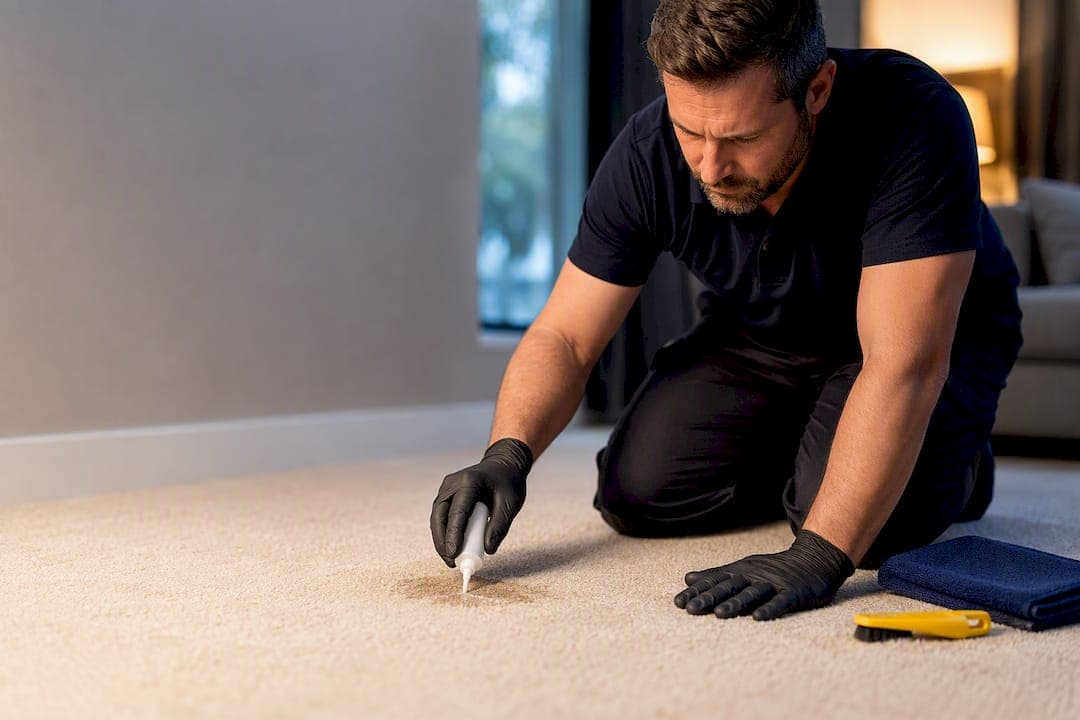
The only reliable fix for pet urine smell in carpet is an enzymatic cleaner applied to the same depth the urine reached, given proper dwell time, then extracted and dried completely. Surface sprays, and steam alone, rarely work because they often don't penetrate down to the pad level. If the odour survives two full enzyme treatments, or the pad and subfloor show staining, the job needs a professional.
TL;DR:
- Enzymatic cleaners are the only reliable solution for pet urine odor, effectively breaking down uric acid crystals when applied to the urine depth and left to dwell.
- Using blacklights, smell mapping, and moisture meters helps identify all contaminated areas, including those spread under carpet backing and padding.
- Fresh accidents respond well to prompt removal using blotting, cold water rinse, enzyme application, and thorough drying, while old stains require extended saturation and multiple treatments.
- Reusing surface sprays or steam cleaning often worsens odors because they fail to address pad and subfloor contamination, which frequently causes recurrent smells.
- When odor persists after two enzyme treatments, or if the pad shows staining or spongeiness, professional sub-surface extraction and inspection are necessary for lasting results.
Table of Contents
- Fast steps to stop pet urine smell in carpet right now
- How do you find hidden pet urine spots in carpet?
- Treating fresh urine vs. old, set-in stains
- Why does pet urine smell keep coming back?
- When should you call a professional carpet cleaner?
- How to prevent pet urine odour in carpet long-term
- A cleaner's honest take on realistic timelines
- Book a professional pet urine treatment with Icleansecuc
- Sources
Fast steps to stop pet urine smell in carpet right now
Fresh accidents respond well to fast action, and every minute you wait lets more urine seep past the carpet backing into the pad below. Here's the order that actually works, based on manufacturer chemistry guides and pro cleaning practice.
- Blot, don't rub. Press thick towels or cleaning and housekeeping gloves - hygiene & cleaning paper towels straight down onto the spot repeatedly. Rubbing spreads the stain and pushes urine deeper into the fibres.
- Rinse lightly with cold water. A small amount diluted onto the spot helps lift surface residue, then blot again until the towel comes up mostly dry. Don't drench it. You're diluting, not flooding.
- Saturate with an enzyme cleaner. Apply generously enough that it reaches pad depth, matching however far the original urine soaked. Enzyme cleaners break down uric acid crystals through the same protease and uricase action pet-safe cleaning guides recommend, but only if the product actually gets where the urine went.
- Cover and let it dwell. Plastic wrap or a damp towel over the spot keeps it from drying out too fast. Give it 12 to 24 hours for anything beyond a fresh puddle, then extract with a wet vac and let it dry fully.
Skip the ammonia-based cleaners and skip the steam cleaner for this first pass. Both can make the smell worse, which the next few sections explain.
How do you find hidden pet urine spots in carpet?
Visible stains are rarely the whole story. Urine spreads laterally under carpet the moment it hits the backing, so treating only what you can see leaves contaminated carpet and pad around the edges.
- A blacklight (UV flashlight) used in a dark room is the fastest way to map the real spread. Dried urine fluoresces a yellowish green, and the glow usually extends noticeably past the visible stain on the surface, sometimes reaching a wider radius, according to pro cleaning field guides.
- Smell mapping works even without a blacklight. Walk the room on a warm afternoon or right after the heat's been running. Warmth and humidity reactivate old odour compounds, so a spot that seems fine in the morning can smell distinct by mid-afternoon.
- A moisture meter tells you what's happening below the surface. If a spot reads high or feels spongy underfoot days after the carpet looks dry, the pad is likely still holding urine.
Pro Tip: Do the blacklight sweep before you start treating anything. Mapping every spot first means one enzyme application covers the full spread instead of you discovering a second stain after the carpet's already dried.
Treating fresh urine vs. old, set-in stains
The approach changes a lot depending on whether you're dealing with something that happened an hour ago or a stain that's been drying for weeks. Treat them the same way and you'll likely waste a bottle of cleaner on the old one.
Fresh accidents (same day)
- Blot immediately, don't press a warm iron or hairdryer on it, and don't reach for the steam cleaner. Heat sets the proteins in urine into the fibres, which is opposite of what you want.
- Dilute lightly with cold water, blot again.
- Apply enzyme cleaner generously, enough to match penetration depth. A light spray on top of a puddle that soaked three centimetres down does almost nothing.
- Cover, dwell for several hours minimum, extract, and dry with fans or open windows.
Dried or long-set urine
Old stains need more patience because the uric acid has already crystallized and the salts have bonded to the fibres and pad.
- Rehydrate the area first with plain water, lightly, to help the enzyme solution disperse rather than sit on a dry surface.
- Saturate heavily with enzyme cleaner, aiming for pad depth. This usually means more product than you'd think reasonable for a stain that "looks" small on the surface.
- Cover with plastic and extend the dwell time to 24 to 48 hours. This isn't a step to rush.
- Extract, check with a moisture meter or your nose after a full dry cycle, and repeat the whole process if odour remains.
A few mistakes come up constantly with set-in stains:
- Bleach or ammonia-based cleaners react badly with the ammonia already present in aged urine, and can intensify the smell rather than remove it.
- Steam or hot water applied before enzyme treatment sets stains and odours in permanently. Enzymes need to go first.
- Oxidizers like hydrogen peroxide-based products can help with lingering discolouration and speed odour reduction on old stains, but manufacturer chemistry guides recommend colourfast testing first and using them as a follow-up to enzymes, not a replacement.
For extraction, a household wet/dry vac handles small spots fine. Anything larger, or a stain that keeps returning, usually needs a portable carpet extractor or sub-surface extraction tool that can pull moisture and residue out of the pad itself, not just the carpet face. That's the step most DIY attempts skip, and it's usually the reason the smell comes back a week later. Icleansecuc's carpet cleaning method walks through this exact enzyme-to-extraction sequence in more detail.
Why does pet urine smell keep coming back?
Because fresh urine and week-old urine are chemically different problems, and most store-bought sprays are built to handle only the first one.
Cleaning products applied to fresh cat urine can visibly reduce odour on day zero, but the same treated samples released new compounds, including a fishy trimethylamine smell and a mold-like 3-octanone note, by day fifteen.
That finding comes from a laboratory analysis of VOCs released from urine-contaminated carpet, and it explains a pattern a lot of homeowners run into: a spray seems to work, then the smell returns days or weeks later, sometimes different from the original odour. Uric acid is the reason. It crystallizes as urine dries and becomes hydrophobic, meaning water-based cleaners glide right over it instead of breaking it down. Enzymes are what actually digest it.
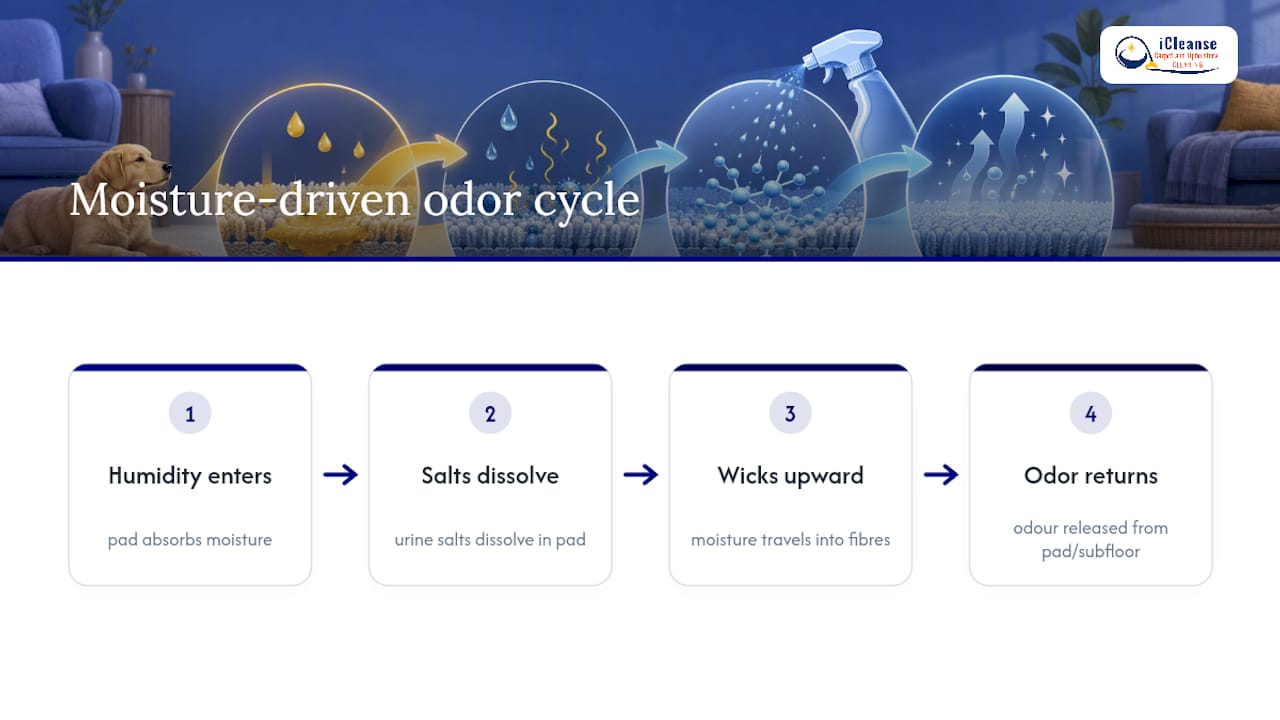
The other culprit is the pad and backing underneath. Both are hygroscopic, meaning they absorb and release moisture with humidity swings. On a humid day, salts trapped in the pad pull moisture in, dissolve slightly, and wick back up through the carpet fibres, carrying odour with them. This is why a stain can seem gone in dry weather and reappear the moment the air gets damp. It's also why surface-only treatment so often fails on anything beyond a small, fresh spot: the smell isn't coming from the carpet fibres anymore, it's coming from the pad and possibly the subfloor beneath it.
When should you call a professional carpet cleaner?
DIY enzyme treatment handles a lot, but there's a point where it stops being the right tool for the job. Watch for these signs:
- The odour is still noticeable after two full enzyme applications with proper dwell time.
- You're finding multiple contaminated spots under blacklight that weren't visible before.
- The pad feels spongy, discoloured, or the subfloor shows staining when you pull back a corner of carpet.
- The smell gets stronger with humidity or heat despite repeated cleaning.
At that point, industry technical guidance points to sub-surface remediation, meaning the pad and sometimes the subfloor need direct treatment or replacement to stop the wicking cycle. Professionals work differently than a bottle from the hardware store: higher-concentration enzyme chemistry designed for saturation depth, sub-surface extraction tools that pull contamination out of the pad rather than just the carpet face, and the ability to lift carpet and inspect what's actually happening underneath before deciding whether the pad can be salvaged or needs replacing.
Pro Tip: When you call for a quote, ask specifically whether the service includes pad inspection and sub-surface extraction, not just surface enzyme treatment. That distinction is usually what separates a fix that lasts from one that doesn't.
How to prevent pet urine odour in carpet long-term
Stopping the next accident matters as much as cleaning up the last one, especially in a home with a puppy, a senior cat, or a pet recovering from a health issue.
- Supervise closely during house-training and stick to a consistent bathroom schedule, since most accidents happen in predictable windows after meals or naps.
- Watch for early warning signs (sniffing, circling, pacing near a door) and intervene before the accident happens, not after.
- Carpet protectors and topical fibre treatments can add a water-resistant barrier that buys you a few extra minutes to catch an accident before it soaks through, though they won't stop a determined pet or a large volume of urine from eventually reaching the backing.
- Clean any accident the same day, every time. Delayed treatment is the single biggest reason odour becomes permanent instead of temporary.
- If a carpet has absorbed repeated accidents over months or years across the same area, replacing the pad, and sometimes the carpet itself, is often more cost-effective than continued treatment.
A cleaner's honest take on realistic timelines
Fresh accidents caught the same day and treated properly with enzymes almost always resolve completely within a single treatment cycle, usually a day or two once you factor in dwell time and drying. Set-in stains are a different story. Anything that's been sitting for weeks or months, especially if it's reached the pad, often takes two or three treatment rounds spaced days apart, and homeowners should expect that as normal rather than a sign something's gone wrong.
Where I'd push back on the usual advice: a lot of guides make it sound like one spray bottle and an hour of dwell time solves everything. It doesn't, not for contamination that's had time to spread and crystallize. The realistic expectation is that surface treatment fixes surface problems, and pad-level contamination needs pad-level intervention, whether that's aggressive DIY saturation or a professional pulling back the carpet entirely. Anyone telling you otherwise is selling a product, not a result.
— Rob
Book a professional pet urine treatment with Icleansecuc
Icleansecuc gets carpets clean where a store-bought enzyme spray hits its limit: enzyme-based treatments matched to the actual depth of contamination, sub-surface extraction that pulls residue out of the pad instead of leaving it to wick back up, and commercial drying equipment that gets carpet dry fast enough to stop mold and lingering damp odour from setting in.
If you've already tried blotting, enzymes, and dwell time twice and the smell is still there, or you've found staining on the pad when you lifted a corner of carpet, that's the point to bring in a professional rather than keep cycling through more product. When you request a quote, ask specifically for pad inspection alongside the enzyme treatment so you know upfront whether sub-surface extraction is needed or whether pad replacement makes more sense. Serving homes and businesses across the Greater Toronto Area, Icleansecuc can walk you through what a targeted treatment looks like for your specific carpet and how quickly it can be scheduled.
Sources
- How to Remove Dog and Cat Urine Smell from Carpet
- Study on VOCs from cat urine contaminated carpet and cleaning product impacts
- Technical bulletin: pet urine and carpet