
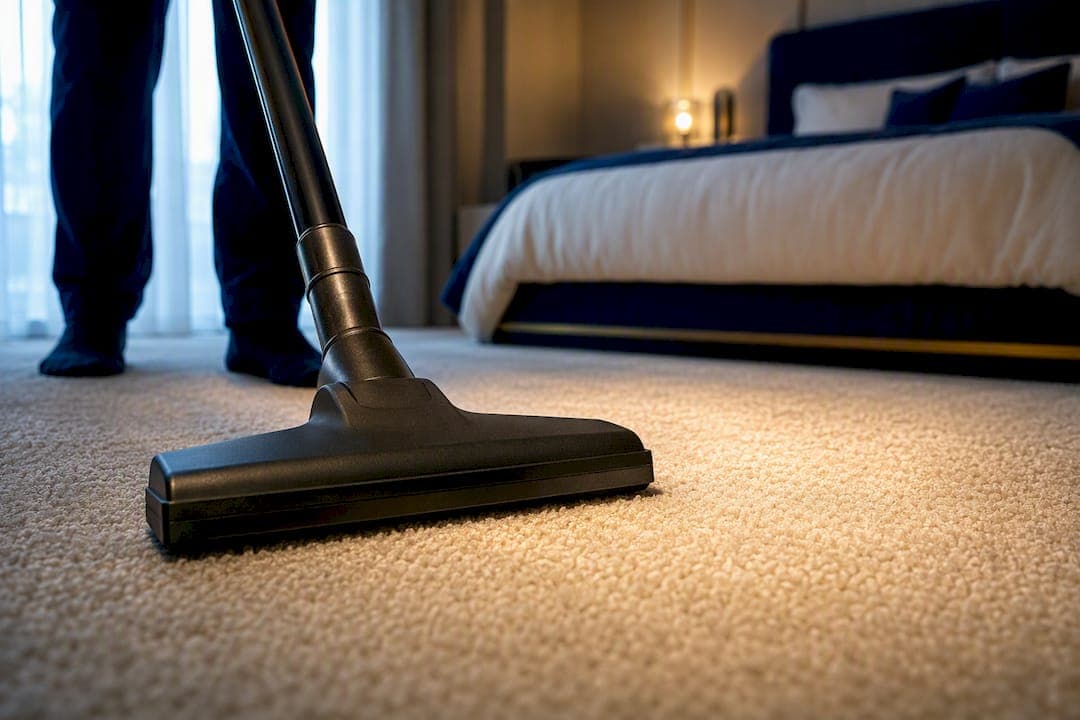
If sneezing, congestion, or asthma flare-ups persist after two weeks of consistent vacuuming, book a professional hot-water extraction. That three-part combination, HEPA vacuuming plus humidity control plus periodic steam extraction, outperforms any single method on its own.
TL;DR:
- Professional hot-water extraction can prolong allergen reduction effectiveness to up to eight weeks, especially in households with persistent symptoms.
- Sealed HEPA vacuums are necessary to contain allergens effectively; improper technique or unsealed filters can resuspend dust mites and pet dander.
- Vacuuming frequency should increase to every other day for homes with pets, allergies, or high foot traffic, to prevent allergen buildup before deep cleaning.
- Maintaining humidity below recommended levels slows dust mite reproduction, making cleaning more effective and reducing the need for frequent professional treatments.
- Carpet replacement after about 10 years is often more effective than cleaning, especially if mold or persistent odors develop or allergy symptoms remain despite regular cleaning.
Table of Contents
- Quick checklist: what to do today to reduce carpet allergens
- How should you vacuum carpets to reduce allergens?
- Does professional steam cleaning actually remove allergens?
- Why humidity control matters as much as cleaning
- Maintenance habits that keep allergens from coming back
- When should you replace carpet instead of cleaning it?
- What professional cleaners actually see in allergy-heavy homes
- Book a professional carpet allergen clean with Icleansecuc
- Sources
Quick checklist: what to do today to reduce carpet allergens
You don't need to wait for a weekend deep clean to start cutting allergen exposure. A few changes today make a measurable difference within days.
- Pull out your vacuum and check it has a sealed HEPA filter, not just a HEPA label on the box.
- Vacuum slowly, in overlapping passes, rather than quick back-and-forth strokes.
- Run a dehumidifier or open windows to bring relative humidity below typical recommended levels.
- Wash removable rugs, throw blankets, and bedding in hot water this week.
- Spot-treat visible stains and clear clutter that traps dust along baseboards and under furniture.
- If symptoms haven't improved in two to three weeks, or the carpet hasn't had a deep clean in a while, schedule a professional hot-water extraction.
These steps target both live dust mites and the allergenic debris they leave behind, which is really what triggers your symptoms.
How should you vacuum carpets to reduce allergens?
Not all vacuums remove allergens. Standard machines often blow fine dust mite waste and pet dander right back into the air through gaps in the housing or an unsealed filter. A sealed HEPA unit traps particles as small as 0.3 microns and keeps them contained, which is exactly the size range for dust mite allergen fragments and pet dander.
Look for a vacuum that specifies "sealed HEPA," not just "HEPA filter." A HEPA filter behind a leaky casing does little good, since the air can still escape through the exhaust or body seams before it ever reaches the filter.
Technique matters as much as equipment:
- Move slowly. A rushed pass barely disturbs allergens buried below the carpet's surface fibres.
- Cross your pattern. Vacuum north to south, then east to west, to lift particles the first pass missed.
- Overlap each stroke by a few centimetres so you're not leaving thin missed strips.
Pro Tip: Empty a bagless canister outdoors or over a garbage bag held at a distance. Dumping it indoors right next to the vacuum just resuspends the allergens you spent 20 minutes removing.
For most homes, twice-weekly vacuuming is enough. Households with pets, allergy sufferers, or high foot traffic should push that to every other day, especially in bedrooms and living rooms.
Does professional steam cleaning actually remove allergens?
Yes, and the evidence is more specific than "it deep cleans." Heat from professional hot-water extraction kills dust mites more effectively than dry vacuuming or spray treatments alone, but killing the mite isn't the finish line. The allergen that triggers your immune system is mostly in mite faecal matter, and that residue stays in the carpet fibres until it's physically extracted along with the water.
Vacuum-only interventions saw allergen levels drift back toward baseline within about four weeks, while steam cleaning effects held for as long as eight weeks in controlled trials. Extraction buys you roughly double the protection window.
That gap explains why professional cleaning isn't just a cosmetic upgrade. Lab work on carpet samples found that steam-vapour treatment produced the largest reduction in dust mite populations among the methods tested, but researchers were careful to note that physical removal of the debris still has to happen for allergen concentrations to actually drop.
Recommended cadence depends on your household:
- Allergy-sensitive homes or households with pets often do best scheduling extraction more frequently than the general guidance suggests.
- General households can usually stick to a professional deep clean every 6 to 12 months.
- High-traffic homes with kids, multiple pets, or heavy shoe use should lean toward the shorter end of that range.
The risk with amateur steam cleaning rentals is over-wetting the carpet backing and pad, which can trap moisture and grow mould, undoing the entire point of the clean. Professional-grade equipment extracts more water than it deposits, which matters more than people expect.
Why humidity control matters as much as cleaning
Dust mites thrive in moisture. Keep relative humidity below typical recommended levels and their reproduction slows dramatically, which means your vacuuming and extraction schedule has less to fight against between cleanings.
- Place a dehumidifier in bedrooms and basements, the two spots that usually run the most humid.
- Run bathroom and kitchen exhaust fans during and after showers or cooking to stop moisture migrating into carpeted hallways.
- Check window seals and basement corners for condensation, an early sign humidity is climbing.
- Public health guidance specifically cautions against carpet in high-moisture rooms like bathrooms and basements, since carpet fibres act as a sink that holds onto pollutants and moisture alike.
Humidity control doesn't replace cleaning. It just means the allergen population you knocked down last month has a harder time rebuilding before your next vacuum session.
Maintenance habits that keep allergens from coming back
Carpet isn't the only allergen reservoir in your home. Fabric, bedding, and daily habits either reinforce your cleaning routine or quietly undo it.
- Wash area rugs and washable soft furnishings on a hot cycle whenever the fabric allows it.
- Wash bedding weekly in hot water, since bedrooms are usually where symptoms are worst overnight and into the morning.
- Prioritise bedroom carpet and mattress areas over less-used rooms when your time is limited.
- Adopt a no-shoes-indoors rule and add a door mat at every entrance to cut down what actually reaches the carpet.
- Declutter floors and under furniture where dust and pet hair tend to collect undisturbed.
Small, consistent habits like these reduce how much allergen accumulates between your deeper cleaning sessions.
When should you replace carpet instead of cleaning it?
Cleaning has limits. Carpet older than about 10 years often holds allergen reservoirs deep in the padding that no vacuum or extraction fully reaches, and replacement becomes the more effective long-term move at that point.
- A persistent musty smell that returns after professional cleaning usually signals mould in the pad or subfloor, not surface dirt.
- Repeated mould growth after wet cleaning, despite proper drying, is a strong signal the carpet has outlived its usefulness.
- Bedrooms and rooms where allergy sufferers spend the most time benefit the most from switching to hard flooring.
- If full replacement isn't in the budget right now, a professional deep clean paired with strict humidity control is a reasonable interim step, just monitor for symptom rebound.
What professional cleaners actually see in allergy-heavy homes
Every allergy-triggering carpet I've walked into has the same fingerprint: deep allergen deposits near baseboards, humidity problems in basements or older homes, and pet dander concentrated in the exact spots the family spends the most time. Homeowners are often surprised the carpet "looks clean" while still causing symptoms, because allergen buildup lives below the surface fibres where the eye never goes.
Most clients notice a difference within a week or two of a proper hot-water extraction, particularly with morning congestion and sneezing. That said, cleaning alone won't fix a humidity problem or an aging carpet holding two decades of dander. The households that see the best long-term results treat cleaning as one part of a routine, not a one-time fix.
— Rob
Book a professional carpet allergen clean with Icleansecuc
Icleansecuc gives you the one thing DIY steam rentals and store-bought sprays can't: commercial-grade hot-water extraction that pulls out moisture and allergenic debris instead of leaving it trapped in the pad. Our technicians inspect your carpet, recommend the right method for your fibre type and soil level, and use eco-friendly solutions safe for kids, pets, and allergy-sensitive households across the Greater Toronto Area.
Booking is straightforward: we assess the carpet on-site, confirm the cleaning method, and give you a clear drying timeline before we start, no surprise charges after the fact. If your symptoms haven't improved with vacuuming and humidity control alone, that's your sign it's time for extraction. Request a quote or check available times to book your cleaning directly online.
Sources
The Environmental Health Perspectives study on physical interventions backs the extraction-versus-vacuum comparison. The 2014 carpet inactivation study supports the mite-kill mechanism. The HEPA and dry steam evaluation informs equipment guidance, and the American Lung Association's carpet page supports the humidity and replacement advice.
This article is general information, not a substitute for advice from a qualified doctor. Consult a qualified healthcare professional about your own circumstances before acting on anything here.
- Inactivation of dust mites, dust mite allergen, and mold from carpet (2014)
- Evaluation of HEPA vacuum cleaning and dry steam cleaning in reducing allergen levels (2018)
- American Lung Association — Carpets and rugs