
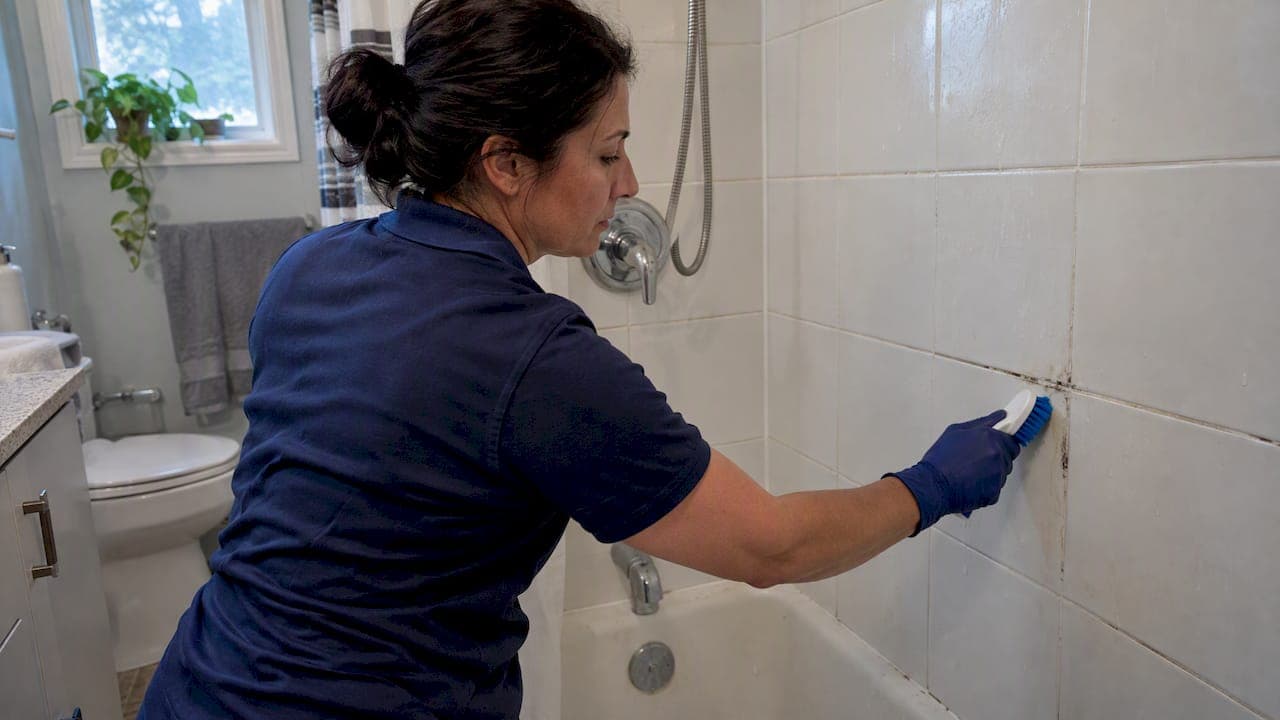
If you see dark spots in your shower grout, treat it as mould or mildew and act now, regardless of which one it technically is. For a small patch on tile or grout, open a window, run the exhaust fan, and clean it with detergent, water, and basic protective gear. If the growth is widespread, keeps coming back, or follows a leak or flood, skip the DIY approach and call a professional.
TL;DR:
- Small, non-porous grout patches under one square meter can be cleaned with detergent and water, but larger or recurring issues require professional help.
- Visible signs like musty odors, grout crumbling, or quick regrowth indicate ongoing moisture problems that DIY cleaning won't fix.
- Daily moisture management, such as running exhaust fans and drying grout after showers, is essential to prevent mold and mildew recurrence.
- Professional remediation involves inspection, moisture source identification, advanced cleaning, and sealing, especially for extensive or hidden growth.
- Mold and mildew pose health risks mainly for sensitive groups, but ongoing exposure can worsen respiratory symptoms and indoor air quality.
Table of Contents
- How to tell mildew from mould in grout
- Health risks from mould and mildew in grout
- Step-by-step cleaning for small grout mould patches
- Preventing mould and mildew from coming back
- Deciding when to hire a professional
- What professionals do differently
- Our take on DIY versus calling in help
- Getting help from iCleanseCUC for stubborn grout mould
- FAQ
- Sources
How to tell mildew from mould in grout
"Mildew" usually refers to a surface-level fungal film, while "mould" covers the broader range of fungi that grow on damp materials. In practice, the distinction matters less than people think: Health Canada notes that appearance alone cannot reliably identify the species or its health significance, and recommends controlling dampness and cleaning visible growth no matter what it is called.
A few visual and situational cues are still worth paying attention to:
- Colour and texture alone won't tell you the species, since many fungi look similar on grout.
- A musty odour often signals active growth even when staining looks minor.
- Regrowth after cleaning usually points to a moisture source that hasn't been fixed, not a failed cleaning job.
- Pitted, crumbling, or discoloured grout suggests the material itself is breaking down and may need replacing rather than cleaning.
Lab testing or speciation is rarely necessary for a bathroom. It mainly helps in disputes, health investigations, or when growth hides inside walls or subfloors.
Health risks from mould and mildew in grout
Fungal growth in grout can affect indoor air quality, and Health Canada reports it may aggravate irritation or asthma symptoms, including nose, throat, or eye irritation, sneezing, or breathing difficulty. How much it affects you depends on exposure level and personal sensitivity, not just the amount of visible growth.
Some groups face higher risk: infants, young children, seniors, and people with asthma or weakened immune systems. If anyone in the home has symptoms that seem tied to the bathroom or to cleaning sessions, it's worth raising with a health professional rather than assuming it will pass once the spot is scrubbed away.

Step-by-step cleaning for small grout mould patches
Health Canada's guidance on small, non-porous patches uses an area under 1 square metre as the cutoff for a DIY job. Anything larger, or anything you're unsure about, belongs with a professional.
For a patch within that range:
- Stop the moisture source first: fix a slow drip, re-caulk a gap, or simply commit to better ventilation going forward.
- Open a window or run the exhaust fan, and keep the room ventilated for the whole job.
- Put on a mask, goggles, and gloves before touching the affected grout.
- Wet the area, then scrub with unscented dish soap or household detergent and water. Bleach is not necessary for this kind of surface cleaning.
- Rinse where the surface allows it, then dry the grout completely with a towel or fan.
- Check back in a few days; if staining returns quickly, the moisture problem hasn't actually been solved.
Pro Tip: Dry the grout immediately after every shower for a week after cleaning; most recurrence happens because the joint never gets a chance to fully dry out between uses.
Porous or repeatedly stained grout is a different story. Once a joint has absorbed moisture over months or years, surface cleaning often just lightens the stain temporarily. A grout haze removal technique can help with general cleaning, but grout that's cracked, crumbling, or stained past the point of visible improvement usually needs to be removed and replaced rather than scrubbed again.
Preventing mould and mildew from coming back
Cleaning solves the symptom. Preventing recurrence means managing moisture day to day. Health Canada and the Canada Mortgage and Housing Corporation both point to humidity control as the core fix, with a target indoor relative humidity that is low enough to discourage fungal growth without drying out the home.
A few habits make the biggest difference:
- Run the bathroom exhaust fan during showers and for about 30 minutes afterward to clear humidity spikes.
- Squeegee shower walls and towel-dry grout lines after each use instead of letting water sit.
- Keep shampoo bottles, loofahs, and bath toys off wet tile where water pools underneath them.
- Repair cracked grout and peeling caulk as soon as you notice it, since gaps trap moisture against the substrate.
Sealing clean, intact grout can slow staining and make it easier to wipe down, and a tile and grout sealing service typically holds up for one to three years before it needs reapplication. It won't fix an underlying leak or a ventilation problem, though, so repairs and airflow always come first. A once-a-week wipe-down with soap and water, paired with the fan habit, keeps most bathrooms from building up the kind of grime that mould feeds on.
Deciding when to hire a professional
The under-1-square-metre guideline is a useful starting point, but it's not the only factor. A small patch in a household with infants, seniors, or someone with asthma deserves more caution than the same patch in a low-risk household.
Call in a professional when:
- The affected area is larger than roughly 1 square metre.
- Staining keeps returning even after you've fixed the moisture source and cleaned properly.
- The growth followed a flood, pipe leak, or other water event.
- You suspect mould is growing inside a wall, under flooring, or behind a tub surround, not just on the visible grout.
A tile-and-grout cleaning service built around realistic DIY limits can confirm whether what you're seeing is a surface issue or something deeper. When vetting any remediation or cleaning company, ask how they assess the extent of the problem, what containment steps they use for larger jobs, and whether repairs (not just cleaning) are part of the plan.
What professionals do differently
A professional visit usually starts with an inspection, not a scrub brush: finding the actual moisture source and checking whether the grout itself is still sound. From there, mechanical agitation and extraction equipment reach into joints that hand scrubbing can't fully clean, and controlled drying afterward matters as much as the cleaning step itself. Sealing intact grout after a proper clean can extend how long it stays stain-free, though it works best as a finishing step, not a substitute for fixing moisture at the source.

Our take on DIY versus calling in help
Small, one-off patches respond well to the basic Health Canada routine: ventilate, protect yourself, clean, dry. Where DIY falls short is scale, hidden moisture, and repeat offenders. If the same spot reappears after you've genuinely fixed the leak and the airflow, that's a sign the problem has moved beyond a sponge and some soap.
— Rob
Getting help from iCleanseCUC for stubborn grout mould
When grout mould keeps coming back or covers more than a small patch, we offer a more durable fix than another round of scrubbing. Our tile and grout cleaning service uses equipment and cleaning solutions to address embedded staining, and we offer an add-on protector or sealer to help keep grout cleaner for longer afterward.

- We inspect the affected area first to confirm whether cleaning alone will solve it or whether moisture repairs are needed too.
- We provide pricing details before any work starts.
- We finish with drying and post-care advice so the results hold up between visits.
Our tile and grout cleaning service serves homes and businesses across the Greater Toronto Area. If your bathroom grout has gone past the point of a quick DIY fix, you can request a quote and we'll take it from there.
FAQ
What removes mould and mildew from grout?
For small, non-porous patches, Health Canada recommends unscented dish soap or detergent and water along with mechanical scrubbing, worn with a mask, goggles, and gloves. Bleach isn't necessary for this kind of surface cleaning, and larger or recurring growth generally calls for professional remediation instead.
How do I know if it's mould or mildew?
Visual appearance alone can't reliably tell you which one you're looking at, since species identification requires more than a glance at colour or texture. A musty smell, regrowth after cleaning, or grout that's visibly deteriorating are more useful signs that the moisture problem hasn't been solved, regardless of the label.
Is mildew in shower grout harmful to health?
It can affect indoor air quality and may aggravate irritation or asthma symptoms such as throat or eye irritation and breathing difficulty. Risk depends on exposure and personal sensitivity, and infants, seniors, and people with asthma face higher risk than the general population.
Does mildew just wipe off?
Not reliably. Grout's texture and moisture retention usually mean staining needs detergent, water, and mechanical scrubbing rather than a quick wipe, and if it returns quickly, the underlying moisture source or damaged joint likely needs repair, not just another cleaning.
Can houseplants help prevent mould in a bathroom?
Some houseplants are associated with modest improvements in indoor air quality, according to a guide on plants and air quality, but they aren't a substitute for ventilation and moisture control in a bathroom. Running the exhaust fan and keeping grout dry remain the primary defences against recurring growth.