
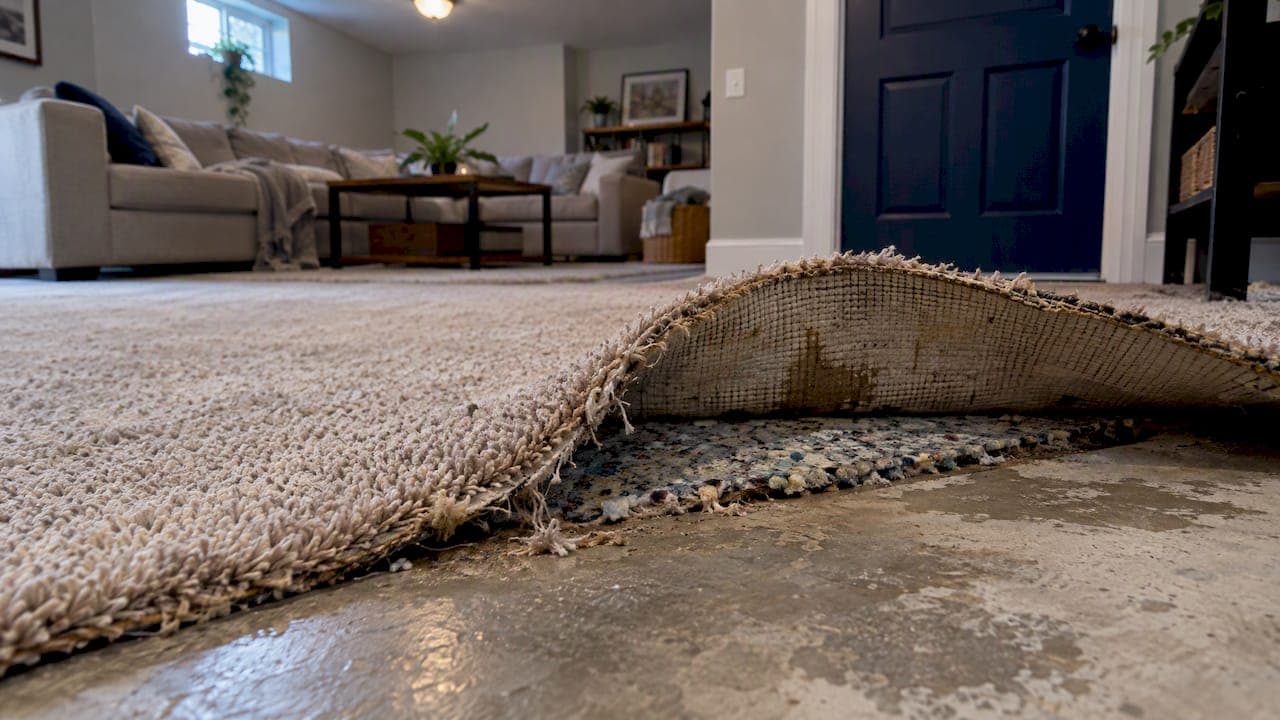
Wet carpet is a race against the clock. Shut off power to the area if it is safe to do so, remove standing water, and get everything drying fast, because Health Canada notes that items dried within 48 hours are less likely to grow mould. Clean water from a supply line can often be dealt with in place. Sewage or heavily contaminated water cannot: that carpet goes in the garbage. This guide walks you through the decision, step by step, for homes and offices across the GTA.
TL;DR
- Act within 24 to 48 hours. After that, mould can start and soaked carpet, and especially the underlay, may not be savable.
- Safety first: breaker off for the affected area, protective gear on, and no outdoor fuel-burning equipment inside.
- Clean water caught early can usually be extracted and dried in place. Sewage-soaked carpet must be thrown out.
- Dry heat is not the answer. Use airflow and dehumidification, and aim for indoor humidity of 30% to 50%.
- Once the carpet is dry and the source is fixed, a professional clean removes leftover dirt, residue and odour. That is where we come in.
Table of Contents
- First hour: make the room safe
- Work out what kind of water you are dealing with
- Step by step: removing water and drying the carpet
- How long until mould starts?
- Can the carpet and underlay be saved?
- When to call a restoration professional
- Cleaning the carpet once it is dry
- Preventing odour and mould afterward
- Our perspective
- What our cleaning costs after water damage
- A quick checklist for renters and landlords
- FAQ
- Sources
First hour: make the room safe
Before you touch a wet carpet, deal with the hazards. Health Canada advises shutting off power to the flooded area at the breaker box and wearing appropriate protective gear. If the breaker panel is itself in standing water, do not go near it: call your utility or a licensed electrician.
The Canadian Red Cross lists rubber boots, safety glasses, rubber gloves and a dust mask as the basics for flood cleanup. Add a hard hat if ceilings are involved. Keep children and anyone with breathing problems out of the room: Health Canada says susceptible people, including children and those with respiratory conditions, should stay away from mouldy areas.
Then find and stop the source: a burst pipe, a failed sump pump, a leaking dishwasher or washing machine hose. Nothing else you do matters if the water keeps coming. Health Canada is clear that the moisture source must be fixed first, or mould will likely return.
Call your insurer early
Once it is safe to be in the home, the Canadian Red Cross advises contacting your insurance company right away to document the damage. Take photos and video of the carpet, the baseboards and the source before you move anything. Keep receipts for equipment rentals and cleaning. Ask your insurer what your policy covers for your type of water, since coverage for burst pipes, sewer backup and overland flooding can differ.
Work out what kind of water you are dealing with
The type of water decides everything that follows. In plain terms, there are three situations:
| Water source | Typical example | What it means for the carpet |
|---|---|---|
| Clean water | Supply line, overflowing sink, appliance leak | Often salvageable if dried fast, with no swelling and intact seams |
| Grey or unclear water | Washing machine drain, dishwasher discharge, water that sat for days | Higher risk. Get professional advice before deciding |
| Contaminated water | Sewage backup, river or storm flooding | Discard carpet and underlay |
The IHSA advises that if water is known or suspected to be contaminated by sewage or chemical or biological pollutants, you should consult a restoration professional. The Red Cross is blunt about sewage: carpets soaked by it are unsalvageable and must be thrown out. No cleaning method makes that carpet safe again.
Time also changes the category. Clean water that sits for days picks up bacteria from the pad, the subfloor and the room. If you are not sure when the leak began, treat the situation more cautiously.
Step by step: removing water and drying the carpet
This sequence applies to clean-water incidents caught quickly, such as a leaking supply line or an overflowed tub.
- Remove standing water. Health Canada recommends pumps or pails first, then a wet/dry shop vacuum. Go over the carpet slowly, in overlapping passes, until little water comes up.
- Move furniture and lift what you can. Take furniture off the carpet. Place aluminum foil or plastic blocks under legs if something must stay, so wood stain and rust do not transfer.
- Pull the underlay if the carpet is saturated. Underlay holds water like a sponge and dries slowly. If the carpet can be lifted from the tack strip at a corner, you can get airflow underneath. This is a job for two people.
- Start airflow and dehumidification. The IHSA says fans and heaters can speed drying of clean water damage but cautions against using heat to dry carpet. Use fans and a dehumidifier, open windows when outdoor air is drier than indoor air, and keep the room ventilated.
- Keep monitoring. Check the carpet edges, the underlay and the baseboards daily. If anything still feels damp after two days, treat it as a problem, not as drying slowly.
A safety point about equipment
Never bring gas-powered pumps, generators or pressure washers indoors. Health Canada warns that outdoor equipment used indoors can cause carbon monoxide poisoning and recommends a working carbon monoxide alarm while you dry the home.
How long until mould starts?
Plan on 48 hours at most. Mould can begin to grow in an area with excessive moisture within 48 hours, and Ottawa Public Health recommends responding within 24 to 48 hours with thorough cleanup, drying or removal of water-damaged materials. Québec's guidance is similar: clean and dry water damage completely within 24 to 48 hours, because beyond that mould may develop and heavily soaked porous materials such as carpet may need to be discarded.

Cold, humid Ontario basements make that window feel tighter. A finished basement in Markham or Whitby with a poured concrete floor can hold moisture under the carpet far longer than the surface suggests.
If you smell mould or see spots
A musty smell or dark spotting means the carpet has been wet too long or has not dried underneath. Small, surface-level issues can be handled with unscented soap and water: Health Canada says bleach is not necessary to clean up mould. But on carpet, the growth is usually in the backing and underlay where you cannot reach it. For a practical overview of how mould on carpet is assessed and removed, see this guide to removing mould from carpet. Larger areas, or anyone in the home with asthma or a weakened immune system, are reasons to bring in a mould specialist rather than DIY.
Can the carpet and underlay be saved?
This is the question behind most searches, and the honest answer is: it depends on the water, the time and the materials.
Usually worth saving:
- Clean water, caught within a day or two.
- No swelling, delamination or lifting seams. The IHSA says materials may be dried in place when there is no swelling and seams are intact; otherwise they should be discarded and replaced.
- Synthetic carpet on a stable backing, lifted and dried properly.
Usually replaced:
- Sewage or flood water contamination.
- Carpet that cannot be dried. Health Canada advises discarding carpets exposed to flood water if they cannot be dried.
- Heavily soaked carpet that has been wet beyond 48 hours. Health Canada also points out that cleaning the surface of soft, porous furnishings may not be effective, so saturated materials should be discarded first.
A common compromise: keep the carpet, replace the underlay. Underlay is the cheapest layer to renew and the hardest to dry.
When to call a restoration professional
Call one in these situations:
- The water is, or may be, sewage or otherwise contaminated.
- More than a small room is affected, or water has moved under walls or into the subfloor.
- The water has sat for more than a day or two.
- Your insurer requires certified drying records.
- You can smell mould already.
The key distinction is between water emergency work and carpet cleaning. Emergency extraction, structural drying and mould remediation belong to restoration firms with the right equipment and moisture meters. We focus on the cleaning that comes after the structure is dry and the source is repaired. We would rather tell you that plainly than have you wait on us while a basement stays wet.
Cleaning the carpet once it is dry
When the carpet and underlay are truly dry, a professional clean is the step many people skip. Floodwater and even clean leaks leave behind dissolved minerals, dirt from the subfloor and residue that cause stains, stiffness and a lingering smell.
Why stains and brown marks come back
If you notice patches reappearing after a clean, the cause is usually moisture. Beaulieu's care guide explains that stains can return when over-wetting moves them into the backing, or when moisture left in the backing or underpad wicks back up. Its advice: blot rather than rub, use carpet-specific products, avoid over-wetting, and favour hot-water extraction as the preferred professional method. We cover the browning side of this in our article on fixing carpet browning after cleaning.
Drying time after the clean
Wet cleaning itself adds moisture, so drying matters again. The Canadian Carpet Institute says carpet should be thoroughly dried within 12 to 24 hours after wet cleaning to avoid mould or mildew, and warns that over-wetting the backing or cushion can promote growth. Our own aftercare notes show how to shorten that: see how to cut carpet drying time and why to dry carpets within 24 hours in Ontario.
Preventing odour and mould afterward
- Ventilate and dehumidify. Health Canada advises ventilating or dehumidifying until the house is dry after cleaning surfaces with unscented soap and water.
- Open windows when possible. The same agency recommends fresh air and a dehumidifier in damp areas, or where condensation forms on cold surfaces.
- Keep humidity in range. Health Canada recommends 30% to 50% indoor humidity after cleanup. A cheap hygrometer from a hardware store tells you where you stand.
- Skip scented cover-ups. Perfumes and deodorizers hide a damp smell without solving it. If the smell remains once the carpet is dry, something is still wet.
Our perspective
Most calls we get about water-damaged carpet come at one of two moments: right after the incident, when people want to know whether to rip everything out, and two or three weeks later, when a smell or a stain has appeared. The second call is almost always avoidable.
Our view is simple. Speed and drying matter more than any product. Eco-friendly solutions, a light touch with water and proper airflow protect your carpet and the people breathing above it. We also believe in telling customers when carpet cannot be saved. Recommending a clean on sewage-soaked carpet would earn us a job and cost you your health and money.
We price in the open, so you know the cost of cleaning before you book, and we stay in touch after the service, because a good clean should still look good a month on. If you are in York Region or Durham Region and unsure whether your carpet is a cleaning job or a replacement job, ask us. A quick conversation costs nothing.
— Rob
What our cleaning costs after water damage
Once your carpet is dry and the source is fixed, our residential pricing is posted per area, so you can add up your own quote. A Living Room or Master Bed Room is $70, a Regular Room $60, a Recreation Room $120, a Set of Stairs $60 and a Closet $10. Hallways run $30 for a Small, $60 for a Medium and $80 for a Large. See all residential carpet cleaning prices or request a quote for a larger or mixed job.
If water reached your area rugs, we price by the square foot: Synthetic Rugs and Seagrass/Jute Rugs are $0.75, Viscose Blend/Persian Rugs are $1.00 and Wool/Oriental/Cotton Rugs are $1.50. For offices and shared spaces, commercial carpet cleaning is $0.30 per square foot for light traffic areas and $0.50 for heavy traffic. Wet tile floors and grout can be done too: tile and grout cleaning starts at $0.80 per square foot for cleaning only.
We serve Toronto, Mississauga, Vaughan, Markham, Richmond Hill, Aurora, King City, Whitchurch-Stouffville, Pickering, Ajax and Whitby, and our work comes with a satisfaction guarantee.

A quick checklist for renters and landlords
In a rental, the order matters as much as the cleanup itself.
- Tell the landlord or property manager immediately, in writing, with photos.
- Do not pull up carpet yourself unless instructed, but do remove standing water and run fans if it is safe.
- Keep the paper trail: dates, who you spoke to, receipts.
- If the carpet is returned to its dry state, book a professional clean before the final inspection. Our move-out and residential cleaning can fit that timing.
Landlords with several units can also look at our notes on regular carpet cleaning for businesses, which apply equally to rental portfolios.
FAQ
Is it bad to spill water on a carpet?
A small spill is not a problem if you blot it and let the area dry within a day. The risk grows with volume, time and what the water carries. A large spill that soaks through to the underlay should be extracted and dried quickly, ideally within 24 to 48 hours.
Why is the water still dirty after carpet cleaning?
Dirty water usually means the carpet was holding soil, residue or contamination that is now coming out. After water damage, it can also point to dirt from the subfloor or underlay. If water keeps coming out brown across several passes, it may be a sign the carpet needs replacing rather than another clean.
How long does it take for carpet to mould after a flood?
Mould can begin within 48 hours in a damp area, according to Health Canada and Ottawa Public Health. That is why the first day or two matter most. Cold, humid basements can stay damp for longer than they appear.
Does water-damaged carpet need to be replaced?
Not always. Carpet exposed to clean water and dried quickly, with no swelling and intact seams, can often be saved. Carpet soaked by sewage or flood water, or carpet that cannot be dried, should be discarded. The underlay is often replaced even when the carpet is kept.
Sources
- Health Canada: Flood cleanup and indoor air quality
- Health Canada: Guide to addressing moisture and mould indoors
- Health Canada: Guide to addressing moisture and mould indoors (2023)
- Health Canada: Flood clean up and indoor air quality infographic
- Health Canada: Addressing mould in your home
- Canadian Red Cross: Floods
- Canadian Red Cross: Flood recovery guide
- IHSA: Mould Remediation Chart (P104)
- Ottawa Public Health: Mould
- Gouvernement du Québec: Finding and eliminating mould from your home
- Canadian Carpet Institute: Deep cleaning
- Beaulieu Canada: Carpet care and warranty guide
- Guide to removing mould from carpet