
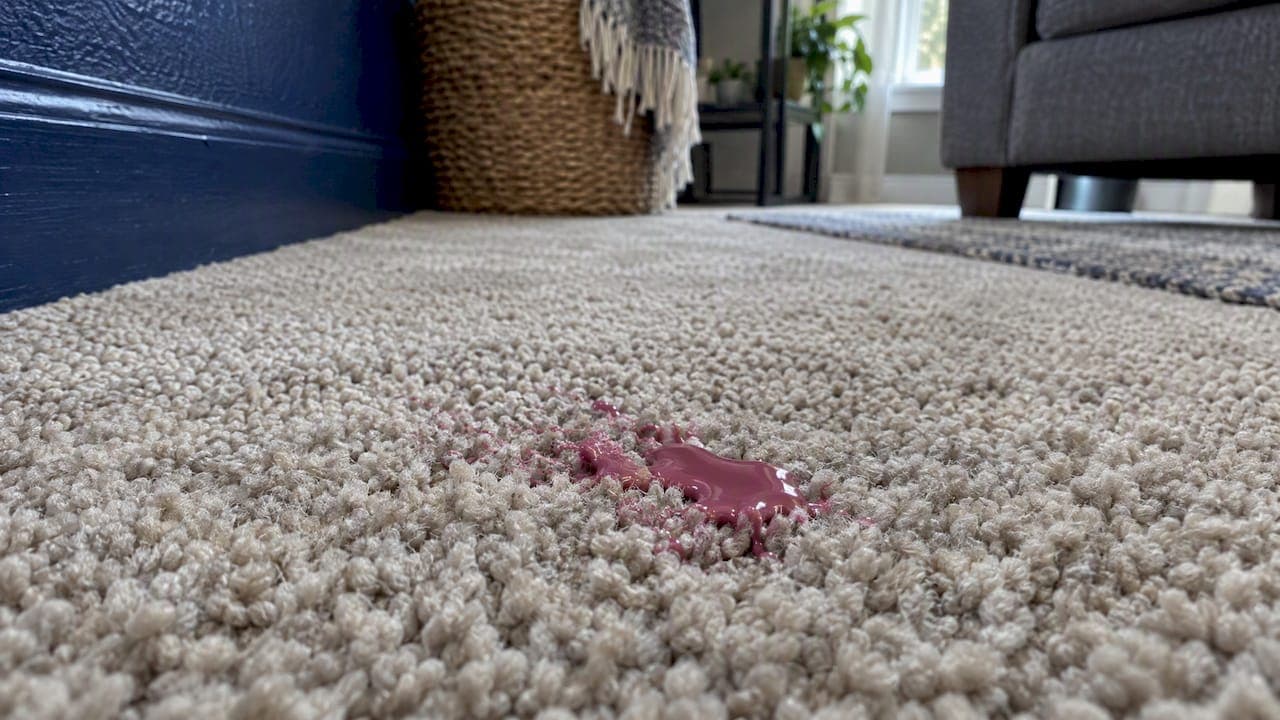
Yes, you can often get nail polish out of carpet, and your odds are best in the first few minutes. Blot or lift off as much polish as you can without pushing it deeper, test a non-oily remover on a hidden spot, then work from the edge of the stain toward the centre in small, patient passes. If the stain is old, large, or sitting on wool or delicate fibre, a professional cleaner is the safer route. Below is the full method, what to use if you have no acetone, and how to tell when to stop.
TL;DR
- Act fast: blot wet polish with a white cloth or paper towel, and gently scrape semi-solid polish with a rounded spoon. Never rub.
- Test every product on a hidden patch first. Solvents can damage some carpet fibres, so check the fibre content before you start.
- Work from the outside of the stain inward, using as little remover as possible and a clean section of cloth each pass.
- No acetone? Rubbing alcohol or dry-cleaning solvent is the usual substitute. Vinegar rarely lifts dried polish.
- Large, old, or set-in stains, and wool or specialty carpets, are worth handing to a professional before the damage becomes permanent.
Table of Contents
- Why nail polish is hard on carpet
- What to do in the first five minutes
- What you need before you start
- Test first: will acetone ruin your carpet?
- How to remove wet nail polish from carpet
- How to remove dried nail polish from carpet
- How to get nail polish out of carpet without acetone
- Mistakes that turn a small stain into a big one
- Special cases: wool, rugs, stairs, and rentals
- When to stop and call a professional
- Our perspective
- Professional help for stubborn polish stains in the GTA
- After the stain is gone: aftercare
- FAQ
- Sources
Why nail polish is hard on carpet
Nail polish is built to cling and to dry into a hard film. On a smooth nail that is the point. On carpet, the liquid wicks down between the fibres, toward the backing, and then hardens around them. The longer it sits, the more it bonds.
That is why the advice from textile specialists is consistent: immediate treatment is best, and the method should match the fibre rather than assuming one solvent is safe for every carpet. Two spills that look identical can need different handling if one is nylon and the other is wool.
The second challenge is the remover itself. The thing that dissolves the polish can also dull dye, soften adhesives in the backing, or leave a ring if you flood the area. So the goal is never to soak the stain. It is to dissolve a little polish at a time and lift it into a cloth.

What to do in the first five minutes
What you do right away matters more than which product you reach for.
- Stop and do not rub. Rubbing spreads the polish and drives it deeper into the pile.
- Remove the excess. For liquid polish, the Carpet and Rug Institute (CRI) says to blot with a dry white cloth or white paper towel. For a thicker blob, lift it gently with the back of a spoon.
- Use white cloths only. A coloured towel can transfer dye into a damp carpet, which turns one problem into two.
- Keep people and pets off the area. Tracking polish across the room is how a coin-sized spill becomes a hallway stain.
- Check what your carpet is made of. Look for a label on the carpet's underside at an edge or in a closet, or check your purchase paperwork. Fibre type decides what is safe.
If the polish has already dried, skip the blotting and move to the scraping step below.
What you need before you start
Gather everything first, because you want to work without pauses while the polish is softening.
- Several clean white cloths or white paper towels
- A rounded spoon or a dull knife edge for lifting
- Cotton swabs for small spots
- A non-oily nail polish remover (non-acetone is the gentler choice), or rubbing alcohol
- A mild liquid dish detergent diluted in water
- Clean cool water in a small bowl
- A window open or a fan running, because these products give off strong fumes
The Wool Carpet Care Guide notes that treatments should be applied through a cotton cloth rather than directly, used sparingly, and used with ventilation. That habit is worth adopting for any carpet.
Test first: will acetone ruin your carpet?
A common worry is whether 100% acetone will ruin carpet. It depends on the fibre. According to Reader's Digest, you should check the carpet content first and never use solvent on acetate, triacetate, or modacrylic. Those fibres can dissolve or deform.
For everything else, the pretest is the safeguard:
- Find a hidden spot: inside a closet, under a sofa, or along a baseboard edge.
- Dab a little of your chosen remover onto a white cloth.
- Press the cloth onto the hidden spot for a few seconds.
- Check the cloth. If any carpet colour has transferred, or the fibres look melted, sticky, or bleached, stop and do not use that product.
CRI recommends pretesting every spot-removal solution in an inconspicuous area for colour transfer or damage before treatment. It takes two minutes and it is the cheapest insurance you have. If you want to understand why some dyes release so easily, our note on how colour bleeding occurs during carpet cleaning explains the mechanism.
How to remove wet nail polish from carpet
Fresh polish is the best case. Here is the sequence, drawing on the procedures published by carpet industry bodies and manufacturers.
Step 1: Lift the excess
Blot with a white paper towel. Use a spoon or putty knife to lift any pooled polish. Reader's Digest advises removing excess without rubbing. Press and lift. Do not wipe.
Step 2: Apply a small amount of remover
Put a little non-oily remover on a white cloth or cotton swab, not straight onto the carpet. Shaw Floors' procedure calls for applying a non-oily, acetone-type remover cautiously and says not to wet through to the carpet backing. You want the pile damp, not saturated.
Step 3: Work from the edge to the centre
CRI says to work from the spill's edge toward its centre and to avoid rubbing. This keeps the stain from growing a halo. Dab, lift, and look at the cloth. If polish is transferring onto it, the method is working.
Step 4: Keep going while it lifts
According to CRI, you should continue with the first agent while polish keeps transferring to the cloth, and complete removal may mean repeating the step or moving to another solution. Switch to a clean part of the cloth each time so you are not putting the polish back.
The Spruce makes a useful point here: repeat only while the stain is actually lifting, and stop if you see discolouration or fraying. If the cloth stops picking up colour and the carpet is changing instead, you have reached the limit of home treatment.

Step 5: Wash out the remover
Mix a few drops of mild dish detergent into water. Blot it on, then blot it off with clean water on a fresh cloth. Leftover remover and detergent can attract dirt and leave a stiff patch, so rinsing matters.
Step 6: Dry it properly
Shaw Floors suggests drying under absorbent towels with a weight on top. Swap the towels when they get damp. A carpet that stays wet can develop odours and mould, which is why we also publish guidance on drying carpets within 24 hours in Ontario's humid months.
How to remove dried nail polish from carpet
Dried polish is a harder job, but not hopeless. The approach changes slightly.
- Break it up. CRI says to gently scrape semi-solids with a rounded spoon and to break up solids before vacuuming. Use the spoon edge to crack the film, then pick out the flakes with your fingers or a vacuum.
- Soften in layers. Apply a very small amount of remover on a swab and let it soften the top layer. Pick up what softens, then repeat. Shaw's procedure builds in repeats for exactly this reason: dried polish comes off in layers, not all at once.
- Treat from the outside in just as you would a fresh spill.
- Clean and dry with diluted detergent, a clear-water rinse, and weighted towels.
Patience is the technique. People who pour remover on a dried spot to "melt it" typically end up with a larger, blurrier stain and a damp backing.
If a residue remains
Shaw Floors says that if residue is left after the remover and detergent steps, you can blot on a solution of 1 tablespoon ammonia to 1 cup water, then apply undiluted white vinegar to neutralise the ammonia, and rinse. Pretest this on a hidden spot as well, and keep the room ventilated. If your carpet is wool, check the care guidance for wool before using alkaline products.
How to get nail polish out of carpet without acetone
Many households do not keep acetone, and many people prefer to avoid it. You have options.
| Option | What it does | Cautions |
|---|---|---|
| Non-acetone nail polish remover | Gentler solvent, the usual first choice | Still pretest; use sparingly |
| Rubbing alcohol | Reader's Digest, citing a Tide senior scientist, recommends it for carpet polish stains | Pretest; blot, do not pour |
| Dry-cleaning solvent | Also recommended in the same article | Strong fumes; ventilate; pretest |
| Hairspray | May work on some stains | Leaves a sticky residue; rinse well |
| White vinegar | Unlikely to lift much polish, especially once dry | Better used to neutralise ammonia than as a main remover |
More home recipes circulate online, including baking soda and ginger ale mixes. We would not rely on them for a polish stain. They do not dissolve the film, and extra moisture in the pile can make things worse.
Mistakes that turn a small stain into a big one
- Rubbing or scrubbing. It frays the pile and spreads the stain. The CRI residential standard says not to scrub.
- Pouring remover on. Excess liquid reaches the backing, spreads the stain sideways, and can weaken the adhesive.
- Skipping the pretest. Discovering a bleached patch after treatment is the most common regret.
- Mixing products without rinsing. CRI's standard advises rinsing between different products so they do not react or leave residue.
- Using solvent on the wrong fibre. Acetate, triacetate, and modacrylic do not tolerate it.
- Leaving it damp. Poorly dried carpet invites odours and mould.
- Treating the stain repeatedly after it stops lifting. At that point you are removing carpet, not polish.
Special cases: wool, rugs, stairs, and rentals
Wool carpet. Wool is more sensitive to chemicals and moisture. The Wool Carpet Care Guide includes carefully applied acetone or lanolin-free remover and rubbing alcohol among possible treatments, but says that extensive or old set-in stains should be handled by a professional experienced with wool. Wool also tends to be the carpet people paid the most for, so caution pays off.
Area rugs. Natural fibres such as jute or seagrass, and viscose or silk-blend rugs, can water-stain or lose colour. Move the rug to a hard floor before you start, so remover cannot soak into the flooring beneath. If it is a hand-knotted or antique piece, skip the home experiments entirely.
Stairs and hallways. Polish tracked on shoes tends to leave a trail of small marks rather than one spill. Treat each spot separately and do not chase them with a big wet cloth.
Rentals. If you are a tenant, a stain left untreated or badly treated can end up as a deduction from your deposit or a repair argument. Treating it early and documenting the result, or having a professional do it, is usually the cleaner path. Landlords preparing a unit between tenants face the same stains in volume.
When to stop and call a professional
Home treatment has a natural limit. Consider professional help when:
- The first two treatment rounds do not shift the stain. CRI's residential standard says to call a professional if the first two steps fail, and CRI also advises contacting an approved professional if blotting and treating do not work.
- The stain is old, large, or already set.
- The carpet is wool, silk, or an expensive specialty fibre.
- Your pretest shows colour transfer, so there is no safe product left for you to try.
- The spill covers more than a hand's width, or runs under furniture.
- You see a ring, a bleached halo, or a stiff patch after your own attempt. Professional cleaning can often improve these, and some dye damage can be addressed with professional colour restoration, though results depend on the fibre and the damage.
What a professional brings is not magic. It is the right solvent for the fibre, controlled application that does not soak the backing, and extraction equipment that pulls residue out rather than leaving it in the pile. You can read about the approaches used in our overview of carpet cleaning methods.
Our perspective
We get calls about nail polish more often than people expect, and the story is almost always the same: the spill was small, someone treated it with whatever was in the cupboard, and the stain grew. The polish rarely does the real damage. Rubbing, over-wetting, and the second and third products stacked on top do.
Our advice is to treat a spill like a short, careful procedure. Lift, test, dab, rinse, dry. If you have done two honest rounds and the cloth is no longer picking up polish, stop. That is the point at which a professional with the right solvent and extraction gear has the best chance of finishing the job without harming the carpet.
We also think customers deserve to know the cost before anyone arrives. Our published residential prices are per room or area, so you can see the number first. We use eco-friendly cleaning solutions, and we stay in touch after the visit, because a stain job is not finished until the carpet is dry and you are happy with it. If a stain will not fully come out, we tell you plainly what to expect rather than promising a miracle.
— Rob
Professional help for stubborn polish stains in the GTA
If your DIY attempt has stalled, we can take it from here. iCleanse Carpet and Upholstery Cleaning serves homeowners, tenants, landlords, and businesses across the Greater Toronto Area, including Markham, Richmond Hill, Vaughan, Aurora, Whitby, Ajax, Pickering, and Toronto. Residential pricing is published by area: a regular room is $60, a living room or master bedroom is $70, a medium hallway is $60, and a set of stairs is $60. See the full list on our residential cleaning page.

Tell us what spilled, what you already tried, and what your carpet is made of, and we will advise on the best approach. You can request a quote or look at the full range of services. Tell us about any home treatments too: knowing what has already gone on the carpet helps us choose what to use next.
After the stain is gone: aftercare
When the spot looks clean, a few steps help keep it that way.
- Let it dry completely. Keep towels in place until no dampness remains, and run a fan if you can.
- Vacuum the area once dry. This lifts the pile and removes any remaining flakes.
- Watch for re-soiling. Residue from detergent can attract dirt. If the patch darkens in a week or two, it likely needs a clean-water rinse or a professional extraction.
- Keep polish away from carpet. Do manicures on a hard floor, over a tray or a towel, and store bottles upright in a closed container. A cap that is not fully tightened is a common culprit.
- Consider a regular clean. Routine professional cleaning removes the soil that makes stains look worse, and for offices and rentals it keeps spills from becoming permanent. Our guide on why regular carpet cleaning matters for businesses covers the commercial side.
FAQ
Can you get nail polish out of carpet?
Often, yes, especially when the spill is fresh. Blot or lift the excess, pretest a non-oily remover, and work from the outside of the stain inward. Old or large stains are harder, and some may not fully disappear.
How do you get nail polish out of carpet without acetone?
Use a non-acetone remover, rubbing alcohol, or dry-cleaning solvent on a white cloth, and blot rather than rub. Hairspray may help on some stains. Vinegar is unlikely to lift much polish, particularly once it has dried.
Will 100% acetone ruin carpet?
It can, depending on the fibre. Do not use solvent on acetate, triacetate, or modacrylic. On other fibres, pretest on a hidden spot with a white cloth, and proceed only if no colour transfers. Use as little as possible and never pour it on.
What is the hardest stain to get out of carpet?
Stains that have dried and bonded to the fibre, such as nail polish, ink, and dye-based spills, are among the toughest. Age matters as much as the substance. If two rounds of careful treatment fail, a professional is the better next step.
Can a professional carpet cleaner remove nail polish?
In many cases, yes. A professional can match the solvent to the fibre and extract residue without soaking the carpet. Results depend on how old the stain is and what the carpet is made of, so a good cleaner will tell you what is realistic before starting.
Sources
- Remove Stains From Fingernail Polish, Lacquer | Textiles (University of Georgia Extension)
- Nail Polish (The Carpet and Rug Institute)
- Solvent and Detergent: Nail Polish Procedure (Shaw Floors)
- How to Get Nail Polish Out of Clothes, Carpet & More (Reader's Digest)
- 8 Easy Ways to Get Nail Polish Out of Your Carpet (The Spruce)
- Wool Carpet Care Guide (American Wool)
- CRI 205 Residential Carpet Standard for Maintenance (Carpet and Rug Institute)