
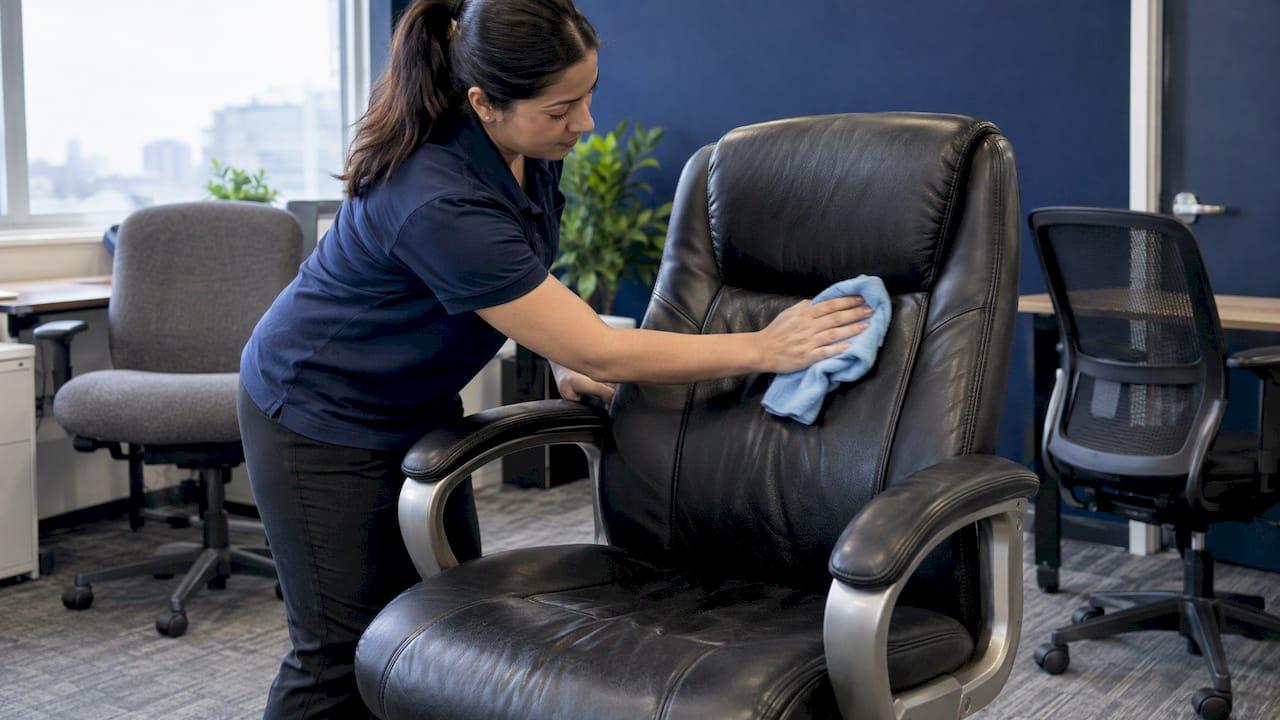
The right way to clean an office chair depends on its upholstery code, and the right moment to hand it over is when the seat is soiled all over rather than spotted. Light upkeep (vacuuming, blotting a fresh spill) is quick. A seat that has darkened across the whole surface, or a floor of 20 chairs that all need the same result, is a job for professional upholstery cleaning. We handle that for homes and businesses across the Greater Toronto Area, and you can request a quote for your office.
This guide covers how to read a chair's care label, how to clean fabric, mesh, leather and vinyl, how to treat stains, what to avoid, and how to decide between routine care and a professional visit.
TL;DR
- Find the cleaning code on the chair (W, S, WS or X) before you put any liquid on it. Code X means vacuum or brush only.
- Remove dry soil first, then blot rather than rub, and always test a hidden spot.
- Fresh spills are far easier than old ones. Residue and excess moisture cause the damage that cleaning is meant to prevent.
- Routine care should happen at least monthly. Professional cleaning is generally due about every 12 to 24 months with light to moderate use.
- Overall-soiled seating, executive leather and multi-chair offices are best handled by a professional team with commercial-grade equipment.
Table of Contents
- Start with the upholstery code, not the cleaner
- Step by step: cleaning a fabric office chair
- Mesh, leather and vinyl chairs
- Removing stains from an office chair
- What to avoid, in one list
- How often office chairs need cleaning
- Why a whole-office job suits a professional team
- Book professional upholstery cleaning for your office
- FAQ
- Sources
Start with the upholstery code, not the cleaner
Most damage to office chairs happens in the first thirty seconds: someone grabs a spray bottle before they know what the fabric is. Mills assign cleaning codes based on the fabric's content and construction. CIX Direct notes that these codes are recommendations and do not guarantee a fabric can always be cleaned that way.
The Office Seating Canada care guide defines them like this:
| Code | What it means | How to clean |
|---|---|---|
| W | Water-based cleaning | Foam from a mild detergent or non-solvent upholstery shampoo, applied with a soft brush in a circular motion, then vacuumed when dry |
| S | Solvent-based cleaning | Mild water-free solvent or dry-cleaning product in a well-ventilated room |
| WS | Either method | Water-based or solvent, as suits the soil |
| X | No liquids | Vacuum or light brushing only |
For code X, water-based foam cleaners may cause excessive shrinking, staining or pile distortion. CIX Direct is blunt about it: no water-based foam or solvent-based agent of any kind.
If the label is gone, which is common on chairs several years old, the professional standard is to test anyway. The IICRC S300 standard for upholstery cleaning, in its December 2024 public-review draft, calls for a colourfastness and fibre test in an inconspicuous area regardless of the manufacturer's label. It also calls for a review of the fabric's composition and construction, which sets the cleaning solution's pH and the process.
The warranty is part of the picture too. Haworth's care standards state that improper cleaning or maintenance may void the material warranty. On an office full of premium task chairs, that is a real cost.
Step by step: cleaning a fabric office chair

1. Remove dry soil first
Hair, lint, crumbs and dust should come off before any moisture goes on. The IICRC draft standard says to remove dry soil to the fullest extent practical using a quality vacuum, lint roller, suitable brush agitator or dry latex sponge. If you skip this, wet cleaning turns dry dust into mud that sinks into the weave.
No vacuum to hand? A lint roller and a soft brush, working in one direction, get most of the surface debris. It will not reach what has settled deep into the cushion, which is where a professional extraction machine earns its place.
Where it goes wrong: pushing a stiff brush hard across the seat. Haworth warns against excessive brushing or rubbing on polyester because it causes pilling.
2. Test a hidden area
Every manufacturer source in this guide says the same thing: pre-test in an unseen spot. The underside edge of the seat or the lower back works well. Apply your chosen method, blot dry, and wait for it to dry fully. Look for colour transfer onto the cloth, a ring, or a change in texture.
3. Clean with the lightest method that works
For light soiling on a fabric chair, the Office Seating Canada guide says to use a damp cloth, blot with very light pressure and never soak the fabric. For more intense soil, do the same with a mild detergent. For polyester, Haworth says accumulated dirt can be lifted with mild detergent or upholstery shampoo and rinsed well without soaking. Oil or grease spots respond to a mild solvent or dry-cleaning agent with a blotting technique.
The IICRC draft explains why gentler is smarter: soil removal rests on four fundamentals, namely chemical activity, heat, agitation and time. When you reduce one, you can raise another. On a delicate fabric, that means more dwell time and less scrubbing, not a stronger chemical.
4. Rinse the residue and blot dry
Haworth states that all cleaners, even mild ones, leave residue that must be removed thoroughly, usually with clean water, or it can harm the surface. Residue attracts new dirt, which is why a chair cleaned with too much soap looks grubby again within weeks. Dry by blotting with a clean cloth. Never rub.
5. Dry it properly
Moisture trapped in a cushion is the hidden risk. Health Canada's draft guidance on indoor air quality in office buildings warns that moisture and mould can get into soft or upholstered furnishings if they become wet or damp. Use as little water as the job allows, and let the chair dry in a ventilated room before anyone sits on it. We explain the same principle for floors in our guide to drying carpets within 24 hours after cleaning.
Mesh, leather and vinyl chairs
Office seating is not all fabric. Each surface has its own rules.
Mesh. Per Haworth, most meshes can be vacuumed. For soiling, use a 10% mild detergent and water solution applied gently in circular motions with a clean towel supporting the mesh from behind, then rinse residue with clean water. Do not use a heavy-bristle brush or excessive heat. ergoCentric, a Canadian seating maker, says hybrid mesh chairs should be vacuumed often and spot cleaned with mild soap and water.
Leather. The Office Seating Canada guide recommends regular wiping with a soft damp cloth without soaking. For deeper cleaning, use a mild soap solution in a light circular motion, repeat with clean water, let it dry and polish with a soft dry cloth. It says not to use detergents, aerosol sprays or other polishes on leather. Haworth adds no saddle soap, polish or wax, and ergoCentric rules out furniture polish, oils, varnish and ammonia. On an executive chair, one wrong product can leave a permanent patch, which is the argument for treating high-value leather with care rather than experimenting.
Faux leather and vinyl. Haworth says faux leather can be wiped with clean water or a 10% mild detergent solution, then rinsed and dried. ergoCentric says vinyl takes water-based cleaners only, no solvents.
Bleach. Some manufacturers allow dilute bleach on certain materials, but the limits are tight. ergoCentric says to avoid bleach on hybrid mesh except for infrequent disinfecting with a 1:10 solution, with total wet contact time capped at 2 hours over the chair's life. For bleach-cleanable fabrics, Mayer Fabrics says a 10% solution must not sit longer than 10 minutes and must be rinsed promptly, or warranties are void. If you are unsure which material you have, do not use bleach.

Removing stains from an office chair
Office stains are predictable: coffee, ink, grease from lunch at the desk, and the slow grey of body oils on the seat edge and armrests.
- Act fast. Haworth and Herman Miller both say that the longer a stain stays, the harder it is to remove.
- Blot, never rub. Use an absorbent cloth. Herman Miller adds that you should not let a stain dry completely before treating it, because it may set.
- Match the stain to the method. Water-based stains (coffee, juice) respond to a damp cloth and mild detergent on a W or WS fabric. Oily or greasy spots on polyester respond to a mild solvent or dry-cleaning agent, applied by blotting.
- Rinse and blot dry. Leftover detergent is the main reason a "cleaned" spot returns.
Some methods circulate online that this guide does not recommend for office seating. Household dish soap, hydrogen peroxide or glass cleaner are not on any manufacturer's approved list here, and a code X fabric will not tolerate them at all. Steam is out as well: ergoCentric says fabric upholstery should never be steam cleaned.
When a stain has spread, set, or sits on a delicate fabric, stop. Haworth directs that a professional furniture cleaning service be contacted for overall soil or large-scale stains. Our post on delicate upholstery fabrics explains which weaves need the most care. Silk, velvet and flocked finishes are among those where the IICRC draft says to avoid excessive agitation.
What to avoid, in one list
- Soaking any seat. Damp is the goal, never wet.
- Water-based foam or any solvent on code X fabrics.
- Solvent or dry-cleaning products on Crypton (C) fabrics.
- Dry-cleaning products containing carbon tetrachloride or other toxic materials.
- Detergents, aerosol sprays, polishes, saddle soap, wax or ammonia on leather.
- Heavy-bristle brushes and excess heat on mesh.
- Steam on fabric upholstery.
- Chrome polishes used near the seat. Canadian indoor-air-quality guidance notes these frequently contain petroleum distillates that affect indoor air quality, and recommends the least-toxic products possible with minimal VOC emissions.
How often office chairs need cleaning
The IICRC draft standard sets a useful rhythm. Routine care (vacuuming, attending to spots, wiping surfaces) should happen at least monthly, more often for delicate fabrics. Professional cleaning is generally due approximately every 12 to 24 months with light to moderate use. Hot-desked chairs, reception seating and boardroom chairs that see client traffic sit at the busier end of that range.
The Office Seating Canada guide draws the line the same way: frequent vacuuming or light brushing for upkeep, and a professional furniture cleaning service once the upholstery reaches an overall-soiled condition. Our post on sofa cleaning frequency applies the same logic to other upholstered pieces.
Why a whole-office job suits a professional team
Cleaning one chair at home is a Saturday-morning task. Cleaning a fleet of office chairs is a different problem. Every chair may carry a different code, and one wrong product can spoil the seat. Each fabric needs its own test, and each seat has to dry quickly so the office is usable the next morning.
That is where we come in. We clean upholstery for homes and businesses across the GTA using commercial-grade equipment and eco-friendly cleaning solutions. For an office manager, this takes the testing, the product choices and the drying out of your hands, and it keeps the warranty-sensitive parts of the job with people who do upholstery all day. Eco-friendly products also fit the indoor-air-quality advice above. If you want to see how we think about upholstery care in general, our upholstery cleaning tips and business carpet cleaning page show our approach. Commercial floors and chairs can be done in the same visit, so ask when you request your quote.
Our view on office chair care
Most chair damage we hear about starts the same way: a well-meant clean with the wrong product. Offices value their seating. An executive leather chair or a premium task chair is a real investment, and the care label is the first thing to read. Cleaning is a matter of matching the method to the fabric, not of using more force.
We believe cleaning should protect health as well as appearance. That is why we use eco-friendly cleaning solutions and professional equipment, and why we care about the details that follow a visit: how a seat dries, and how to keep it fresh between cleanings. Our approach is built on clear upfront pricing, responsive support and satisfaction guarantees.
For the offices we serve across York Region and Durham Region, the sensible rhythm is simple: light upkeep in house, and a scheduled professional clean once the seating needs it. That keeps chairs looking sharp for clients and staff for years.
Rob
Book professional upholstery cleaning for your office
If your chairs are overall-soiled, stained beyond a quick blot, or simply too many to test one by one, tell us what you have. We serve Markham, Richmond Hill, Vaughan, Aurora, Whitchurch-Stouffville, King City, Ajax, Whitby, Pickering, Mississauga and Toronto. You can request a quote with the number and type of chairs, or see our commercial cleaning services.
FAQ
How do I clean an office chair without a vacuum?
Use a lint roller or a soft brush to lift hair, lint and dust, working in one direction. The IICRC standard lists lint rollers, brush agitators and dry latex sponges as ways to remove dry soil before any moisture is applied. Then blot with a barely damp cloth on a W or WS fabric.
Can I use dish soap on a fabric office chair?
Only if the chair's code allows water-based cleaning (W or WS), and only a small amount of mild detergent, tested first on a hidden spot and rinsed well with clean water. Never use it on code X fabric, and never on leather, where manufacturers say to avoid detergents.
How do I get a stain out of an office chair?
Blot the fresh stain with an absorbent cloth, then use a damp cloth, or mild detergent for stronger soil, after testing in a hidden area. Rinse residue and blot dry without rubbing. Old, spread or oily stains on valuable chairs are better left to professional upholstery cleaning.
How often should office chairs be professionally cleaned?
The IICRC draft standard suggests approximately every 12 to 24 months for light to moderate use, with routine vacuuming and spot care at least monthly. Heavily used or delicate-fabric seating sits toward the shorter interval.
Can I steam clean an office chair?
Manufacturers advise against it for fabric upholstery. ergoCentric says fabric upholstery should never be steam cleaned. Heat and excess moisture can also harm mesh. Controlled low-moisture methods suit most office seating.
Sources
- IICRC S300 Standard for Professional Upholstery Cleaning (public-review draft, December 2024)
- Office Seating Canada: care and cleaning recommendations
- Haworth: Care and Maintenance Standards (July 2024)
- CIX Direct: Care and Cleaning Information (2021)
- ergoCentric: Care and Cleaning Instructions
- Health Canada: Draft guidance on improving indoor air quality in office buildings
- Mayer Fabrics: Cleaning codes
- Custodial Activities module, Canadian indoor air quality resource (2013)