
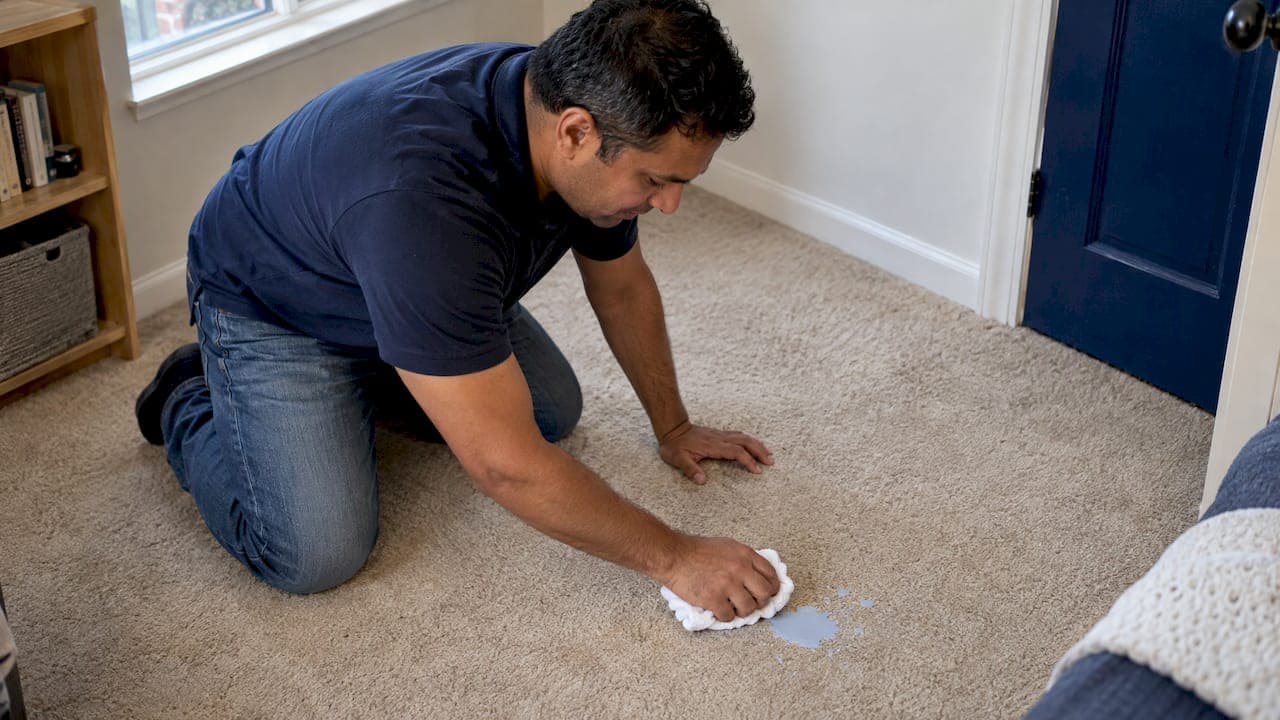
The best chance of getting paint out of carpet is to act while it is still wet: scoop and blot (never rub), then treat water-based latex paint with a weak dish soap solution. Dried paint is harder but often workable with scraping and a spot-tested rubbing alcohol step. Oil-based paint and large or set-in stains are where a professional hot-water extraction visit usually pays for itself.
TL;DR
- Wet paint: lift off the excess with a spoon or spatula, then blot with a white cloth. Rubbing pushes paint deeper into the fibres.
- Latex (water-based) paint: use a very weak solution of colourless dish soap in lukewarm water, and repeat with clean cloths.
- Dried paint: scrape and vacuum the flakes, then test rubbing alcohol on a hidden spot before using it on the stain.
- Oil-based paint: mineral spirits on a cloth, never poured onto the carpet, and only after soap and water have failed.
- Large, old or stubborn paint spills: stop before you spread it and call a pro. Check your carpet warranty first.
Table of Contents
- First, work out what kind of paint it is
- What to do in the first five minutes
- How to remove wet latex paint from carpet
- How to remove dried paint from carpet
- What about oil-based paint?
- Does WD-40 remove paint from carpet?
- Common mistakes that turn a small spill into a permanent stain
- When it's time to call a professional
- What professional paint-on-carpet cleaning costs with us
- Book a paint stain visit in the GTA
- Preventing paint on carpet during your next project
- FAQ
- Sources
First, work out what kind of paint it is
Everything else depends on this. Check the can if you still have it. Latex and acrylic paints are water-based and clean up with water and soap. Oil-based (alkyd) paints need a solvent. If you cannot tell, the label on the can, or the sheen and smell of the paint, usually gives it away: oil-based paint has a strong solvent odour and cures to a hard, glossy film.
It also matters when it happened. The Carpet and Rug Institute, the U.S. industry body for carpet, says to act quickly because a delayed spill may become a permanent stain. Reader's Digest makes the same point from the other side: paint is designed to be a semi-permanent or permanent colour treatment once it dries, so wet paint is your best window.
Two more things to check before you touch anything:
- Your carpet fibre. Wool, nylon, polyester and olefin respond differently to solvents and moisture. Wool and natural fibres, such as seagrass, jute and viscose blends, are the least forgiving. If you have a wool carpet, our wool carpet care guide explains what it tolerates.
- Your warranty. Carpet One Canada notes that failing to follow its stain-removal guidelines may void your warranty, and that a carpet with an Ultra 25a warranty should be reported to 3M before any stain is treated. Before you reach for a solvent on a newer carpet, read the warranty paperwork or call the retailer.
What to do in the first five minutes
Whether the paint is latex or oil, the first moves are the same, and they matter more than any product you use later.
- Stop the spread. Keep feet and pets away. Lay down a towel around the edge of the spill so the paint does not creep outward.
- Lift, don't smear. The Carpet and Rug Institute recommends blotting liquids with a dry white absorbent cloth or white paper towels, and scraping up semi-solids with a rounded spoon. Work from the outside of the spill toward the centre.
- Use white cloths only. Coloured cloths can transfer dye into damp carpet, and you will not see whether the paint is coming up if the cloth is already stained.
- Do not rub. Good Housekeeping's cleaning experts put it simply: focus on pulling the paint up and out of the fibres rather than scrubbing. Rubbing frays the pile and drives paint down toward the backing.
- Do not saturate the carpet. Extra water pushes paint into the underlay and can leave a ring or a damp-smell problem later.
How to remove wet latex paint from carpet
Latex is the most common household paint, and the most forgiving. Here is a method built on guidance from the carpet industry and a major home-care publisher.
What you need
- A plastic spoon, spatula or old credit card
- Several clean white cloths or white paper towels
- Colourless liquid dish soap (the plain kind, with no bleach, no added dyes)
- Lukewarm water
- A dry white towel
Steps
- Scoop the excess. Martha Stewart's guide suggests scooping excess paint with a small spatula or plastic spoon, then blotting with a damp white cloth without rubbing.
- Mix a weak soap solution. The Carpet and Rug Institute specifies 1/4 teaspoon of liquid dishwashing detergent in one cup of lukewarm water and warns never to use a stronger concentration. It looks too weak to work. That is deliberate: strong soap leaves residue that attracts dirt, and the stain comes back as a dirty patch.
- Blot, then blot again. Apply the solution to a clean white cloth, not straight onto the carpet, and press it onto the paint. Switch to a clean section of cloth each time. Keep going until no more paint transfers.
- Rinse. Dab with a cloth dampened with clear, warm water to take out the soap, then press with a dry towel to lift moisture.
- Dry thoroughly. Leave a dry white towel under a light weight overnight if the patch is still damp. Then vacuum once dry to lift the pile.
Carpet One Canada gives a slightly stronger recipe for the same job, 1/2 teaspoon of clear dish detergent to 1 cup of warm (not hot) water, applied with a damp towel for 3 to 5 minutes, then blotted. If you are unsure which to use, start with the weaker mix and move up only if you need to, after a spot test.
Which soap is safe?
The soap matters more than people think. The Carpet and Rug Institute advises against laundry detergents, which may contain optical brighteners that dye carpet fibres, and against automatic dishwasher detergents, which may contain bleaching agents that can destroy dyes and some fibres. That is the answer to the common question about Dawn. A mild liquid hand-dishwashing soap is the right type of product, and Good Housekeeping used Dawn Ultra as its standard dish soap for testing, saying it can handle oily splotches and carpet stains. Whatever brand you use, keep it colourless, keep it dilute and rinse it out.

Using a home carpet machine
If you own a rental or home extractor, Martha Stewart's guidance is to generally use hot water only and skip shampoo or soap, checking the manufacturer's instructions for water temperature. Only do this after you have lifted the bulk of the paint by hand. Running an extractor over a pool of paint just spreads it.
How to remove dried paint from carpet
Dried paint is the situation most people search for, often after discovering a splatter days later. It takes more patience and has a lower success rate, but small spots are often fixable.
- Scrape. Reader's Digest advises scraping dried water-based paint with a plastic scraper or old credit card and vacuuming the flakes. Work gently so you do not pull up the carpet loops or cut the pile.
- Soften with soap and water. Dab with the weak soap solution above. Hold a damp cloth on the dry paint for a few minutes to see if it softens. Many latex splatters will lift at this stage.
- Spot-test rubbing alcohol. If the paint remains, test rubbing alcohol in an inconspicuous spot, such as inside a closet. If the colour does not change, dampen a microfibre cloth, loosen the paint gently without pressing deeply or rubbing hard, then blot with a damp cloth until the alcohol smell is gone and press with a clean dry towel. That sequence comes from the Reader's Digest guide.
- Trim as a last resort. On a cut-pile carpet, a dried drop sitting on the very tips of the fibres can sometimes be snipped off with small scissors. Take only the paint-coated tips and stop when the carpet looks level. This only works for small spots, and it removes fibre for good, so do it in a hidden area if you can.
You may see advice to soak dried paint in vinegar and water. Some top-ranking pages recommend it for fresh paint. We would test it first on a hidden patch, particularly on wool and natural fibres, and we would not leave it sitting on the carpet.
What about oil-based paint?
Oil-based paint can be more difficult to remove. Martha Stewart's guide says that if soap and water are not enough, apply a small amount of mineral spirits to a clean white cloth and blot the stain, and never pour mineral spirits directly onto the carpet.
Some ground rules for solvents:
- Ventilate the room: open windows and keep pets and children out.
- Test on a hidden spot first, because solvents can affect carpet backing and dyes.
- Dab, don't pour. A little solvent on the cloth is enough.
- Follow with the weak soap solution and a clear-water rinse to remove the solvent, then dry.
- Dispose of used cloths safely. Solvent-soaked rags should not be left in a pile. Check your municipality's household hazardous waste rules for disposal.
Carpet One Canada's page says its dish-detergent method works for both latex and oil paint: scrape or blot the excess, apply the solution for 3 to 5 minutes, and blot rather than rub. Try that first, because it is the gentlest.
Does WD-40 remove paint from carpet?
It is a popular suggestion and you will find it on many DIY pages, but we do not recommend it for carpet. WD-40 is a petroleum-based lubricant, and it leaves an oily residue. That residue can leave a dark, greasy patch that attracts soil and is a stain in its own right, and it is difficult to rinse from carpet backing. None of the carpet-industry guidance above uses it. If you try it anyway, test a hidden spot, use a tiny amount on a cloth, and be ready to treat the oily mark afterwards. For anything beyond a small spot, a professional is the safer move.
Common mistakes that turn a small spill into a permanent stain
- Rubbing or scrubbing. It spreads the paint and damages the pile.
- Hot water on latex. Heat can help paint set into fibres. Use lukewarm unless the manufacturer says otherwise.
- Too much soap. More soap is not better, and leftover residue attracts dirt.
- Laundry detergent or bleach products. These can strip or alter colour.
- Soaking the carpet. Wet backing and underlay take a long time to dry.
- Waiting. If you see a spill, treat it now. Leaving it for the weekend turns a 10-minute job into a hard one.
- Skipping the spot test. Every solvent, alcohol or soap should be tried somewhere hidden first.
When it's time to call a professional
Home methods work best on small, fresh spills. Call a pro when:
- The paint covers more than a few centimetres, or has soaked through to the underlay.
- It is oil-based, gloss, enamel or an unknown type that does not respond to soap.
- The paint is old and fully cured.
- The carpet is wool, silk, viscose or another delicate fibre, or is a rug with natural dyes.
- You have a manufacturer's warranty to protect.
- You have already tried one or two methods and the stain is not shifting. Every extra attempt makes the next one harder.
The Carpet and Rug Institute itself says that for stubborn spills, you should consider consulting a professional cleaner, who has the ability and equipment to use more aggressive cleaning solutions. Hot-water extraction is also the method carpet makers name for deep cleaning: Beaulieu's care guide calls it the preferred professional method, with non-cationic products below pH 10. You can read how the main approaches differ in our carpet cleaning methods overview.
Our perspective
Paint calls usually reach us after one or two rounds of home treatment. The reasons are almost always the same: the spill was rubbed, too much soap went on, or the carpet was soaked and the paint moved into the backing. We understand why. Nobody wants to pay for a cleaner when a spoon and a cloth are on hand.
Our advice is to treat the first ten minutes as yours and everything after that as a judgement call. Lift the paint, blot, use a very weak soap solution and stop as soon as the stain stops improving. Once you are going back for a third product, the carpet is better off in the hands of a technician with commercial-grade equipment and cleaning solutions chosen for the fibre.
We build our work around eco-friendly solutions, clear upfront pricing and follow-up care after the visit. We would rather you call us after one careful attempt than after five aggressive ones, because a clean start gives us the best chance of a good result. We can't promise every dried paint stain will come out entirely, and we will tell you plainly what we expect before we begin.
Rob
What professional paint-on-carpet cleaning costs with us
Our residential carpet cleaning is priced per room, with the price shown on each service page. A regular room is $60, a living room or master bedroom is $70, a recreation room is $120, and a set of stairs starts at $60 (stairs with one landing are $70, with two landings $80). Hallways are $30 for a small one, $60 for a medium and $80 for a large one, and a closet is $10.

If the paint is on an area rug, rugs are priced per square foot: synthetic and seagrass or jute rugs are $0.75, viscose blend and Persian rugs are $1.00, and wool, oriental and cotton rugs are $1.50. Heavy-traffic commercial carpet is $0.50 per square foot, and light-traffic is $0.30. Stain spot treatment depends on the paint type and age, so ask for a quote and send us a photo.
Book a paint stain visit in the GTA
We clean carpets, rugs, upholstery and tile throughout the Greater Toronto Area, including Markham, Richmond Hill, Vaughan, Aurora, Whitchurch-Stouffville, Ajax, Whitby, Pickering, Mississauga and Toronto. If a spill is beyond a cloth and a spoon, our team arrives with professional equipment and eco-friendly solutions.

See our residential carpet cleaning prices and book, or request a quote with a photo of the stain. If the paint is on a rug, check area rug cleaning. You can also look at our before and after gallery to see what professional cleaning can do.
Preventing paint on carpet during your next project
Most paint accidents happen during painting, not after. A few habits will keep a roller drip from becoming a repair job:
- Use canvas drop cloths rather than thin plastic sheeting, which is slippery and tends to leak at the folds. Tape the edges to the baseboard.
- Keep the paint tin on a tray or a board, never directly on carpet.
- Pour only as much as you need into the roller tray, and carry it with both hands.
- Keep a small kit nearby: a plastic scraper, white cloths, a spray bottle of lukewarm water and a little colourless dish soap.
- Move furniture out if you can, and cover what you can't.
- If you are painting before a move, remember that a clean carpet is part of getting a deposit back, and that is what our move-out cleaning is for.
FAQ
Can you get dried paint out of carpet?
Often, yes, if it is a small spot of water-based paint. Scrape it off with a plastic scraper, vacuum the flakes, then try dish soap solution and, after a spot test, rubbing alcohol on a microfibre cloth. Large, old or oil-based stains are less likely to come out completely, so ask a professional before you try a solvent.
Does Dawn dish soap get paint out of carpet?
A plain liquid dish soap such as Dawn can work on fresh latex paint, but only in a very weak solution. The Carpet and Rug Institute suggests 1/4 teaspoon per cup of lukewarm water. Avoid laundry detergents and dishwasher detergents, and rinse the area with clear water afterwards.
Can I use a hairdryer or steam to speed things up?
We would not. Heat can help paint set into the fibres, and steam may drive it deeper. Blot the stain dry with clean towels and let the carpet air-dry instead.
How much will it cost to have paint removed from carpet in the GTA?
Our standard room prices start at $60 for a regular room, and rugs are priced per square foot depending on the fibre. Paint stains are assessed individually, so send a photo through our quote form and we will confirm the work and price before we start.
Sources
- Paint, Latex Wet, The Carpet and Rug Institute
- How to Get Paint Out of Carpet, Carpet One Canada
- How to Get Paint Out of Carpet: Acrylic, Latex, Oil-Based, Reader's Digest
- How to Get Paint Stains Out of Carpet, Martha Stewart
- How to Get Paint out of Carpet, According to Experts, Good Housekeeping
- Top Awards for Cleaning Products, The 2019 Good Housekeeping Cleaning Awards
- Beaulieu Carpet Care and Warranty Guide