
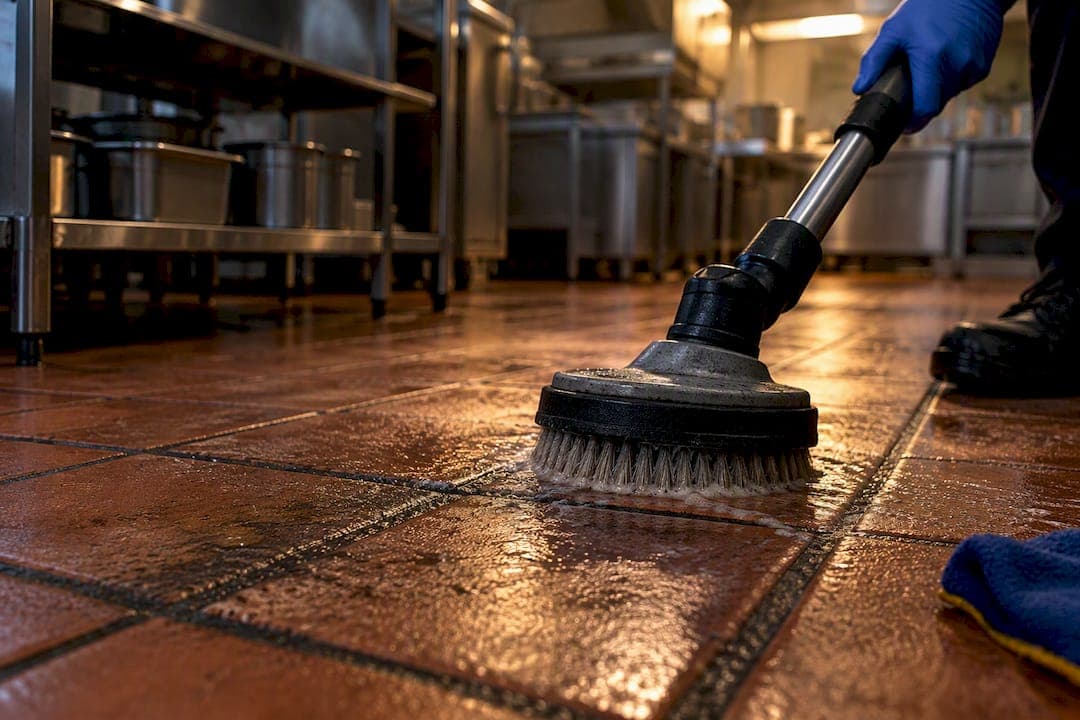
The fastest, most defensible way to get restaurant tile and grout sanitary is a documented professional deep clean, performed to CFIA-style cleaning-and-sanitation elements, with an impregnating sealer applied afterward if your substrate calls for it. That means a qualified provider removes grease, applies a compatible cleaner, agitates the grout mechanically, extracts and dries the floor, then hands you a record. Icleansecuc offers this as one available option through its tile and grout cleaning service.
TL;DR:
- Proper deep cleaning involves using a matched degreaser, mechanical agitation, and wet extraction, with each step documented to ensure CFIA compliance.
- Documented work records, including chemical details, test patches, and acceptance checklists, are essential for passing inspections and verifying quality.
- Frequency of professional cleaning depends on grease load and traffic, with more frequent cleaning needed for high-grease or heavy-use floors, scheduled quarterly or more often.
- Using equipment like dispense-and-vac or steam extraction paired with sealed grout treatments enhances cleaning effectiveness and stain resistance.
- Leftover moisture or grease residues after cleaning indicate incomplete removal and require proper inspection, documentation, and communication to ensure job completion.
Table of Contents
- Why professional restaurant tile and grout cleaning matters for compliance
- What does a professional deep-clean sequence for tile and grout look like?
- Tools and chemistry: what a real provider brings
- How do you choose a restaurant tile and grout cleaning provider?
- How often should restaurant floors get a deep tile and grout clean?
- Aftercare: how do you know the job actually worked?
- Common tile and grout materials in restaurants and their cleaning needs
- Dealing with grease, mould, and stubborn grout stains
- Health and safety rules that touch tile and grout cleanliness
- Does clean grout actually change how customers rate a restaurant?
- What a provider actually sees on the job
- Book a documented tile and grout clean with Icleansecuc
- Sources
- FAQ
Why professional restaurant tile and grout cleaning matters for compliance
CFIA treats floor cleaning as a process control, not a cosmetic task. Its cleaning and sanitation program guidance says a written procedure must name the surfaces being cleaned, the chemicals and tools used, the frequency, the exact method, and the rinsing and drying requirements. That level of specificity exists because grout is porous. Grease and food soil settle into the joint lines where a mop never reaches, creating harbourage for bacteria long after the floor looks fine to the eye.
This is the gap that trips up a lot of kitchens: a floor can look spotless and still fail an inspection, because a visual pass is not a sanitation record. An inspector wants to see what chemical was used, at what dilution, and how often, not just a shiny tile. Restaurant floor maintenance built around documentation, rather than appearance, is what actually holds up when someone checks.
What does a professional deep-clean sequence for tile and grout look like?
A restaurant tile and grout cleaning job should follow a specific order every time, and you should be able to see it written into the work order before the crew shows up. The sequence below reflects the process Canadian food-safety guidance supports for hard-surface deep cleaning in food environments.
- Prep the space. Move smallwares, mats, and rolling equipment out of the work zone, cover any exposed food or prep surfaces, and confirm ventilation and after-hours access.
- Remove dry debris. Sweep or dry-vacuum loose soil before any liquid touches the floor. Wet debris just smears into grout lines.
- Apply a compatible cleaner or degreaser. The product has to match your tile glaze and grout type. This is not a step where a generic all-purpose spray belongs.
- Hold the dwell time. Every label specifies how long the cleaner needs to sit before it works. Skipping this step is the single most common shortcut that produces a "clean-looking" floor with leftover soil in the joints.
- Mechanically agitate the grout. A brush or rotary tool breaks up embedded grease that a mop pass alone cannot touch.
- Extract with a wet vacuum or recovery system. This pulls out loosened soil and spent solution rather than pushing it around.
- Rinse if the label requires it. Some chemistries need a clean-water rinse before food-contact areas are considered safe.
- Dry the floor fully, then inspect it and sign off, ideally with photos and a checklist attached to the work order.
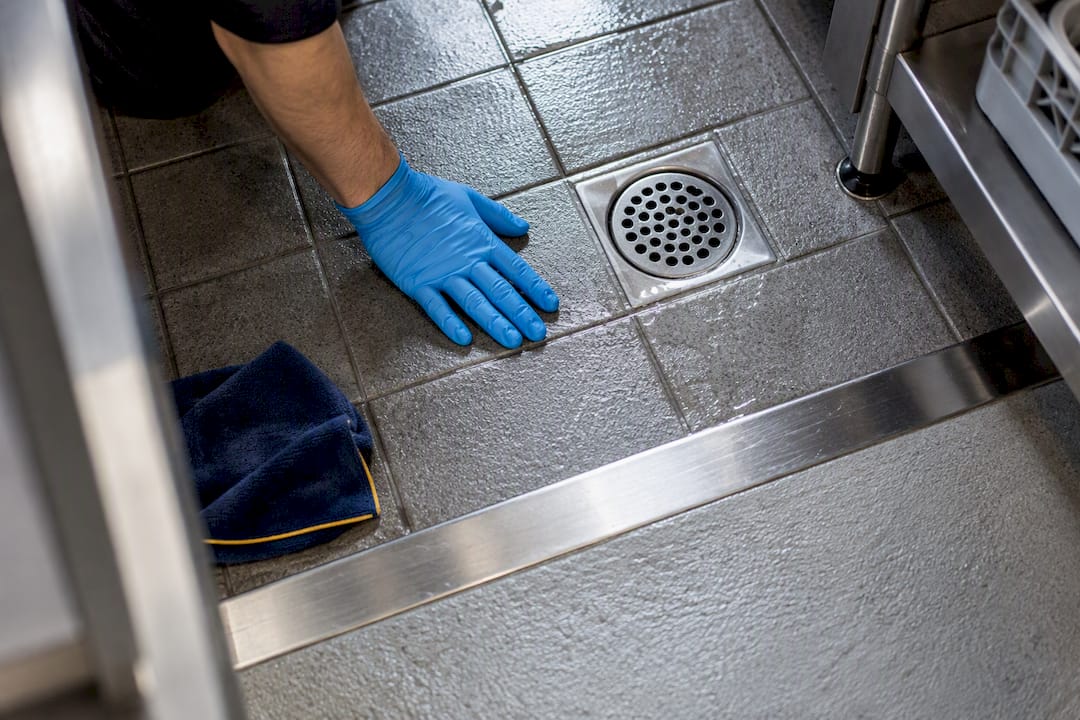
Ask about the test patch, too. A competent contractor runs one on an inconspicuous section before treating the whole floor, and checks how drains and transition strips will be handled, since those edges are where cleaning crews most often cut corners.
Tools and chemistry: what a real provider brings
Equipment tells you a lot about whether a contractor is running a real operation or showing up with a mop bucket. A restaurant tile and grout cleaning job worth paying for usually involves some combination of the following:
- Dispense-and-vac systems that apply cleaner and recover it in a single controlled pass, reducing wasted product and standing liquid.
- Steam extraction paired with wet vacuum recovery, useful for breaking down grease without relying purely on harsh chemistry.
- Mechanical agitation brushes, handheld or machine-driven, built to work grout lines rather than flat tile surfaces.
- Wet/dry extraction units for pulling spent solution and soil off the floor before it dries back into the grout.
On the chemistry side, expect a genuine distinction between cleaners/degreasers, which lift grease and soil, and impregnating sealers, which soak into porous grout to resist future staining. A sealer is not a substitute for cleaning, and a surface coating is not the same as an impregnating one. Manufacturer-safe cleaning methods matter because acidic or high-alkaline products can etch certain glazes or strip grout colour. Health Canada's hard-surface disinfectant guidance makes clear that label directions on rinsing and contact time govern use around food-contact surfaces, not general assumption.
How do you choose a restaurant tile and grout cleaning provider?
The contract is where most compliance problems get solved or created. Put these items in writing before anyone starts work:
- Scope of work naming the exact areas, tile type, and grout condition.
- SDS and chemical disclosure for every product the crew plans to use.
- A required test patch before full-floor treatment.
- A stated wastewater recovery and disposal plan, not just "we clean up after."
- Written acceptance criteria: no visible soil, no pooled water, dry within a stated window.
- A signed checklist or photo record attached to the invoice.
Ask direct questions during the quote call: What equipment will you use on this floor? How is wastewater recovered and where does it go? Can I see your SDS sheets? Will you run a test patch first? What's the drying time before we can reopen the space?
Red flags are easy to spot once you know what to look for. Vague answers about "our proprietary method," no SDS on request, no willingness to test a small area, or no documentation at the end of the job all point to a provider who is not running a CFIA-aligned process.
Pro Tip: Keep every signed acceptance checklist in the same binder as your daily cleaning logs. Inspectors respond far better to a continuous paper trail than to a single spotless-looking floor on inspection day.*
How often should restaurant floors get a deep tile and grout clean?
There is no fixed universal interval, and CFIA's own guidance backs that up: frequency should be risk-based, scaled to grease load, foot traffic, tile texture, and drainage. A fry station floor with heavy grease and constant traffic needs far more frequent professional attention than a dry storage corridor.
Operationally, this means booking deep cleans after hours whenever possible, moving mats and rolling carts out of the zone in advance, and protecting exposed food and equipment before the crew starts. Coordinate timing with grease-interceptor servicing where you can. Doing both on the same maintenance cycle avoids doubling your disruption and keeps grease-related buildup from compounding between services.
Link your deep-clean dates directly to your daily maintenance log. A floor that gets a documented professional clean quarterly, backed by consistent daily mopping and spot treatment, gives inspectors and auditors a pattern they can trust rather than a single good day.
Aftercare: how do you know the job actually worked?
The most common failure after a restaurant tile and grout cleaning job isn't dirty grout. It's incomplete recovery. Leftover moisture and grease residue near drains, edges, and transition strips is where crews most often cut corners, and it's exactly where inspectors look first.
Confirm the contractor's wastewater plan before the job starts, not after. Ask specifically how it's recovered and where it's discharged, since dumping grease-laden wastewater into a floor drain without proper interception can create separate plumbing and compliance headaches down the line.
Once the job is done, check for pooled water and slippery residue, and make sure grout joints feel sound rather than crumbly. A floor that's genuinely finished should be dry, not just damp-looking. Require the contractor to hand over photos, a signed checklist, and a plan for correcting anything found during the walkthrough. That documentation becomes your baseline for the next scheduled clean and your evidence if a health inspector asks questions.
Common tile and grout materials in restaurants and their cleaning needs
Not every kitchen floor behaves the same way under a degreaser, and the material dictates the method more than most managers expect.
Quarry tile, the unglazed reddish tile common in commercial kitchens, is durable but highly porous, which means it absorbs grease deep into the surface, not just the grout lines. It typically needs a stronger degreaser and longer dwell time than glazed tile, plus a sealer that penetrates rather than sits on top.
Glazed ceramic tile resists staining better on the tile face itself, but the surrounding grout is still vulnerable. Aggressive acidic cleaners can dull or etch the glaze over repeated use, so a manufacturer-safe, pH-balanced approach matters more here than raw cleaning power.
Porcelain tile, increasingly common in newer builds, is denser and less porous than quarry tile, but its grout joints still need the same mechanical agitation since porcelain's low absorbency doesn't extend to the grout itself.
Cementitious grout, the standard sanded or unsanded grout in most installations, is the most porous element in any tile floor and the main reason sealing matters. Epoxy grout, used in some newer or renovated kitchens, resists staining far better and needs a gentler cleaning approach since it doesn't accept sealer the same way cement-based grout does.
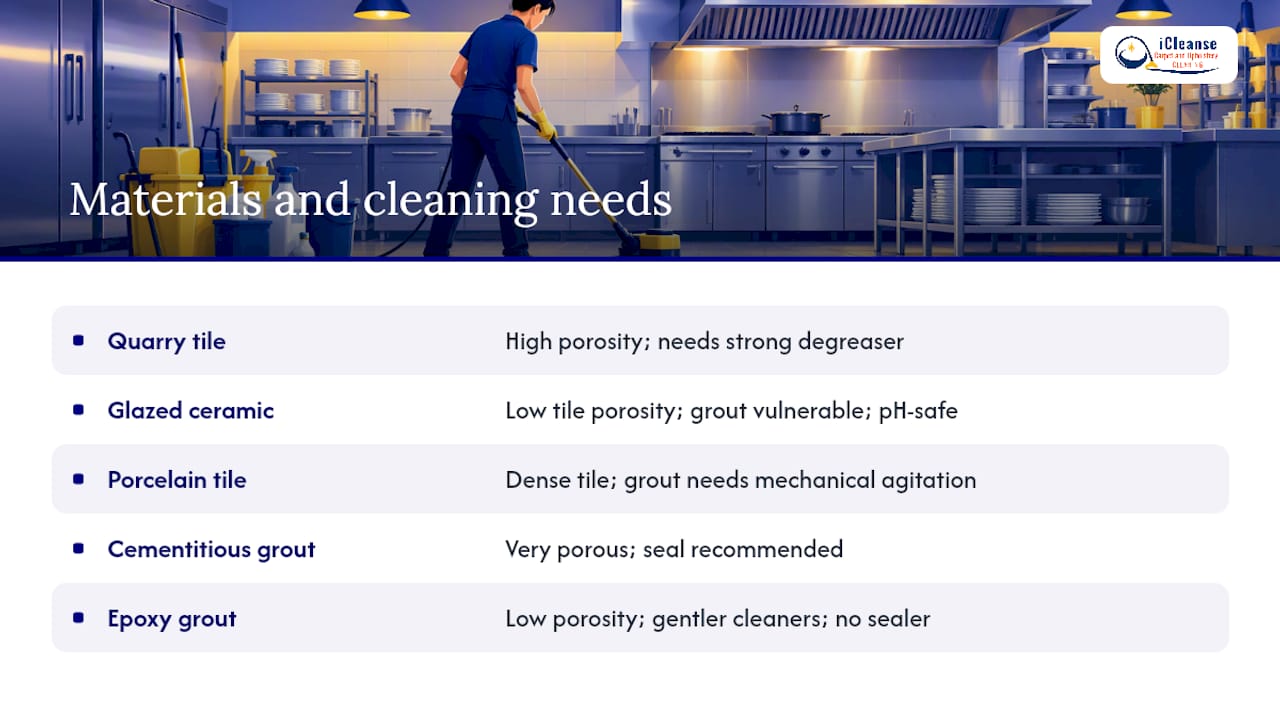
Knowing which type you have before booking a service saves a wasted test patch and a possible callback.
Dealing with grease, mould, and stubborn grout stains
Grease buildup is the single most persistent problem in restaurant floor maintenance, and it's rarely solved by a stronger chemical alone. It needs dwell time and mechanical agitation working together. A cleaner that sits without agitation just re-deposits the grease it lifted once it dries.
Mould and mildew show up most often near dish pits, walk-in coolers, and floor drains where moisture lingers. These spots need attention beyond the scheduled deep clean, since standing moisture between services lets mould re-establish within days. If a specific drain area keeps recurring, that's usually a drainage or ventilation issue, not a cleaning-frequency issue, and no amount of extra scrubbing fixes a floor that never fully dries.
Recurring dark grout staining that keeps returning after cleaning, even with a sealer applied, often points to grout that's already saturated below the surface. At that point, cleaning alone won't reverse it. That's when professional grout restoration, which can include stripping old sealer, deep extraction, and reapplying an impregnating sealer, becomes the more realistic fix than another round of standard cleaning.
Never mix bleach and ammonia-based products, and never combine any two cleaning chemicals unless the label explicitly permits it. CCOHS guidance is direct on this: that combination produces toxic gas, and it's one of the most common preventable safety incidents in commercial kitchens.
Health and safety rules that touch tile and grout cleanliness
In Ontario, O. Reg. 493/17 requires food premises to be operated and maintained so that surfaces are clean and sanitizable, with expectations around cleaning and sanitizing frequency and method that extend to floors, not just food-contact equipment. That regulation is the one your local inspector is actually checking against, whatever generic advice you find online.
On the chemical handling side, staff who use cleaning products need to read labels and Safety Data Sheets, understand dilution ratios and hazards, use proper ventilation, and wear the PPE the label specifies. CCOHS's guidance on cleaning products makes this a baseline expectation, not an optional precaution, for anyone handling commercial-strength degreasers or disinfectants.
Cleaning and disinfecting are separate steps with separate rules. Health Canada's guidance on hard-surface disinfectants specifies that disinfectant labels govern contact time and rinse requirements around food-contact zones, and a disinfectant applied over unremoved grease doesn't do its job properly. Soil has to come off before disinfection claims mean anything, which is exactly why the deep-clean sequence matters more than a quick disinfectant wipe-down.
Does clean grout actually change how customers rate a restaurant?
Health inspection scores are public in most jurisdictions, and a documented floor-cleaning program is one of the more controllable factors behind a strong result. Inspectors respond to written procedures and records over appearance alone, which means a restaurant with a consistent professional cleaning schedule tends to build a stronger paper trail than one relying on daily mopping alone.
Customer perception runs on a shorter feedback loop but the same logic. Diners rarely see the kitchen floor directly, but they see the open kitchen pass, the server station, and the restroom tile, and dark grout lines or a lingering grease smell register instantly, even to someone who couldn't name the cause. A restaurant that keeps its visible tile surfaces genuinely clean signals the same standard applies where customers can't see.
The connection isn't abstract. A kitchen that treats floor cleaning as routine maintenance, scheduled and documented like any other compliance task, is the same kitchen that tends to score well and get fewer complaints tied to cleanliness. It's one of the little hygiene factors a manager can fully control on a set schedule.
What a provider actually sees on the job
Most managers underestimate how much grease sits below the visible grout line until a proper degreaser and agitation pass reveal it. A reputable provider approaches restaurant tile and grout work with commercial-grade equipment and eco-friendly solutions, documenting each job so managers have a record beyond a clean-looking floor. The most common gap in a manager's spec isn't the cleaner used, it's the missing acceptance checklist that proves the work actually happened the way it was ordered.
— Rob
Book a documented tile and grout clean with Icleansecuc
Icleansecuc gives restaurant managers a documented alternative to a one-off scrub crew: a written process, test patch, and signed acceptance record instead of a floor that just looks clean on the day. Two service options cover most kitchens: Tile And Grout Cleaning Only for a straightforward deep clean, and Tile And Grout Cleaning + sealer when your grout needs an impregnating sealer to resist future staining.

Every job includes an on-site inspection, a test patch on your specific tile and grout, and a documented acceptance check before the crew leaves. Booking is straightforward: request an after-hours slot that works around your service hours, and have your grease-interceptor schedule handy so both can be coordinated on the same visit. If your floor needs broader attention beyond tile and grout, the commercial cleaning services page covers additional scope. Ready to get a floor that holds up to inspection, not just appearance? Request a quote and get a documented deep clean scheduled around your kitchen's hours.
Sources
FAQ
What do professionals clean tile and grout with?
Professionals use a compatible cleaner or degreaser matched to the tile and grout type, applied with mechanical agitation, then recovered through wet extraction or a wet vacuum. The exact product and dilution should appear on the SDS the contractor provides, and rinsing depends on what the label specifies for food-contact areas.
How much does tile and grout cleaning usually cost?
Pricing varies by provider and floor condition, but Icleansecuc's Tile And Grout Cleaning Only service is priced at $0.80 per square foot, while Tile And Grout Cleaning + sealer runs $1.30 per square foot. A sealer add-on protects grout from future staining and typically extends time between deep cleans.
Does professional tile and grout cleaning work?
Yes, when it follows a documented sequence, dry debris removal, compatible cleaner, dwell time, mechanical agitation, extraction, and drying, rather than a quick mop-and-chemical pass. The supported deep-clean sequence is what actually reaches grease embedded in porous grout, which surface mopping alone cannot remove.
What is the best way to deep clean tiles and grout?
The most reliable method combines a compatible degreaser held for its labelled dwell time with mechanical agitation of the grout lines, followed by full wet extraction and thorough drying. Skipping dwell time or agitation is the most common reason a floor looks clean but still fails on inspection for hidden soil in the joints.