
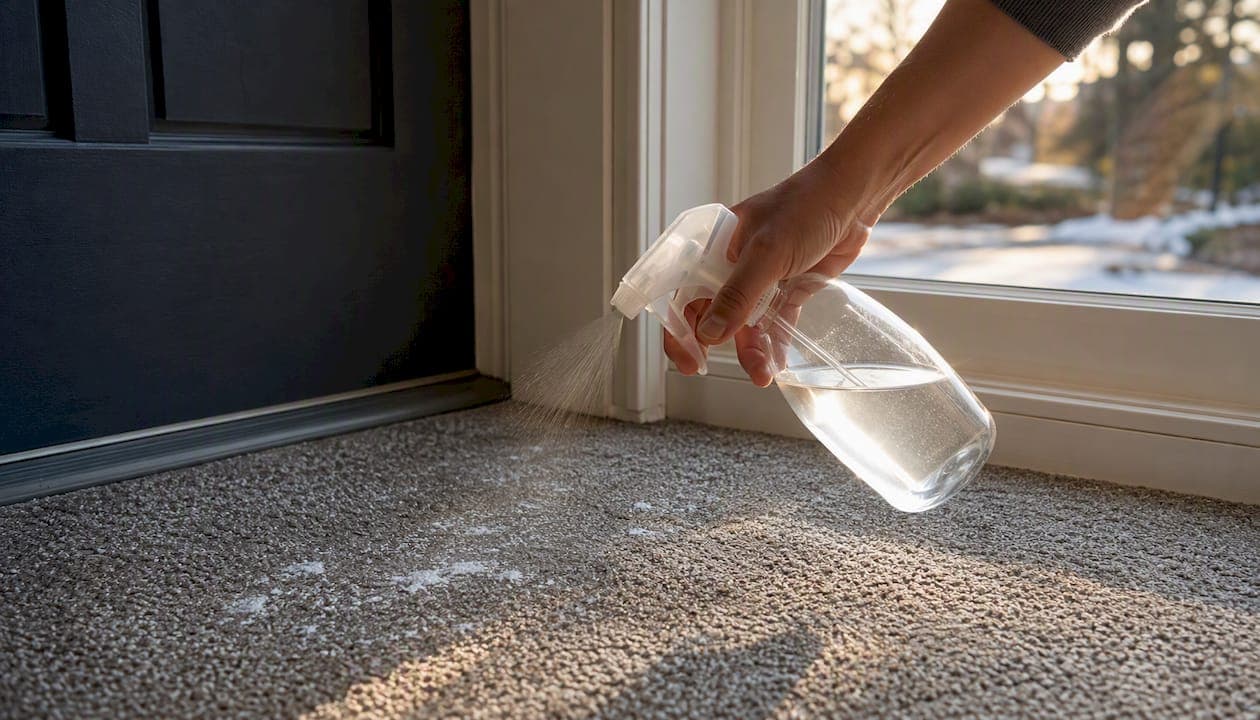
For a fresh salt stain, act in this order: vacuum thoroughly, spray a diluted white vinegar solution, blot with a clean cloth, rinse with cold water, and dry completely. That five-step routine handles the majority of road salt carpet stains before they set. For stiff, discoloured, or widespread staining that persists after two attempts, the damage likely runs deeper than surface fibres, and professional extraction is the right call.
- Vacuum first, multiple passes, multiple directions, before any liquid touches the carpet
- Mix a diluted white vinegar solution in a spray bottle
- Spray lightly, blot from the outside of the stain inward, never rub
- Rinse with cold water, blot again, then dry with a fan or low-heat dryer
Pro Tip: Always test your vinegar solution on a hidden patch of carpet first. Boiling water is never the right choice here. It dissolves salt and pushes it deeper into the backing.
Call a professional when you see stiff or crunchy fibres across a large area, a white haze that returns after cleaning, persistent odour, or any sign of discolouration that DIY methods have not shifted after two rounds.
Key takeaways
Vacuum before any liquid touches the carpet, neutralise with a diluted white vinegar solution, blot thoroughly, rinse with cold water, and dry completely to remove salt stains without driving them deeper.
| Point | Details |
|---|---|
| Vacuum before wetting | Multiple passes in multiple directions remove loose crystals before liquid can push them deeper. |
| Vinegar neutralises salt | One part white vinegar to two parts cold water converts alkaline residues into forms that blot away. |
| Cold water only | Hot water dissolves salt and drives it into the backing, causing stains to return and worsen. |
| Dry fast to prevent mould | Use fans and a dehumidifier; if the carpet is still damp after 12 hours, professional extraction is needed. |
| Icleansecuc for set-in damage | Truck-mounted extraction and pH-balanced treatment remove embedded salt that DIY methods cannot reach. |
Table of Contents
- Why salt stains in carpet behave differently from ordinary spills
- How to remove salt stains from carpet step by step
- How to tackle old, crusty, or set-in salt stains
- Mistakes that make salt stains worse
- Preventing salt stains: your winter routine for Ontario homes
- Drying after cleaning: timelines and mould risk
- When should you call a professional carpet cleaner?
- What I keep seeing on the job
- Professional salt stain removal across the GTA
- Sources
Why salt stains in carpet behave differently from ordinary spills
Road salt is not a single substance. Ontario municipalities use a mix of sodium chloride, calcium chloride, and magnesium chloride depending on temperature and road conditions. Each compound behaves differently once it reaches your carpet.
The key problem is that salts are hygroscopic — they pull moisture from the air and hold it inside the fibre. That trapped moisture keeps the salt in a semi-dissolved state, which means it can migrate downward into the carpet backing and padding even when the surface looks dry. When the area dries out, the salt recrystallises, often deeper than it started, which is why white rings reappear days after you thought you had cleaned them.
- Sodium chloride (standard road salt): the most common, moderately alkaline, and relatively easy to neutralise with a mild acid like white vinegar
- Calcium chloride: used in colder conditions, more hygroscopic, and harder to remove because it bonds more aggressively to fibres
- Magnesium chloride: similar to calcium chloride, often found in liquid de-icers applied before storms
Salt crystals are also physically abrasive. Foot traffic grinds them into the pile, fraying individual fibres and accelerating wear. Left untreated long enough, the damage becomes permanent — fibres thin, dye sites weaken, and the carpet takes on a dull, matted appearance that no amount of cleaning fully reverses.
Pro Tip: Canadian de-icing mixes vary by municipality. If you notice stains that resist a standard vinegar treatment, you may be dealing with calcium or magnesium compounds, which respond better to a chelating spot cleaner than to vinegar alone.
How to remove salt stains from carpet step by step
What you need
- Vacuum cleaner with strong suction
- Spray bottle
- White vinegar (plain, not seasoned)
- Cold water
- Microfibre cloths or clean white towels
- FOLEX Instant Carpet Spot Remover (available at Canadian Tire and most hardware stores) as an alternative to vinegar
- BISSELL Little Green portable extractor for a more thorough rinse and extract step
- Fan or hair dryer on the lowest heat setting
The step-by-step process
- Dry-vacuum first. Vacuum thoroughly with multiple passes and directions to lift loose crystals before any liquid touches the carpet. Skipping this step drives grit deeper.
- Spot-test your solution. Apply a small amount of the vinegar mix to an inconspicuous area, wait two minutes, and check for colour change or fibre reaction. This matters most on wool, nylon with reactive dyes, or any antique rug.
- Mix your solution. Combine one part white vinegar with two parts cold water. This diluted solution neutralises alkaline salt residues, converting some insoluble compounds into soluble forms that lift out with blotting.
- Spray lightly. Mist the stained area — do not soak it. Over-wetting pushes dissolved salt into the padding.
- Blot, don't rub. Press a clean cloth onto the stain and lift straight up. Work from the outer edge toward the centre. Rubbing spreads the stain and damages fibre structure.
- Rinse with cold water. Apply a small amount of plain cold water to the area and blot again. Skipping the rinse step is one of the most common DIY failures — residual vinegar or cleaner attracts new soil.
- Extract or dry. Use a BISSELL Little Green to extract remaining moisture, or press dry towels firmly onto the area and run a fan. Dry the carpet as quickly as possible.
How to tackle old, crusty, or set-in salt stains
Set-in salt stains are harder but not hopeless. The approach shifts from simple neutralisation to a two-stage process: loosen the crystallised deposit first, then extract.
- Baking soda pre-treatment: Sprinkle baking soda generously over the dry stain, let it sit for 15–20 minutes, then vacuum thoroughly. Baking soda lifts crystallised deposits and absorbs moisture before liquid application.
- Chelating cleaners: For calcium or magnesium-based compounds, a chelating spot cleaner (one that binds to mineral ions) outperforms plain vinegar. FOLEX is a widely available option in Canada that works on mineral-based staining without harsh chemicals.
- Consumer extractor: A BISSELL Little Green is effective on small to moderately set stains. Fill it with cold water, apply your cleaner separately, and use the extractor to rinse and pull moisture out rather than pushing it deeper.
- Truck-mounted extraction: For large or deeply embedded deposits, professional hot-water extraction is the most reliable method to remove salt from the full depth of the pile and restore fibre softness.
Damage indicators that suggest permanent harm
| Sign | What it likely means |
|---|---|
| Fibres feel stiff or crunchy after cleaning | Salt is still embedded in the backing or padding |
| White haze returns within 24–48 hours | Salt is wicking up from deeper layers |
| Fibres look thin, matted, or frayed | Physical abrasion from grit has weakened the pile |
| Colour appears lighter or uneven | Dye sites have been damaged by alkaline compounds |
Pro Tip: If the stain area feels stiff even after thorough cleaning and drying, the salt has likely reached the backing. At that point, a consumer extractor won't reach deep enough — professional truck-mounted extraction is the next step.

Mistakes that make salt stains worse
A few common instincts actively damage carpets when applied to salt stains.
- Boiling or very hot water: Heat dissolves salt quickly, which sounds helpful. The problem is that dissolved salt migrates into the carpet backing and recrystallises deeper when the area cools, making the stain return and setting it further from the surface. Always use cold water.
- Over-wetting: Saturating the carpet pushes dissolved salt into the padding, where it is nearly impossible to remove without professional extraction. It also creates the conditions for mould growth in the backing.
- Scrubbing: Rubbing a salt stain spreads it laterally and breaks down fibre structure. Blot only.
- Bleach or alkaline cleaners: Salt residues are already alkaline. Adding more alkalinity does nothing to neutralise them and can strip dye from fibres. Stick to a mild acid (vinegar) or a pH-neutral spot cleaner like FOLEX.
- Skipping the rinse: Leaving cleaning solution in the carpet creates a sticky residue that attracts dirt and can cause the area to re-soil faster than the surrounding carpet.
Preventing salt stains: your winter routine for Ontario homes
The most effective carpet maintenance tip is the one that happens at the door. Once salt is tracked past the entryway, you are already in reactive mode.
- Dual-mat system: Place a rubber-backed outdoor mat at every exterior door to scrape boots, and an absorbent indoor mat immediately inside. This combination blocks the majority of tracked salt before it reaches carpeted areas.
- Boot trays: A tray inside the door gives wet, salt-covered boots a place to sit without contact with flooring.
- Shoe-off policy: The single highest-impact habit. Salt on boot soles transfers directly to carpet pile with every step.
- Vacuuming schedule: In high-traffic entry zones during Ontario's winter months (roughly November through March), vacuum daily or every other day using recommended EVS task management and housekeeping tracking practices to maintain carpet quality and cleanliness. A routine of frequent vacuuming in these zones dramatically reduces long-term fibre damage by removing abrasive grit before it embeds.
- Wash entry mats weekly: A mat that is saturated with salt is no longer absorbing — it is redistributing.
- Carpet protectant: A fluoropolymer-based protectant (applied by a professional after a thorough cleaning) creates a barrier that slows salt penetration and makes future spot-cleaning easier. Apply at the start of the season, not mid-winter.
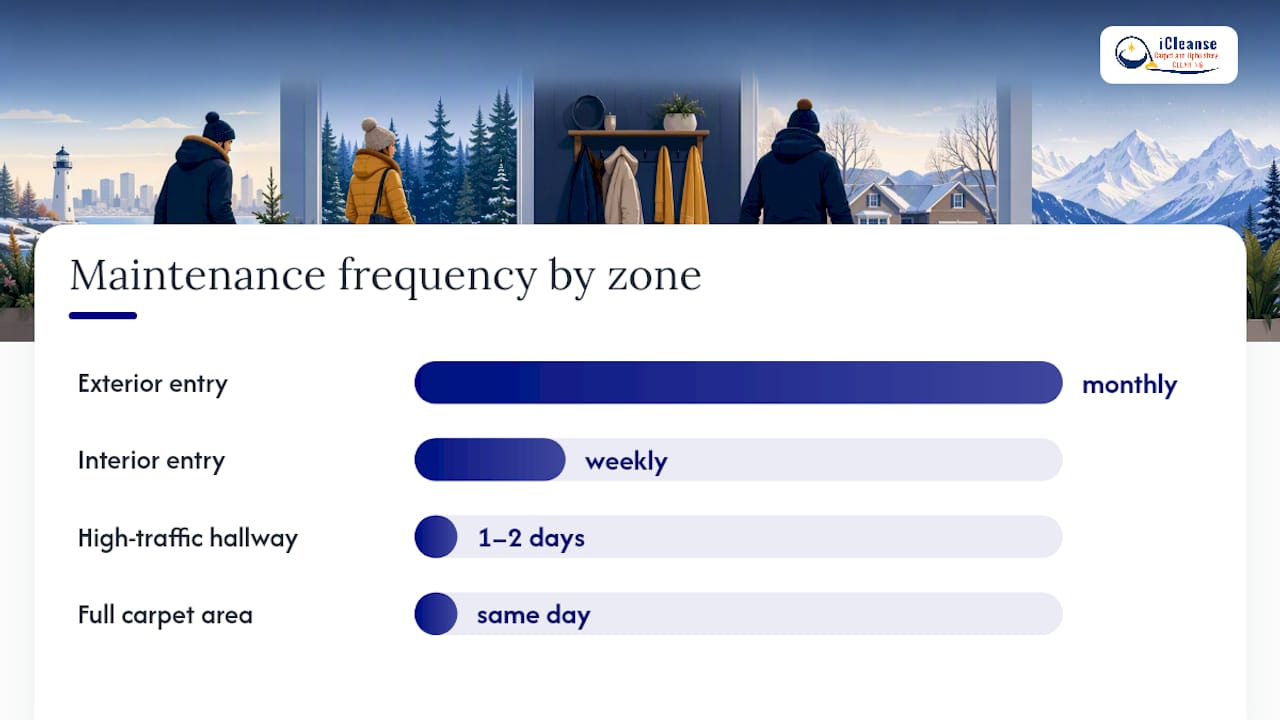
| Zone | Recommended action | Frequency |
|---|---|---|
| Exterior entry | Rubber scraper mat | Replace or clean monthly |
| Interior entry | Absorbent mat plus boot tray | Wash mat weekly |
| High-traffic hallway | Vacuum thoroughly | Every 1–2 days in winter |
| Full carpet area | Spot-treat any visible residue | As needed, same day |
Drying after cleaning: timelines and mould risk
Carpet drying time after salt-stain treatment depends on pile depth, padding thickness, and indoor humidity. A low-pile carpet in a well-ventilated room can dry in two to four hours. A thick-pile carpet with dense padding in a humid Ontario basement can take 12 hours or longer.
- Speed drying safely: Run a fan directly over the cleaned area, open windows if outdoor humidity is low, and use a dehumidifier in basements or poorly ventilated rooms.
- Low-heat dryer use: A hair dryer on the lowest setting can help with small areas. Keep it moving and hold it at least 15 centimetres from the surface to avoid heat damage to synthetic fibres.
- What not to do: Do not place furniture back on a damp carpet — metal or wood feet can transfer rust or tannin stains. Do not close off the room; air circulation is the fastest drying tool you have.
- Signs of trouble: If the carpet still feels damp after 12 hours, or if a musty smell develops within 24–48 hours, moisture has likely reached the padding. Low-moisture cleaning methods can reduce this risk, but once the padding is wet, professional extraction and possibly padding replacement are the only reliable fixes.
- Mould indicators: Visible dark spots at the base of fibres, a persistent earthy smell, or allergy symptoms flaring in the room all suggest mould growth in the backing. At that stage, the carpet needs professional assessment, not another DIY attempt. For guidance on indoor air quality after carpet exposure, the connection between damp backing and airborne allergens is worth understanding before you decide how to proceed.
When should you call a professional carpet cleaner?
Some situations are simply past the point where a spray bottle and a microfibre cloth will do the job.
- Staining covers a large area (more than a few square feet) or runs along an entire hallway or room
- Fibres feel stiff or crunchy after two rounds of DIY cleaning
- The white haze returns within 48 hours of treatment
- There is a persistent odour, visible mould, or the carpet backing feels damp days after cleaning
- The carpet is wool, a natural fibre blend, or an antique or handmade rug — these require pH-controlled cleaning that consumer products rarely deliver safely
- Discolouration remains after cleaning, suggesting dye or fibre damage
What professionals bring to the job is not just stronger equipment. Truck-mounted hot-water extraction operates at temperatures and pressures that consumer machines cannot reach, flushing salt from the full depth of the pile and the upper layer of padding. A professional technician also applies pH-balanced neutralising agents matched to the specific salt compounds present, then conditions fibres and can apply a protective coating before leaving. For high-traffic hallway carpets that take the worst of Ontario's winter, this level of cleaning is often the difference between a carpet that lasts another decade and one that needs replacing.
Pro Tip: Book professional cleaning at the end of winter, not just when a stain appears. A single end-of-season extraction removes accumulated salt, grit, and de-icing residue before it has a full summer to set into fibres.
What I keep seeing on the job
The most common mistake I encounter is the hot-water instinct. A homeowner sees a white crust, grabs a kettle, and pours it on. The stain disappears immediately, which feels like success. Two days later it is back, whiter and larger, because the dissolved salt wicked up from the padding as the carpet dried. By that point, the salt is sitting in the backing, not the pile, and a consumer spot cleaner will not reach it.
The second mistake is waiting. A small salt stain treated the same day takes five minutes and a spray bottle. That same stain left for two weeks may need a professional extractor and still show some residual discolouration. Ontario winters are long, and salt gets tracked in from November through March. The homeowners whose carpets hold up best are the ones who vacuum entry zones every day or two and treat any visible residue the same day it appears. Prevention and speed matter more than the specific product you use.
Professional salt stain removal across the GTA
When DIY methods have reached their limit, Icleansecuc handles what a spray bottle cannot. Using commercial-grade truck-mounted extraction, pH-balanced neutralising solutions, and eco-friendly cleaning agents, the team removes embedded salt from carpet pile and backing, restores fibre softness, and applies protective treatments to slow future penetration.

Icleansecuc serves homeowners, tenants, landlords, and businesses throughout the Greater Toronto Area, covering everything from spot treatment on a single stained patch to full-room extraction after a heavy winter season. Upholstery and car interior cleaning are also available for road salt tracked into vehicle seats and floor mats. Pricing is transparent, and the process is straightforward from first contact to finished job. To see the full range of professional carpet cleaning methods or to get a quote for your space, book your appointment today.
Sources
- How to Clean Winter Salt and Grit Without Ruining Your Floors (Carpet, Rugs and Hardwood) - Vacuum Warehouse
- How to clean salt stains from carpet permanently - Clean Gear Canada
- Remove salt stains carpet: 7 proven winter fix tips - HouseCleaningSF
- Salt damage to carpet | Removal & prevention tips - Hero Carpet Cleaning
Products available at Canadian retailers (Canadian Tire, Home Depot Canada, Walmart Canada):
Always spot-test any cleaning solution on a hidden area before applying it to a visible stain, and follow product directions for dilution and dwell time.