
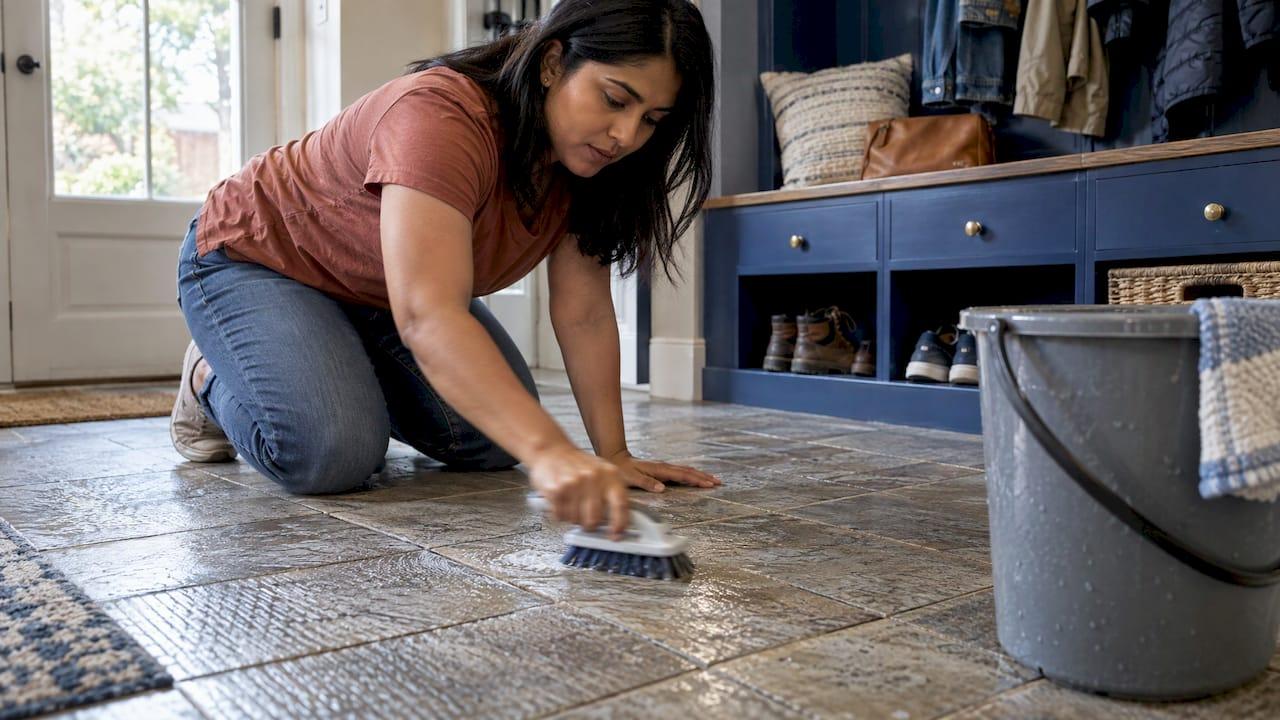
Textured tile is cleaned with a medium-bristle brush, a pH-neutral tile cleaner that is left to dwell for a few minutes, and a thorough rinse. A flat mop alone skims over the ridges, so dirt stays in the grooves. Below is the method tile manufacturers describe, what to keep off your floor, how to handle the grout, and when a professional machine clean makes more sense than another weekend of scrubbing.
TL;DR
- Sweep or vacuum first, then apply a pH-neutral, low-VOC tile cleaner, let it dwell 3 to 5 minutes, agitate with a medium-bristle brush and rinse with clear water.
- Textured and rough tile needs more frequent and more intense cleaning than smooth tile, because grit and mop water settle into the surface.
- Skip ammonia, bleach as a routine cleaner, vinegar, steel wool and wax or oil-based products. They can damage grout, glaze or sealer.
- Grout lines hold the most dirt. Clean them regularly and reseal on the schedule your installer or sealer maker gives.
- For large areas, heavy build-up or a floor you want restored, our tile and grout service starts from published rates of $0.80 to $1.30.
Table of Contents
- Why textured tile holds on to dirt
- What you need before you start
- Step-by-step: cleaning textured ceramic tile
- Which cleaning products are safe for textured tile
- Cleaning the grout between textured tiles
- How to keep textured tile clean longer
- When a professional clean makes sense
- Our approach to textured tile
- Tile and grout cleaning from iCleanse
- Frequently asked questions
- Sources
Why textured tile holds on to dirt
Smooth glazed tile sheds dirt with a wipe. Textured tile, whether it has a slip-resistant finish, a stone-look relief or a hand-formed surface, has tiny valleys where soil, soap residue and mop water collect. MAPEI's care guide for ceramic and porcelain tile states that heavily textured tiles, especially those with a high coefficient of friction, need more frequent and intense cleaning than smooth ones.
That is why the usual advice of "just mop it" fails on these floors. Homeowners describe the same thing: the mop glides over the top, the floor looks grey after it dries, and the grooves stay dark. Two things cause it:
- Dirty mop water. Each pass leaves a thin film of soil that dries in the texture. Marble Systems notes that frequent water changes prevent dirty mop water building up in textured areas of the glaze and grout lines.
- Grout that stands slightly lower than the tile. Grout is porous and sits in a channel, so it collects whatever the mop pushes off the tile.
In Greater Toronto Area homes, the pattern is familiar. Winter salt and sand come in on boots, spread across entryway and kitchen tile, and grind into the surface. Pets, cooking grease and bathroom soap scum do the rest.
What you need before you start
The manufacturers agree on a short kit. You do not need specialty gear for a routine clean:
- A broom or a vacuum with soft wheels or a hard-floor setting.
- A medium-bristle brush for the tile surface. NFM's care guide recommends a medium-bristle brush for textured floors, and a soft nylon brush for grout.
- A microfiber mop or pad, plus two buckets: one for solution, one for rinse water.
- A pH-neutral, low-VOC cleaner made for tile and grout. Daltile recommends a nonhazardous, low-VOC cleaning chemical.
- Clean towels or a wet-dry vacuum to lift rinse water.
Before you open a bottle, check the warranty or the manufacturer's website for your specific tile. There are many types of ceramic tile, and the maker's instructions take priority.
Step-by-step: cleaning textured ceramic tile
1. Remove loose dirt in more than one direction
Sweep or vacuum thoroughly. NFM suggests sweeping textured surfaces in multiple directions, which lifts grit out of ridges that a single pass misses. Do this before wetting the floor so you are not mixing grit into your water. MAPEI also advises sweeping or vacuuming often to remove sand and other abrasives, since grit left on the floor can scratch and wear the surface.
2. Apply the cleaner and let it dwell
Work in sections of a few square metres. Apply your neutral tile cleaner with a mop or sponge and leave it. Daltile's guide says heavily soiled areas may need 3 to 5 minutes of dwell time, depending on the cleaner's directions. Dwell time is what loosens soil from the texture, so do not rush it, and do not let the product dry on the tile.
3. Agitate with the brush
Scrub with the medium-bristle brush in overlapping directions: with the pattern, then across it. Light, even pressure works. The bristles reach into the grooves, which a mop pad cannot do.
4. Rinse with clear water, and change it often
Rinsing matters as much as scrubbing. A cleaner left behind becomes a sticky film that attracts new dirt, and Daltile points out that cleaners which do not require rinsing can leave residue that reduces slip resistance. Rinse with clean water, swap your rinse bucket as soon as it looks cloudy, and wipe or vacuum the area dry to prevent film formation.
5. Check the result in side light
Crouch and look across the floor with a window or lamp at a low angle. Dull patches or a hazy bloom mean cleaner or soil is still in the texture. Repeat the rinse on those spots.

Which cleaning products are safe for textured tile
Most glazed ceramic and porcelain needs very little. Rona's tile care manual says glazed tile can be cleaned with clear water and/or a pH-neutral liquid cleaner, followed by a clear-water rinse and a wipe dry. For heavier soil, step up to a professional-strength tile and grout cleaner that handles grease, soap scum, body oil and mildew stains, and that is low-VOC.
The table sums up what the manufacturers' guides say.
| Product or tool | Fit for textured tile? | What the guides say |
|---|---|---|
| pH-neutral tile cleaner | Yes | Routine cleaning on glazed tile and grout |
| Warm water and a little dish detergent | Yes, for light soil | Rinse well so no film remains |
| Medium-bristle brush | Yes | Reaches into the grooves |
| Microfiber mop | Yes | Follows the surface better than a sponge mop |
| Ammonia | No | May change grout colour and stability |
| Routine bleach | No | Can discolour and weaken grout over time |
| Vinegar and other acids | No | Can discolour and weaken grout, and harm sealer |
| Steel wool or abrasive pads | No | Can scratch tile and leave rust stains in grout |
| Wax or oil-based cleaners | No | Leave residue |
What to keep off the floor
This is the safe-use list, and it is worth reading before you reach for whatever is under the sink.
- Ammonia, bleach and acid. NFM advises against ammonia and cleaners containing bleach or acid on porcelain tile, because they can alter grout colour and stability. It also rules out wax and oil-based cleaners and steel wool.
- Vinegar as a routine cleaner. MAPEI's guidance is to never use acidic solutions such as vinegar for routine maintenance, and MAPEI Canada says regular use of vinegar or bleach can discolour and weaken grout.
- Fluorine compounds. Daltile says chemicals that contain them will damage ceramic, glass and stone.
- Strong alkaline, acidic or abrasive products. Laticrete notes these may damage some tile and grout surfaces and degrade an applied sealer, which lowers its stain repellency.
Occasional disinfecting is a different matter. MAPEI Canada says grout should withstand occasional diluted bleach, about one cup per gallon of clean water, but not as a routine product. Always rinse well afterward and never mix bleach with another cleaner.
The same logic applies to steam. MAPEI Canada says steam cleaning tile and grout is generally safe, but some pre-mixed grouts can be damaged by prolonged high heat, so check your grout manufacturer's recommendation first. For more on matching methods to glaze, our guide to manufacturer-safe ceramic tile cleaning in Canada goes through it in detail.
Cleaning the grout between textured tiles
Grout is where dirt shows first. On textured floors, the contrast between a clean tile face and a dark grout line makes the whole floor look dirty, even right after mopping.
Rona's manual says grout should be cleaned periodically to remove surface build-up. For routine cleaning, a household or commercial tile cleaner is enough. When it needs heavy-duty treatment, a professional-strength product that removes grease, soap scum, body oil, mildew stains and algae from the joints is the right tool.
For a manageable area, this works:
- Wet the grout line with your neutral cleaner and let it dwell 3 to 5 minutes.
- Scrub along the line with a soft nylon brush. MAPEI's guide for tile with non-cement grout lists a soft nylon bristle brush, or a scrubbing machine with white nylon pads.
- Rinse with clean water and dry.
- Repeat monthly. MAPEI's maintenance guide describes regular damp-mopping plus monthly scrubbing to keep floor and grout clean.
A baking-soda-and-water paste on an old toothbrush is a common choice for light grout grime. Keep it gentle and rinse it fully.
If you see black or green spotting in bathroom grout, that is a separate question. Our guide on dealing with grout mould using Canadian health advice explains when a small patch is manageable and when it is not.
Sealing and resealing
Cleaning gets dirt out. Sealing keeps it from going back in. Rona's manual says cementitious grout should be sealed after installation with a penetrating sealer that does not contain silicone, which can shorten the sealer's useful life. Grout can be sealed 72 hours after installation and may need resealing about annually, depending on sealer quality, traffic and your cleaning routine. Our post on a tile and grout maintenance schedule covers how to time it for your home.

How to keep textured tile clean longer
A handful of habits make the next deep clean easier:
- Sweep or vacuum a few times a week. Loose dirt and grit spread across the floor, stick to tile and grout, and scratch the surface when walked on.
- Use doormats inside and outside every entry. MAPEI recommends mats at doorways to catch the abrasive soil that would otherwise reach the floor. In an Ontario winter, this one habit does the most work.
- Dry-clean before wet-cleaning. Portobello's maintenance guide recommends sweeping or vacuuming prior to mopping, then a microfiber mop with a low-VOC cleaner.
- Change mop water often. When the bucket goes cloudy, the floor is getting a dirty film instead of a clean rinse.
- Wipe spills quickly. Grease and coloured liquids are far harder to extract from texture once they dry.
- Do a restoration clean now and then. Some tile care guidance suggests an occasional deeper scrub, perhaps yearly depending on use and traffic, with a soft-bristle deck brush or nylon pad and a pH-neutral cleaner.
When a professional clean makes sense
A brush and a bucket handle regular upkeep. They are slower when the job is large or the soil is old. Daltile's care guide notes that large problem areas and periodic heavy cleaning call for a cylindrical autoscrub machine with a soft to medium bristle brush, with the cleaner left to dwell 5 to 10 minutes. That is machine-based work, and it is the reason a professional visit suits several situations:
- A whole kitchen, mudroom, basement or entry floor with dark grout lines.
- Tile that has gone grey or hazy after years of mopping.
- A rental turnover or move-out where the floor has to look right on a deadline.
- A commercial space where tile needs regular maintenance. Our guide to restaurant tile and grout cleaning for CFIA inspections shows what that routine looks like.
- Floors you want sealed or protected after cleaning, so the next clean is easier.
Our approach to textured tile
We see the same thing in homes across York Region, Durham and the rest of the GTA: the tile is not worn out, the texture is just full. Mopping spreads a thin film across the surface, and the grooves stay loaded with soil that no flat pad reaches.
That is why we clean textured tile as a process, not a wipe. We use commercial-grade equipment and eco-friendly cleaning solutions to work soil out of the surface and the grout lines, then rinse it away. Where a floor would benefit, we can add a protector or sealer so the texture holds on to less next time.
Our pricing is published and clear up front, and if you are unsure which option fits your floor, our team will explain it before the appointment. We also stand behind the work with a satisfaction guarantee and stay in touch after the service. Our goal is that you walk across a floor that looks and feels clean, and know how to keep it that way.
Rob
Tile and grout cleaning from iCleanse
If you would rather hand the grooves to a team with the right equipment, we clean ceramic tile and grout for homes and businesses across the Greater Toronto Area, including Markham, Richmond Hill, Vaughan, Aurora, Whitby, Ajax, Pickering, Mississauga and Toronto. Our published rates on the tile and grout cleaning page are:
- Tile and grout cleaning only: $0.80
- Tile and grout cleaning with protector: $1.00
- Tile and grout cleaning with sealer: $1.30

The protector and sealer options are worth considering on textured tile, since they are designed to help the surface release dirt more easily between cleans. Tell us your floor area and tile type through our quote request page and we will confirm the total for your space before we book.
Frequently asked questions
What is the best cleaner for textured ceramic tile?
A pH-neutral, low-VOC cleaner made for tile and grout is the safest routine choice. Apply it, leave it for 3 to 5 minutes, agitate with a medium-bristle brush and rinse with clear water. Check your tile maker's instructions first, since products differ.
Can I use vinegar or bleach on rough tile?
Not for routine cleaning. MAPEI Canada says regular use of either can discolour and weaken grout, and acids can also degrade sealer. Diluted bleach is acceptable occasionally for disinfecting, then rinse thoroughly. A neutral tile cleaner is the better everyday choice.
Why does my textured tile still look dirty after mopping?
A mop rides over the ridges and leaves dirty water drying in the grooves. Sweep in several directions first, use a brush, and change your rinse water often so you are not spreading soil back across the floor.
How often should textured tile be deep cleaned?
Sweep or vacuum a few times a week, damp-mop regularly and scrub grout about monthly. A deeper restoration clean once a year suits many busy floors. Heavily textured tile may need it more often, because it holds more soil than smooth tile.
Is it safe to steam clean textured tile?
Often, but not always. MAPEI Canada says steam cleaning tile and grout is generally safe, while some pre-mixed grouts can be damaged by prolonged high heat. Check your grout manufacturer's recommendation before using a steam cleaner.
Sources
- Daltile: Ceramic & Porcelain Tile Care & Maintenance
- NFM: Cleaning Glazed Porcelain and Ceramic
- MAPEI UltraCare: How to clean, maintain and care for ceramic and porcelain tile
- MAPEI: Maintenance of tile where non-cement grout was used
- MAPEI Canada: UltraCare Concentrated Tile & Grout Cleaner
- Rona: Tile Care & Maintenance manual
- Marble Systems: Tile Care and Maintenance
- Laticrete: Surface Care Resource Guide