
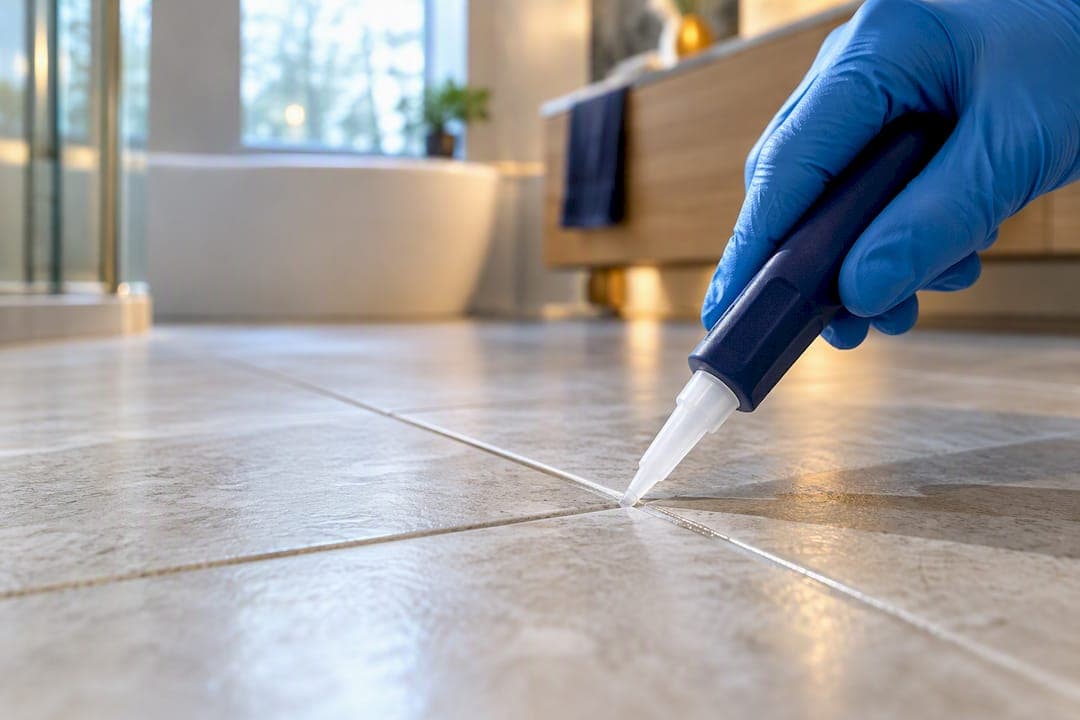
Sweep and damp-mop daily to weekly, deep-clean monthly or quarterly if you have pets or heavy traffic, book a professional clean every 6 to 18 months depending on how hard your floors work, and reseal grout every 1 to 3 years. Sealing is the single move that stretches every other interval further, because a well-sealed joint resists the soil that forces early professional visits. Skip it, and you're cleaning on a much shorter clock, no matter how diligent your weekly routine is.
TL;DR:
- Resealing grout every 1 to 3 years is crucial to prevent early damage, with higher frequency needed in showers and heavy-use areas.
- Daily cleaning should include sweeping or vacuuming and damp-mopping with a pH-neutral cleaner, avoiding acid-based products regularly.
- Deep cleaning via hot-water extraction is recommended monthly for high-traffic or pet areas, but can be quarterly for less-used spaces.
- Signs that grout needs professional attention include persistent darkening, a hazy film, or lingering musty odors after cleaning.
- Professionals typically handle grout repairs and regrouting if it crumbles or stains persist beyond routine cleaning efforts.
Table of Contents
- How often should you clean tile and grout?
- What should you clean daily and weekly?
- When do you need monthly or quarterly deep cleaning?
- How often should you reseal grout?
- Does your tile type change the maintenance schedule?
- What tools and cleaners belong in your cleaning kit?
- When should you call a professional instead of doing it yourself?
- Rob's take: the mistake that ages grout early
- Book a tile and grout clean and sealer visit with Icleansecuc
- Where these recommendations come from
- Sources
- FAQ
How often should you clean tile and grout?
There's no single number that works for every kitchen, bathroom, or hallway. A guest bedroom that sees socked feet twice a week ages nothing like a mudroom that swallows boots, paws, and road salt every day. The right approach sets a baseline by traffic and use, then adjusts.
The table below groups common Greater Toronto Area spaces into six practical categories, each with its own rhythm for routine care, deep cleaning, and resealing.
These bands line up with what floor care providers report seeing across homes with pets or heavy use, which often need service two to four times a year, compared with once-a-year visits for lower-traffic households.
Getting a household onto this rhythm doesn't take much:
- Walk the home and sort each area into one of the six bands above.
- Mark your last professional clean and last reseal date somewhere visible, like a calendar app note.
- Set a recurring reminder at the shorter end of your band's deep-clean window, not the longer end.
- Book the professional clean before grout looks obviously grey, not after.
What should you clean daily and weekly?
Grit is the enemy of grout, and most of the damage happens between cleanings, not during them. Sand, dust, and pet litter act like sandpaper under foot traffic, grinding into grout lines and dulling glaze.
- Every day: sweep or vacuum on a hard-floor setting to lift loose grit before it gets ground in.
- Every day in busy zones: damp-mop with a pH-neutral cleaner, in the pH 6 to 9 range, rinsing the mop head often.
- Every week: run a stiff grout brush along high-traffic or textured tile lines where a flat mop pad can't reach.
- Every week: shake out and rotate entrance mats so they keep trapping grit instead of just hiding it.
Skip vinegar and other acidic cleaners on a routine basis. They're fine for the rare mineral scale spot, but repeated use etches cementitious grout and dulls sealer over time. Dust-mop treatments and floor waxes cause a different problem: they leave a film that traps soil in grout pores rather than lifting it out.
Pro Tip: Match your mop pad to your tile's texture. A smooth microfiber pad glides fine on glazed porcelain, but on textured or matte tile it can leave a hazy film behind. Switch to a slightly coarser pad or a grout brush attachment for anything with texture.
When do you need monthly or quarterly deep cleaning?
Daily mopping lifts surface soil. It doesn't touch what's packed into the grout's pores. That's where a monthly or quarterly deep cycle comes in, and the right frequency depends on how the space gets used.
Homes with pets, young children, or a kitchen that sees daily cooking oil splatter usually need a monthly pass. A lower-traffic bathroom or hallway can often stretch to quarterly. The chemistry shifts too: daily cleaners stay mild, but periodic deep extraction calls for a mildly alkaline cleaner, around pH 10 to 12, strong enough to break down embedded grease and soap film without attacking sealed grout the way acids do.
Hot-water extraction machines, the kind used in professional tile-and-grout service, push heated cleaning solution into the grout under pressure, then vacuum it back out along with the dissolved soil. It's the same principle as carpet extraction, adapted for a hard, porous surface.
Watch for these signs that a deep cycle is overdue:
- Grout still looks dark or dingy immediately after a normal mop.
- Tile surface has a hazy or slightly sticky film even when dry.
- A faint musty odour lingers in bathrooms or kitchens after cleaning.
How often should you reseal grout?
Sealing is the one habit that changes every other number on this schedule. A penetrating sealer fills the microscopic pores in grout that otherwise soak up grease, coffee, and soap scum like a sponge. Once those pores are blocked, soil sits on the surface instead of migrating in, which is exactly why sealed grout needs professional attention far less often than bare grout does.
Most residential grout needs resealing every 1 to 3 years, though the exact timing depends on exposure:
- Showers and hard-water bathrooms: reseal annually; mineral deposits and constant moisture break sealers down faster than anywhere else in the house.
- Heavy-traffic kitchen floors: reseal every 1 to 2 years given daily grease and foot traffic.
- Low-traffic rooms and outdoor-exposed tile: outdoor UV and freeze-thaw cycles also shorten sealer life, even in rooms that see little foot traffic.
Testing whether you're due for a reseal takes thirty seconds: drip a few beads of water onto the grout line and watch. Water that beads up and sits means the sealer's still working. Water that soaks in and darkens the grout within a minute or two means it's time to reapply.
Manufacturer guidance from MAPEI's UltraCare line confirms sealing porous grout and many unglazed tiles is standard practice, and notes that one exception exists: epoxy grout is largely non-porous by design and typically doesn't need sealing at all.
Does your tile type change the maintenance schedule?
Not every floor ages the same way, and the material dictates how much sealing and scrubbing it actually needs.
- Glazed ceramic or porcelain tile: the glaze itself is essentially waterproof, so the tile surface rarely needs sealer. Grout lines between glazed tiles still do.
- Unglazed or polished porcelain: more porous than its glazed cousin, and usually benefits from a penetrating sealer to resist staining.
- Quarry tile and cement-based tile: highly porous by nature, these almost always require sealing, often on a shorter cycle than glazed installations.
- Cement-based grout: the traditional standard, and the type that needs sealing most consistently.
- Epoxy and some pre-mixed grouts: resist staining on their own and often skip the sealer step entirely, per manufacturer specs.
Before switching cleaning chemistry on any of these, check the tile or grout manufacturer's technical data sheet and safety data sheet. What's safe for cement grout can dull a polished porcelain finish, and vice versa.
What tools and cleaners belong in your cleaning kit?
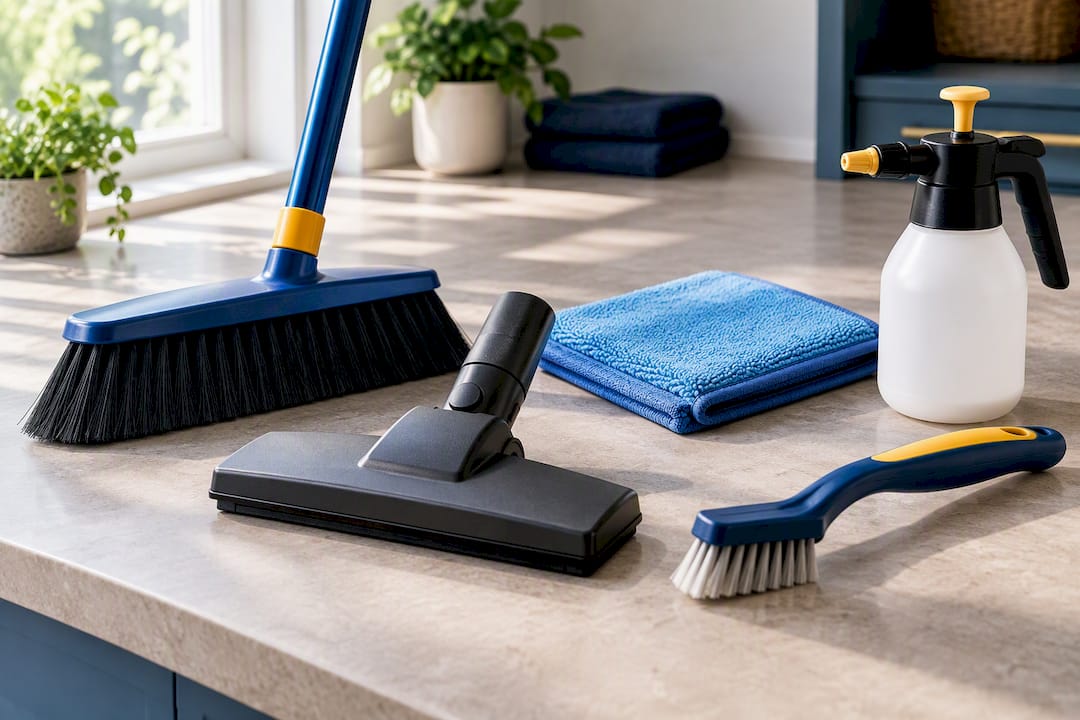
The gear list is short: a broom, a vacuum with a hard-floor setting, a microfiber mop, a stiff grout brush, and a low-volume pump sprayer if you're applying sealer yourself.
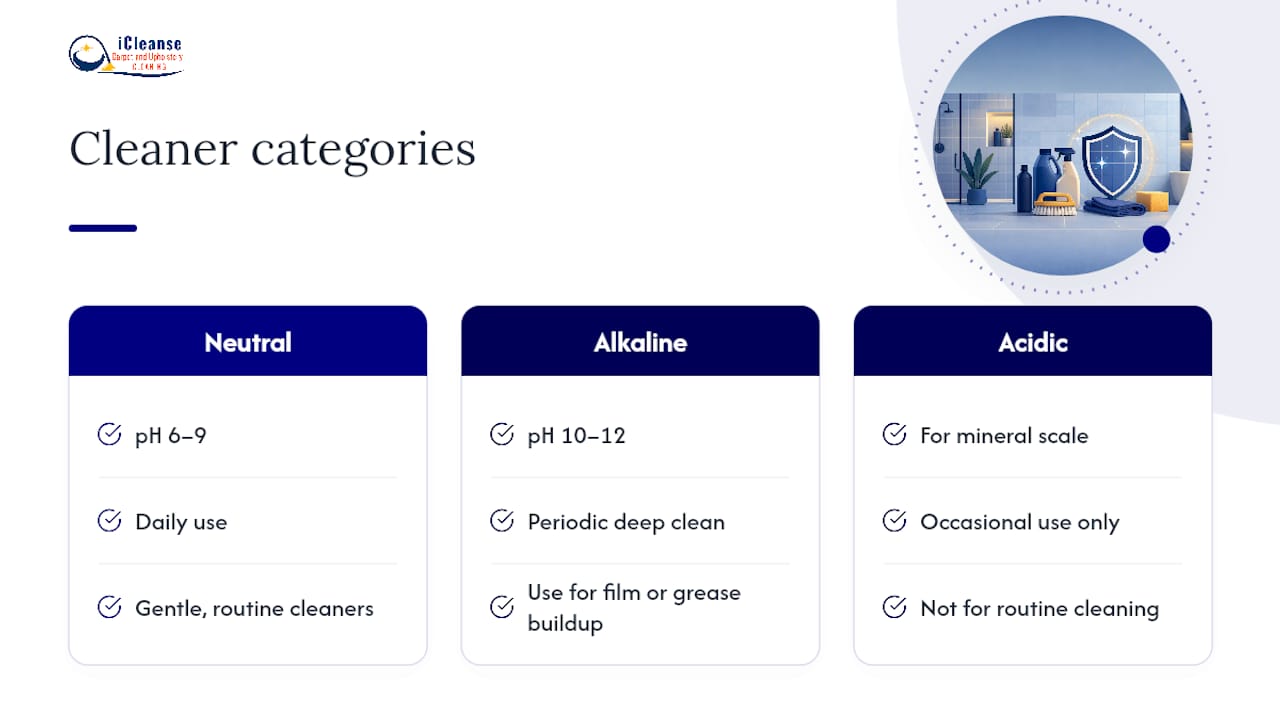
Chemistry matters more than tool count. Keep daily cleaners in the pH 6 to 9 neutral range. Save alkaline cleaners, around pH 10 to 12, for periodic deep extraction when film or grease has actually built up. Acidic cleaners have a narrow, occasional use for mineral scale removal and shouldn't be part of a routine rotation.
Steam cleaners deserve caution. High heat can exceed some grout manufacturers' temperature tolerances, so check the grout maker's guidance before using one rather than assuming steam is automatically gentler than a liquid cleaner.
Pro Tip: A product's TDS (technical data sheet) tells you how to use it correctly; the SDS (safety data sheet) tells you what's in it and how to handle it safely. Read both before trying a new cleaner on grout you've already sealed.
When should you call a professional instead of doing it yourself?
A few clear signs mean it's time to stop scrubbing and start dialing.
- Grout crumbles when you press a fingernail or screwdriver tip into it. Cleaning won't fix eroded grout, and joints recessed more than about 1/16 inch typically need re-grouting, not another cleaning session.
- Staining persists after you've already tried a proper deep clean. Embedded soil that survives extraction is a job for stronger, controlled equipment.
- Mineral scale won't rinse off, especially in shower stalls with hard water buildup.
A typical professional visit involves a sequence of cleaning steps including film removal, grout scrubbing, extraction, rinsing, drying, and sealing. Ask any provider three questions before booking: is the method safe for your specific tile and grout, what sealer are they using and how long is it rated to last, and do they stand behind the work with a guarantee. The described tile and grout service follows that same sequence and maps directly onto the reseal windows above.
Rob's take: the mistake that ages grout early
The most common mistake I see is homeowners treating sealing as optional or "already done at installation" when it's actually the single lever that determines how often everything else needs to happen. Skip resealing, and a 12-month professional clean interval quietly becomes a 6-month one, because unsealed grout absorbs soil the moment it's exposed.
The fix is rarely more scrubbing. It's a better sealer schedule and matching your cleaner's pH to the job, not reaching for whatever's under the sink.
— Rob
Book a tile and grout clean and sealer visit with Icleansecuc
This service provides a direct alternative to piecing together DIY sealer, rental extractors, and guesswork on pH levels: one visit covers the deep clean, hot-water extraction, and reseal in a single appointment, using eco-friendly, manufacturer-safe methods that match the tile and grout notes above.

The Tile And Grout Cleaning + sealer service delivers 1 to 3 years of stain protection depending on the area, at $1.30 per square foot. If you only need the clean without resealing, Tile And Grout Cleaning Only runs $0.80 per square foot, and a version with added protector is available through the tile and grout category page at $1.00 per square foot.
Before you book, have three details ready: your tile and grout type, the approximate date of your last seal application, and any visible staining or crumbling spots you want flagged. That lets the crew plan the right chemistry and sealer for your floor instead of a one-size-fits-all pass. Request a quote to get a scheduled visit on the books.
Where these recommendations come from
- MAPEI UltraCare technical guidance on sealing, cleaner pH, and tile-specific care.
- Opora's grout care playbook for production-level pH and re-grout thresholds.
- Frequency benchmarks from professional cleaning providers cited throughout this schedule.
Sources
- UltraCare how-to ceramic & porcelain tile (MAPEI technical guidance)
- Ceramic and porcelain tile grout care playbook (Opora)
- How Often Should Tile and Grout Be Professionally Cleaned? (Restore-It)
FAQ
How often should you clean grout?
Sweep or vacuum daily, damp-mop weekly to daily with a pH-neutral cleaner, and book a professional deep clean roughly every 6 to 18 months depending on traffic and pets. Homes with heavy foot traffic or pets tend to sit at the shorter end of that range.
When should you clean tile grout beyond routine mopping?
Run a deeper monthly or quarterly cycle once you notice grout staying dark after a normal mop, a hazy film on the tile, or a musty smell that won't go away. Those are signs soil has worked into the grout pores, which a daily mop can't reach.
How often should grout be resealed?
Most residential grout needs resealing every 1 to 3 years, with showers and hard-water bathrooms on the shorter end near 1 year. Icleansecuc's Tile And Grout Cleaning + sealer service is priced at $1.30 per square foot and includes that protective reseal step.
What's the best pH range for daily tile and grout cleaners?
Daily cleaners should sit in the pH 6 to 9 neutral range to avoid damaging sealer or grout over time. Save higher-pH alkaline cleaners, around pH 10 to 12, for occasional deep extraction only.
Does epoxy grout need sealing?
No. Epoxy grout is largely non-porous, so manufacturer guidance confirms it typically skips the sealing step that cement-based grout requires.