
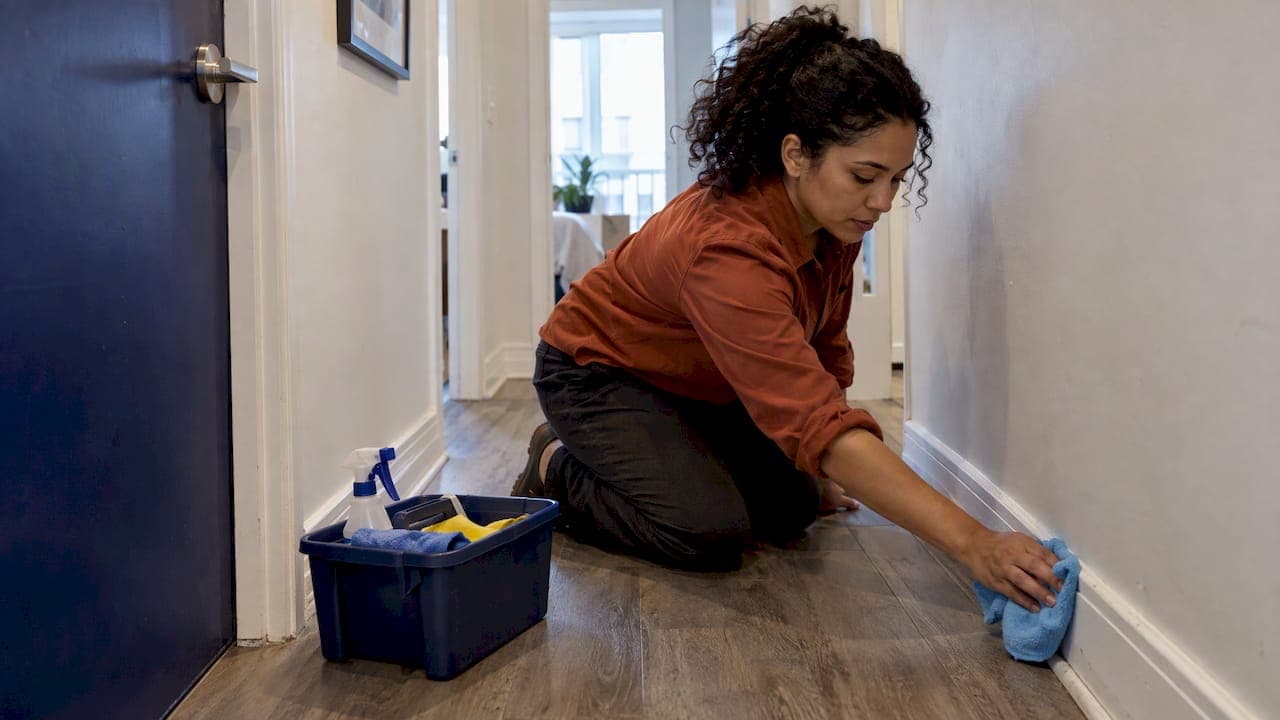
To move out of a Toronto home cleanly, work from the top down and room by room. Start with the kitchen and bathrooms, which landlords check first. Then do bedrooms and living areas, and finish with floors, carpets and the walkthrough. Ontario law asks tenants for "ordinary cleanliness", not a showroom finish. Condos add a few building rules, such as elevator bookings, that can derail moving day if you leave them late. This guide gives you the full checklist, what the law actually requires, and which jobs are worth hiring out.
TL;DR
- Ontario tenants must leave the unit at ordinary cleanliness and pay for damage they caused, but not for normal wear and tear.
- Clean after the last box is out, in this order: kitchen, bathrooms, bedrooms and living areas, then floors and carpets last.
- Condo residents should book the elevator and check the building's rules well before moving day.
- Photograph every room when you finish and compare with your move-in photos.
- Carpets, tile and grout are the jobs most tenants do badly by hand, and the ones a professional can finish in a few hours.
Table of Contents
- What Ontario law expects you to clean
- Before you start: prepare for the move
- The room-by-room move-out cleaning checklist
- Condo move-out: what to add
- Carpets, tile and grout: the jobs that decide the result
- Do-it-yourself or hire help?
- How we handle carpets and tile for a move-out
- Our perspective
- Handing back the keys: the final walkthrough
- If the landlord says it was not clean enough
- More guides for tenants
- FAQ
- Sources
What Ontario law expects you to clean
The legal standard is lower than most people fear. Under section 33 of the Residential Tenancies Act, 2006, a tenant must maintain ordinary cleanliness in the rental unit, unless the tenancy agreement makes the landlord responsible for that cleaning. The Act also requires you to repair or pay for undue damage caused by willful or negligent conduct.
The Landlord and Tenant Board's guide to the Act puts it in plain terms: keep the unit as clean as most people would consider ordinary, and repair or pay for damage caused by you, your guests or another occupant. Normal wear and tear is not on you.
In practice, that means:
- Your job: no garbage, no visible dirt, no grease in the oven, no mould on the shower curtain you left behind, no stains you caused.
- Not your job: faded paint, worn carpet in a walkway, minor scuffs from furniture, or small marks that come with years of living in a place.
Toronto Metropolitan University's moving-out guidance says the same: leave the premises at a reasonable level of cleanliness, with no garbage or visible dirt, and expect to be responsible only for significant damage you caused.
Where the checklist goes beyond the law
Some tasks appear on almost every landlord's or property manager's list even though the Act never names them: cleaning inside the oven and fridge, wiping inside cabinets, washing walls and baseboards, and shampooing carpets. Whether you owe them depends on what "ordinary cleanliness" means in a particular unit, and on your lease. Treat them as the practical standard for getting a clean handover and no argument. They are also what a new tenant or a buyer will expect to find.

If you have any doubt, read your lease and ask the landlord in writing what they expect. Having it on record is useful if a dispute follows.
Before you start: prepare for the move
Cleaning goes faster and cheaper when it is not squeezed into the last hour. A few jobs belong earlier in the timeline.
- Give proper notice. An Ontario tenant ending a 12-month lease or a month-to-month tenancy should give the landlord at least 60 days' notice, and month-to-month notice must be in writing, according to Toronto Metropolitan University's housing office.
- Book the elevator, if you have one. The same guidance tells tenants to book elevators where needed, notify service providers so services move at the right time, and update their mailing address.
- Find your move-in report and photos. You will compare against them at the end.
- Declutter first. Donate, sell or dispose of what you are not taking at least a week before. Cleaning around piles takes twice as long.
- Gather supplies or book help. You need a vacuum with a working hose, microfibre cloths, a degreaser, a bathroom cleaner, a scrub brush, a mop and garbage bags. For carpets and tile, decide now whether you will hire a professional so you can book a slot after the movers leave.
- Plan the order. Cleaning is the last thing you do, after the furniture is out and before you hand back the keys.
The room-by-room move-out cleaning checklist
Work top to bottom in each room so dust and drips fall onto surfaces you have not cleaned yet. A room-by-room format is the most reliable way to keep a long job from slipping, and a room-by-room housekeeping checklist shows how to break recurring cleaning duties into trackable tasks.
Kitchen
The kitchen is where most deductions and disputes start, so give it the most time.
- Empty the fridge and freezer, defrost if needed, and wash shelves, drawers and door seals.
- Remove racks from the oven, soak them, and scrub the oven interior and door glass.
- Degrease the stovetop, drip pans, knobs and range hood. Wash or replace the filter if it is greasy.
- Wipe the microwave inside and out.
- Run an empty dishwasher cycle, then clean the filter and door seal.
- Wipe inside and outside of all cabinets and drawers, including the top edges, and remove shelf liners you added.
- Clean the sink and faucet, polish stainless steel, and scrub the backsplash.
- Wipe counters, then sweep and mop the floor last.
Bathrooms
- Scrub the toilet inside and out, including the base and behind the seat hinges.
- Remove soap scum from the tub, shower walls and glass doors.
- Scrub tile and grout lines. This is where mould and discolouration show up.
- Clean the sink, vanity and inside the drawers.
- Polish mirrors, fixtures and light switches.
- Clear the exhaust fan cover of dust.
- Take down any shower curtain you own, then mop the floor.
Bedrooms
- Remove everything from closets and wipe shelves and rods.
- Dust ceiling corners, ceiling fans, vents and light fixtures.
- Wipe baseboards, window sills, window tracks and door frames.
- Spot-clean marks on walls with a damp cloth. Do not scrub painted walls hard, since you can remove the paint.
- Vacuum carpet thoroughly, including edges and under where the bed stood.
Living and dining areas
- Dust shelves, vents, radiators and baseboards.
- Wash interior windows and wipe the tracks. Remove dead insects and debris from the sills.
- Wipe light switches, outlet covers and door handles.
- Check behind and under where large furniture sat. That is where dust, pet hair and stains hide.
- Vacuum, mop or have carpets cleaned, depending on the flooring.
Hallways, stairs and entry
- Wipe the front door, frame and handle, plus the closet doors.
- Clean the stair treads, risers and spindles if you have a townhouse or house.
- Vacuum or have carpet cleaned along the high-traffic path, where soiling concentrates.
Laundry, utility and storage
- Clean the washer and dryer, including the lint trap and drum, if they belong to the unit.
- Wipe the inside of the laundry sink and cabinets.
- Sweep and mop the floor, then clear anything left in lockers or storage.
Balcony, patio and garage
- Sweep the balcony, wipe the railings and remove plant pots, grills and rings or stains left by them.
- In a house, clear the garage and sweep the driveway or porch.
- Take garbage and recycling to the right place and leave nothing in common areas.
Condo move-out: what to add
A condo adds one layer: the building. The Condominium Authority of Ontario explains that tenants must follow the Condominium Act, the Residential Tenancies Act and the corporation's declaration, by-laws and rules, which can cover elevators, pools, gyms and common areas. The same page notes that the governing documents may limit when and how common elements are used and may require you to register or book them in advance.
For a Toronto condo, add this to your list:
- Book the service elevator and loading dock. Many buildings limit move times and need a deposit or a booking window. Ask the concierge or property manager for the move-out procedure.
- Protect common areas. Hallway walls and elevator pads are the building's responsibility to repair, but damage you cause can be charged back.
- Return fobs, keys and parking passes. Include locker keys and visitor tags.
- Check cleaning rules. Some buildings restrict where you can dispose of cleaning waste or large items. Do not pour cleaning liquids down a shared drain you have not been cleared to use.
- Clean the balcony and the locker. Condo landlords often include both in the walkthrough.
- Mind noise hours. Scrubbing, vacuuming and equipment can fall under the building's quiet hours.
If you are cleaning a condo that is smaller, the work is easier but the finish is closer to inspected. A one-bedroom with a brand-new bathroom shows every streak.
Carpets, tile and grout: the jobs that decide the result
Most tenants can wipe a counter. The jobs that give themselves away are carpets and grout. Dirt packed into carpet fibres does not vacuum out, and grout absorbs grime that surface cleaning only spreads around. Rentals in particular carry years of soil in the main walkway, near the door and in front of the couch.

If you want to understand when to hire and what to ask for, our guides on carpet cleaning for a rental inspection in Ontario and using clean carpet to recover your damage deposit go into detail. If you are not sure whether you need a standard clean or something larger, read deep cleaning vs move-out cleaning.
Timing matters. Book carpet cleaning for after the furniture is out, since the cleaner can then reach the whole floor, and before the final walkthrough, so the carpet has time to dry. Do not walk on damp carpet in street shoes.
Do-it-yourself or hire help?
Doing it yourself is fine for a small unit, especially if you are patient and have a full day. Hiring makes sense when you have a tight window, a large home, pets, children's stains, or you are moving a long way and cannot come back to finish.
| Situation | Likely choice |
|---|---|
| Studio or small one-bedroom, light use | DIY with a hired carpet cleaning if needed |
| Two-bedroom condo with stains in carpet | Hire a carpet cleaner, DIY the rest |
| Family home with stairs and several rooms | Hire for carpets, tile and grout; split the rest |
| Landlord demands professional receipts | Hire a professional and keep the invoice |
| Pets or smoke in the unit | Professional carpet and upholstery cleaning |
Keep every receipt. If a landlord later claims the unit was not clean, an invoice with a date helps show you left it in good order.
How we handle carpets and tile for a move-out
We are iCleanse Carpet & Upholstery Cleaning, based in Richmond Hill, and we serve the Greater Toronto Area with professional carpet, upholstery, tile and grout and move-out cleaning, using commercial-grade equipment and eco-friendly cleaning solutions. For homes, our published residential prices are per area:
| Area | Price |
|---|---|
| Living room | $70 |
| Master bedroom | $70 |
| Regular room | $60 |
| Small hallway | $30 |
| Medium hallway | $60 |
| Large hallway | $80 |
| Set of stairs | $60 |
| Stairs with one landing | $70 |
| Stairs with two landings | $80 |
| Recreation room | $120 |
| Closet | $10 |
See the residential carpet cleaning prices for the current list, or request a quote with your room count and move-out date. We also clean ceramic tile and grout, with options for tile and grout cleaning only, with a protector, or with a sealer.
Our perspective
After years of cleaning carpets in homes across the GTA, we see the same pattern before every move-out. People spend their last day scrubbing the oven and bathroom, which is right, then run out of time for the floors. The carpet gets a quick vacuum, and the stain in front of the couch is still there at handover.
Our advice is to split the job by what takes skill. Wipe-down work is yours and costs only time. Carpet, tile and grout need equipment and the right solution, and a poor attempt can set a stain or leave carpet damp. We would rather book one visit after the movers leave and have the floors dry before the landlord arrives.
We also encourage people to keep the process simple and documented. Take dated photos of each room when you finish, keep the invoice, and compare with your move-in photos. A tenant who can show the unit's condition is in a much stronger position than one who relies on memory.
— Rob
Handing back the keys: the final walkthrough
The last hour decides how the cleaning is judged.
- Do a full lap with the checklist. Check each room against the list with fresh eyes and good light, and open every cupboard and drawer.
- Compare with your move-in report. Walk the unit area by area with the move-in inspection report and photograph what changed, ideally beside the move-in photo of the same spot, as this inspection guide recommends.
- Photograph everything. Capture close-ups of the oven, fridge, bathrooms, carpets and floors, then wide shots of each room. Keep the files with a date.
- Remove all garbage. Nothing should remain in the unit, balcony, locker or common area.
- Return keys and fobs and get written acknowledgement if you can.
- Offer the landlord a walkthrough. Doing it together can settle small questions on the spot.
If the landlord says it was not clean enough
Stay calm and keep to the facts. Do not withhold rent over a maintenance dispute. The LTB's guide notes that landlord and tenant disputes can go to mediation or adjudication at the Board.
A landlord can apply to the Board if a tenant has not repaired damage, and the Board can order the tenant to pay the repair cost. The landlord also carries the burden of showing that the damage went beyond normal wear and tear and came from the tenant's negligence or wilful conduct, as one Ontario landlord guide explains. That is why your photos, receipts and move-in report matter.
If a claim arrives, respond in writing, attach your dated photos and invoices, and separate cleaning from wear and tear. For a legal question about your own case, contact Tribunals Ontario or a community legal clinic.
More guides for tenants
For a broader walkthrough, see our end of lease cleaning checklist for Canadian tenants. If you are cleaning after work on the unit, our guide to post-renovation carpet cleaning covers the dust that regular cleaning misses.
FAQ
Do I have to clean the oven and fridge when I move out of a Toronto rental?
Ontario law requires ordinary cleanliness, and a greasy oven or a fridge with spoiled food is hard to defend as clean. Most landlords expect both to be cleaned, so do it. It takes about an hour for the two.
Do I need professional carpet cleaning to get my deposit back?
The Act does not require professional cleaning by name. Carpet that is visibly soiled can still be a problem, though, and a professional invoice is clear proof you took care. Check your lease for any specific wording.
How far ahead should I tell my landlord I am leaving?
For a 12-month lease or a month-to-month tenancy in Ontario, at least 60 days' notice is the standard, and month-to-month notice must be in writing. Check your own lease and the official guidance before you send it.
Is a condo move-out different from a house or apartment?
The cleaning is the same, but condo rules add elevator bookings, move hours and common area rules. Ask the property manager for the move-out procedure early. Missing a booking can push your move back.
Sources
- Residential Tenancies Act, 2006, Ontario
- LTB Guide to the Residential Tenancies Act
- Moving out of a place, Toronto Metropolitan University Housing
- Leasing a condo, Condominium Authority of Ontario
- Move-in and move-out inspections in Ontario
- Ontario landlord inspection guide