
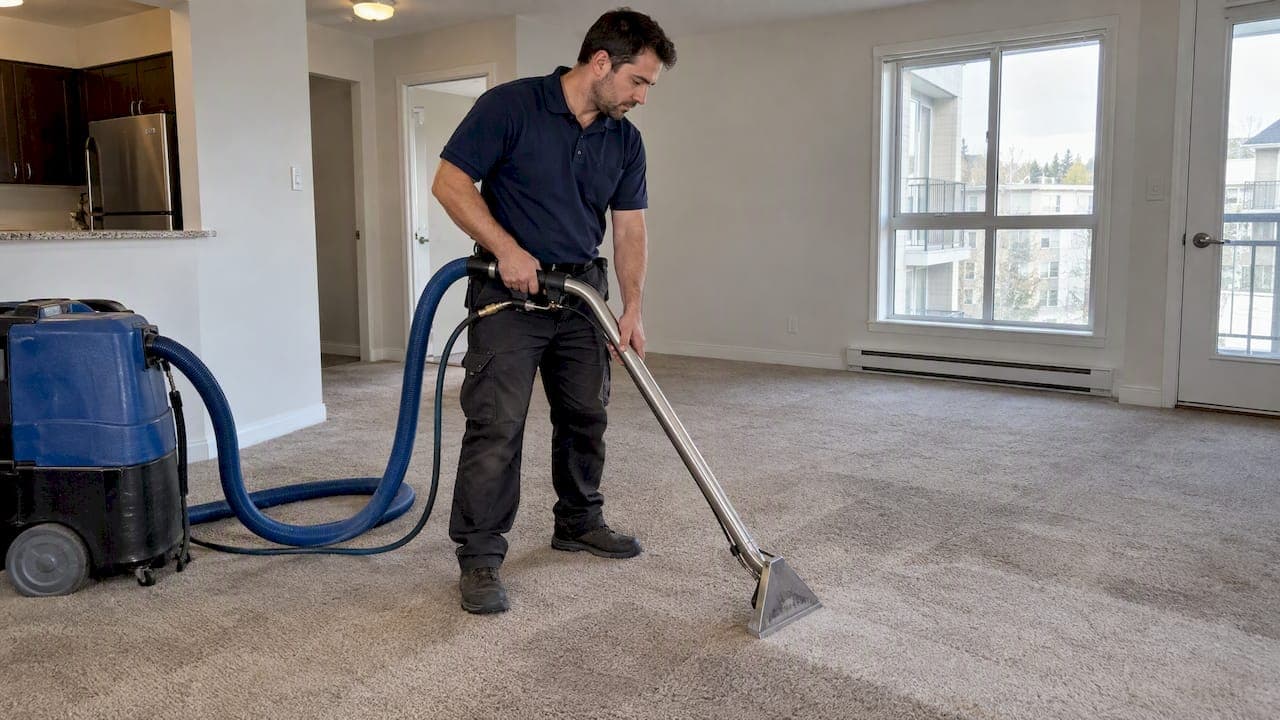
In Ontario, a tenant must leave carpets in a reasonable state of ordinary cleanliness, and a landlord cannot charge for normal wear and tear. Professional carpet cleaning before an inspection is not automatically required by law. It is still the most reliable way to avoid a dispute, because it gives both sides a clean, documented starting point. This guide covers who is responsible for what, how inspections work, what to photograph, how to book cleaning around a move-out, and what it costs with us in the GTA.
TL;DR
- A landlord needs at least 24 hours' written notice to enter for an inspection, and the notice must state the reason and a time between 8 a.m. and 8 p.m.
- Tenants are liable for damage beyond ordinary wear and tear and for failing to keep ordinary cleanliness. Landlords cover normal ageing of the carpet.
- Dated photos or video at move-in and move-out matter more than any cleaning receipt in a dispute.
- Choose a cleaning method that dries the carpet within 24 hours, and ask for a receipt that lists the rooms cleaned and the date.
- Our residential rates are published per room, for example $70 for a living room and $60 for a regular room.
Table of Contents
- What the law says about carpets in a rental
- How rental inspections work in Ontario
- Who should clean, and when
- Document the carpet at move-in and move-out
- Rental carpet cleaner or professional service?
- Method matters: drying time and mould
- What we think about rental carpet cleaning
- What it costs with us
- Book before the inspection
- A short checklist for the week of the inspection
- FAQ
- Sources
What the law says about carpets in a rental
Three ideas carry most Ontario carpet disputes, and all come from the Residential Tenancies Act, 2006 and the Landlord and Tenant Board (LTB).
Landlords maintain. According to the LTB's maintenance and repairs brochure, landlords are responsible for keeping the unit in a good state of repair. That includes carpet repair or replacement because of normal ageing.
Tenants keep it ordinarily clean. The same brochure says tenants must maintain ordinary cleanliness and can be held responsible for repair costs when they fail to, or when they cause damage beyond ordinary wear and tear. A pet urine stain, a burn or a large wine stain left to set is damage. Foot-traffic lanes in a carpet that has been down for years are not.
Untidy is not the same as evictable. The LTB notes that a landlord cannot evict a tenant simply for an untidy unit. Cleanliness only becomes grounds for action when it interferes with others' reasonable enjoyment or creates health and safety hazards such as pests or fire risk.
What the law does not say is that every tenant must hire professionals when they leave. Some leases include a "professional cleaning required" clause. Whether such a clause can be enforced is a legal question. If you are a tenant facing a charge you think is unfair, speak to a community legal clinic or the LTB before you pay. If you are a landlord, check your lease wording and your facts with a paralegal or lawyer before you deduct or claim anything.

The deposit question
Ontario has no general damage deposit. Landlords can collect a last month's rent deposit, which is meant to be applied to the final month, not to cleaning costs. So a landlord who thinks the carpet is damaged usually has to claim the cost through the LTB rather than simply keep money. That is why evidence matters so much, and why both parties benefit from a clean, documented unit. Our article on cleaning carpet to recover your damage deposit goes into the tenant side of this.
How rental inspections work in Ontario
An inspection is a legal entry, so it follows entry rules. Under the Residential Tenancies Act, a landlord may enter to inspect whether the unit is in a good state of repair or meets maintenance standards. The landlord must give at least 24 hours' written notice that states the reason for entry and a time between 8 a.m. and 8 p.m. Plain-language summaries such as this one on landlord entry repeat the same points: written notice, a stated reason and the 8 a.m. to 8 p.m. window, with emergencies such as fire or flood as the exception.
Two practical consequences for carpets:
- A 24-hour notice is not enough time to schedule most cleaning. If you want carpets cleaned before an inspection, book as soon as you receive the notice, or better, clean on a regular schedule so you are never rushing.
- Carpets need time to dry. Damp carpet at an inspection looks worse and can smell. More importantly, slow drying is a real mould risk. Health Canada's indoor air quality guidance says that when carpets are professionally cleaned, moisture should be kept low with high-efficiency extraction and the area dried within 24 hours, ideally with extra ventilation. It is written for office buildings, but the principle holds in any home.
Who should clean, and when
If you are a tenant
Clean before the final walkthrough, not weeks before. Furniture comes out, the unit is empty, and the carpet gets one clean pass that matches the condition you will be photographing. If you have a stain you cannot lift, tell the cleaner before they start. A good technician will say honestly what is likely to come out and what is not. A permanent stain that is documented as pre-existing, or as normal wear, protects you better than a rushed DIY attempt that spreads it.
If you are a landlord
Clean between tenancies, even when the previous tenant cleaned. A professional turnover clean gives you a baseline for the next move-in inspection. Landlords who skip this step often find themselves arguing about a stain nobody can date. Keep the invoice with the photographs.
You can also choose to clean during a long tenancy. As a landlord, you are responsible for ageing and wear, so an occasional professional clean after several years is a maintenance decision, not a charge to pass on.
If you manage several units
Standardise. Same checklist, same photos, same cleaning schedule. Property managers describe professional move-out inspections as a way to record the unit's condition formally so repair costs are clearly identified and attributable when damage exists. Carpet cleaning fits naturally right after that inspection, once you know which rooms actually need work.

Document the carpet at move-in and move-out
The LTB guidance on maintenance makes clear that who pays depends on what changed during the tenancy. You cannot prove what changed without a before and an after. A simple process:
- Walk the unit on the first day. Photograph or film every carpeted room, hallway and stair set in daylight, with the date visible or in the file's metadata.
- Close-ups of any existing stains, burns or worn patches. Add a wide shot so the location is clear.
- Both parties sign or acknowledge the condition report. A short written list is enough. Email it to each other so there is a timestamp.
- Repeat at move-out, after cleaning and with the unit empty, from the same angles.
- Keep the cleaning receipt. It should show the date, the address and the areas cleaned.
The Reddit-style horror story, such as a cat urine charge of $1,500 weeks after move-out with no move-in report, comes down to the missing first step. With no baseline, both sides are guessing, and a tribunal has little to go on.
Rental carpet cleaner or professional service?
Many tenants consider renting a consumer machine from a grocery or hardware store. It looks cheap, but there are trade-offs that matter in a rental:
| Factor | Rented consumer machine | Professional service |
|---|---|---|
| Water extraction | Limited suction, carpet often stays wet longer | High-efficiency extraction, shorter drying times |
| Drying risk | Higher, especially in basements and condos with low airflow | Lower when paired with air movement |
| Stain and odour treatment | Basic detergents | Treatments matched to the stain and fibre |
| Your time | Half a day of heavy work, plus returning the machine | A booked appointment |
| Proof for a landlord or LTB | Your own word | A dated receipt for the work |
A rental machine can be fine for a lightly used bedroom. For a whole unit, pet areas or a stubborn stain, the extraction and drying difference is the point. Our guide on professional carpet cleaning versus rental machines covers it in more detail.
Method matters: drying time and mould
Because the inspection is often soon after cleaning, drying time is a practical concern. Over-wetting is the main way carpet cleaning goes wrong. Ask any provider:
- Which method will you use, and how long should the carpet take to dry?
- Will you use air movers or ventilation advice for a basement or windowless room?
- What should I do in the first 24 hours?
We explain the options in our pages on carpet cleaning methods, truck-mounted cleaning and the dry carpet cleaning process. Our aftercare notes on drying carpets within 24 hours to prevent mould are worth reading before an appointment, particularly for basements in Durham and York Region homes.
What we think about rental carpet cleaning
We clean a lot of carpet at the end of tenancies, and the same pattern repeats. The disputes are rarely about dirt. They are about uncertainty: nobody knows what the carpet looked like on day one, nobody wrote down who was responsible for what, and the cleaning was done in a hurry the night before the walkthrough.
Our advice is simple. Photograph first. Clean once, at the right time, when the unit is empty. Ask your cleaner to be honest about which stains will come out. And choose a method that dries quickly, because a damp carpet at a handover helps no one. We are clear on pricing before we start, and we stand behind the work with a satisfaction guarantee and follow-up after the appointment. That follow-up is where we answer drying questions or retreat a spot that came back.
If you are a landlord with several units, tell us which rooms are in play. A turnover that needs only a living room and a hallway should not be priced like a whole-house job.
— Rob
What it costs with us
Our residential carpet cleaning is priced per room, as published on our residential cleaning page:
| Area | Price |
|---|---|
| Living room | $70 |
| Master bedroom | $70 |
| Regular room | $60 |
| Recreation room | $120 |
| Small hallway | $30 |
| Medium hallway | $60 |
| Large hallway | $80 |
| Set of stairs | $60 |
| Stairs plus 1 landing | $70 |
| Stairs plus 2 landings | $80 |
| Closet | $10 |
A worked example. For a small two-bedroom rental with a living room, a master bedroom, one regular room and a small hallway, the published prices add up to $70 + $70 + $60 + $30 = $230. A landlord turning over the same unit with a set of stairs would add $60.
Area rugs have their own rates on our area rug cleaning page, starting at $0.75 for synthetic and seagrass/jute rugs and reaching $1.50 for wool, oriental and cotton rugs. If your unit has ceramic tile and grout that also needs attention before handover, see our tile and grout cleaning options. For offices and other commercial units, rates are on the commercial cleaning page.
A caution on comparing quotes: flat "whole unit" prices and per-room prices are not the same product. Ask what is included, which rooms count, and whether stain treatment and deodorizing are extra.
Book before the inspection
We serve Toronto, Mississauga, Markham, Richmond Hill, Vaughan, Aurora, King City, Whitchurch-Stouffville, Pickering, Ajax and Whitby. If you have an inspection or a move-out date, request a quote with the address, the rooms and the date, and tell us about any stains or pet areas. We will confirm the price up front, and we use eco-friendly solutions and commercial-grade equipment. For a broader checklist, our end of lease cleaning checklist covers the rest of the unit.
A short checklist for the week of the inspection
- Confirm the notice is in writing, names a reason and gives a time between 8 a.m. and 8 p.m.
- Pull your move-in photos and any condition report.
- Identify each carpeted room, hallway, stair set and closet.
- Mark stains and say what caused them, if you know.
- Book cleaning at least a day ahead so the carpet dries before anyone walks through.
- Open windows or run fans in basements for the first 24 hours.
- Keep the receipt and take dated after-photos.
FAQ
How often can a landlord inspect a rental in Ontario?
The Residential Tenancies Act does not set a fixed number of inspections. It sets conditions for each entry: written notice at least 24 hours ahead, a stated reason and a time between 8 a.m. and 8 p.m. An inspection must relate to the state of repair or maintenance of the unit, so repeated unexplained visits are a problem you can raise with the LTB.
Do landlords have to professionally clean carpets between tenants?
The law does not spell out a professional clean between tenancies. The landlord is responsible for maintaining the unit and its carpets in good repair, so many landlords clean at turnover to give the next tenant a clean start and to create a baseline for later disputes. If you are unsure of your duties, ask a paralegal or lawyer.
Can my landlord charge me for carpet cleaning when I move out?
Not for normal wear and tear. Tenants can be liable for damage beyond that, or for failing to keep ordinary cleanliness, according to the LTB's guidance. If you receive a charge you think is unfair, gather your move-in and move-out photos and contact a community legal clinic or the LTB.
Are rental carpet cleaners sanitary?
They can clean adequately, but a consumer machine often leaves more moisture in the carpet. Health Canada's guidance stresses drying within 24 hours to avoid mould and microbial growth, which is easier to achieve with professional extraction and airflow. For pet areas, basements or a whole unit, a professional service is the safer choice.
Sources
- Residential Tenancies Act, 2006, ontario.ca
- LTB brochure: Maintenance and Repairs
- Health Canada: Guidance on improving indoor air quality in office buildings
- Ontario Tenant Rights When Moving Out, Upmove
- Landlord Entry Rules in Ontario, GottaRent
- Property Management, Dean Gibbons