
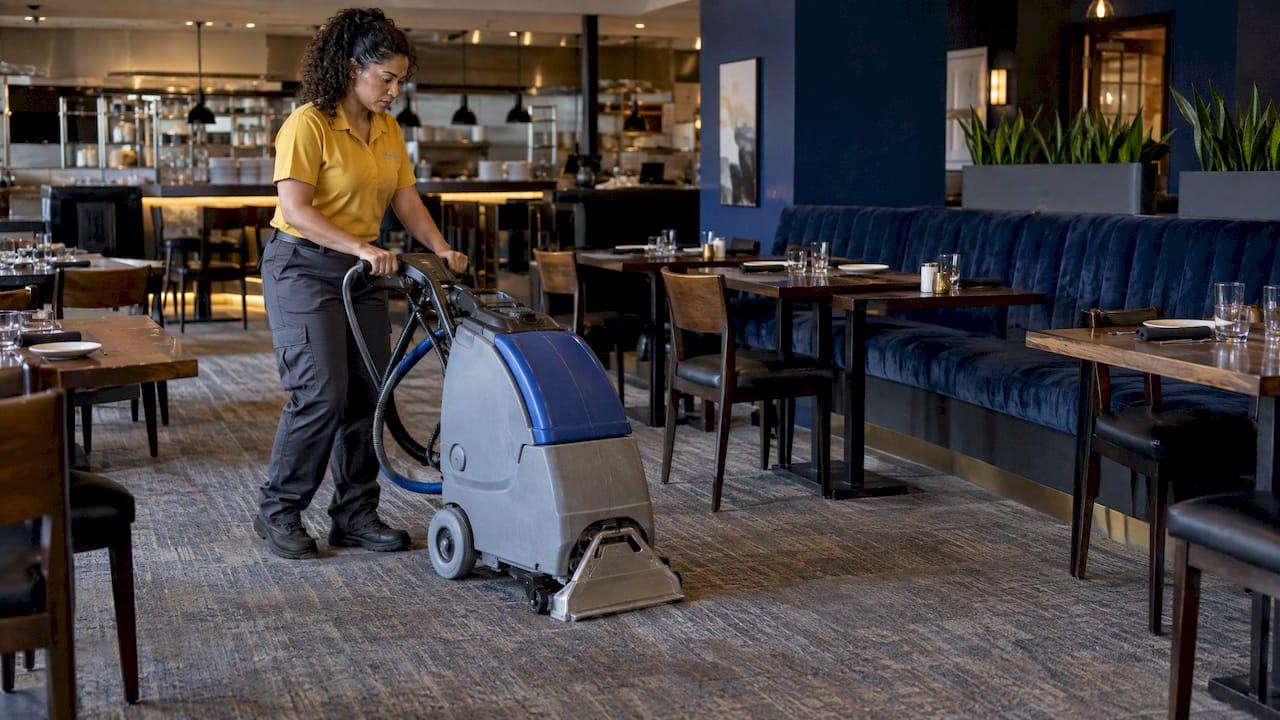
A restaurant carpet takes more punishment than almost any other in a commercial building: grease, sugar, wine, coffee, and hundreds of pivoting shoes a night. The way to keep it looking right is a scheduled deep clean by a professional team with commercial-grade equipment, planned around your service hours, with your staff handling daily vacuuming and fast spotting in between. That is how we approach restaurant dining rooms, lounges and banquet halls across York Region, Durham Region and the wider GTA, and the rest of this guide explains the reasoning so you can plan it properly.
TL;DR
- Carpet near food service is treated as a high-traffic area: vacuum it daily and spot-clean spills quickly, then book deep cleaning on a fixed cycle rather than when stains show.
- Industry guidance for heavy-traffic carpet is deep cleaning 2 to 6 times a year, with interim cleaning more often; severe-traffic areas can need more.
- In Ontario, carpet is allowed in areas where food is served only if it is kept clean and sanitary, so the cleaning schedule is also a compliance habit.
- Schedule cleaning after close, use air movers and ventilation, and keep guests off damp carpet until it is completely dry.
- Our published commercial rates are $0.50 for heavy traffic areas and $0.30 for light traffic areas; a quote confirms the total for your floor plan.
Table of Contents
- Why restaurant carpet is a different job
- What Ontario expects of carpet in a food premises
- Three levels of cleaning, and what each does
- How often a restaurant should clean its carpet
- What your staff should do between visits
- Planning around service: drying time and guest safety
- Cleaning solutions in food-service areas
- What restaurant carpet cleaning costs in the GTA
- A sample plan for a 100-seat dining room
- Book a cleaning that fits your service hours
- FAQ
- Sources
Why restaurant carpet is a different job
An office carpet collects dry soil. A restaurant carpet collects dry soil plus oils, sugars and liquids that bind to the fibre and then attract more dirt. Grease and sticky residue make a carpet look dark in walkways long before the rest of the room looks tired, and they hold odours that guests notice the moment they sit down.
The Carpet and Rug Institute (CRI), the industry body that writes the commercial maintenance standard, states in CRI 204 that areas next to food service are high-traffic, frequent-pivot zones that should be vacuumed and maintained daily or even more often. Pivoting matters: feet turning at a table or a server station grind soil into the pile far faster than straight walking does.
For an owner of a high-end dining room, the carpet is part of the guest's first impression. For a multi-location operator in the GTA corridor, it is a recurring cost that is much easier to control when it is scheduled than when it is reactive.
What Ontario expects of carpet in a food premises
Ontario's Food Premises regulation (R.R.O. 1990, Reg. 562) generally requires floors in food-handling areas to be tight, smooth and non-absorbent. It makes an allowance for carpeting in areas where food is served, on the condition that the carpeting is maintained in a clean and sanitary condition. In other words, your dining room carpet is permitted, and keeping it clean is what keeps it permitted.
The province's 2019 Food Premises Reference Document adds useful context. It explains that rooms where food is served must be kept free of accumulated dust, debris, grease and residues, and that illness-causing bacteria can survive on many surfaces and spread by cross-contamination. It also notes that pathogens such as norovirus may persist on environmental surfaces for up to two weeks. A documented cleaning routine is the simplest way to show your public health inspector that the dining room is under control.
This guide is not a substitute for your local public health unit's requirements. If you are unsure how your specific layout is classified, ask the health unit that inspects your premises.

Three levels of cleaning, and what each does
CRI 204 describes three levels of commercial carpet care. Knowing them makes it easier to read a proposal and to plan a budget.
| Level | What it is | Who usually does it |
|---|---|---|
| Routine | Daily vacuuming and timely spot and spill cleaning | Your staff |
| Interim maintenance | Low-moisture appearance cleaning that lifts surface soil between deep cleans | Professional team |
| Deep cleaning | Extraction that removes accumulated soil from within the pile | Professional team |
Interim cleaning
Interim cleaning uses very little water, so the room is back in use quickly. According to ISSA, the cleaning industry association, encapsulation products suit this appearance-cleaning level, with the soil removed by vacuuming once the carpet has dried, usually the next day. For a restaurant, that rhythm fits well: clean after close, vacuum before the next service.
Deep cleaning by hot water extraction
Deep cleaning removes what vacuuming cannot reach. ISSA lists four basic cleaning principles: chemistry, heat, agitation and time. Hot solution improves cleaning, agitation works it into the pile, and a thorough rinse flushes out soil and detergent during extraction. Airmovers then speed up drying.
For restaurants, ISSA also notes that enzyme preconditioners are an excellent choice for extremely soiled carpeting such as restaurant carpet, and that d-limonene boosters help with heavier oily soils. These are the products and methods that make the difference on a carpet that has taken months of grease and beverage spills. You can read more about how the methods compare on our carpet cleaning methods page.
We use commercial-grade equipment and eco-friendly cleaning solutions on carpets across the GTA, which matters in a room where guests eat and where you want no lingering chemical smell.
How often a restaurant should clean its carpet
The honest answer is: by traffic level, not by the calendar on the wall. CRI 204 recommends deep cleaning before soil is easily visible. Its frequency table suggests, for heavy-traffic carpet, deep cleaning 2 to 6 times a year, interim cleaning 6 to 12 times a year, and daily vacuuming. For severe traffic, deep cleaning ranges from 2 to 26 times a year, with weekly interim cleaning in soil-prone areas.
A flooring manufacturer's hospitality care guide (Tarkett Hospitality) offers a more concrete schedule. It suggests daily vacuuming and spot removal at every traffic level, interim cleaning every 2 months for moderate traffic, every month for heavy traffic and every 15 days for extra heavy traffic, and deep cleaning every 6, 4 or 3 months for moderate, heavy and extra heavy traffic.
A practical way to apply this to a restaurant:
- Entrance, host stand, bar approach, server stations and the path to the kitchen: treat as heavy or extra heavy. Interim cleaning monthly or more often, deep cleaning every three to four months.
- Main dining floor: heavy. Interim cleaning every month or two, deep cleaning every four months.
- Private rooms, lounge corners, low-use banquet space: moderate. Deep cleaning twice a year may be enough.
We go deeper on frequency for Canadian facilities in our guide to annual to monthly commercial carpet cleaning, and on why regular cleaning slows replacement in how frequent cleaning prevents carpet replacement. Replacing a dining room carpet is a far larger expense than a cleaning plan, and CRI 204 notes that following its maintenance guidance, including using CRI Seal of Approval certified providers, equipment and solutions, can extend the carpet's life and help preserve applicable warranties. If your carpet is under warranty, check its care requirements first and share them with us when you book.
What your staff should do between visits
Professional cleaning works best on a carpet that has been looked after daily. Two habits do most of the work.
Vacuum every day. Dry soil acts like sandpaper on fibres and is the main reason walkways go dull. Do it before opening, and again after service in the busiest zones.
Treat spills quickly. CRI 204 says routine spot and spill cleaning is normally done by building staff, and that the longer a spot sits, the greater the chance of permanent staining and the more soil residue it attracts. It recommends that staff be informed about timely spotting with proper products and procedures. Brief your team once: blot, never rub; note the location of any wine, oil or sauce spill so the professional crew can focus there at the next visit.
Keeping a simple log of larger spills and the date they occurred takes a minute and gives your cleaning team useful information when they arrive. If you manage several locations, our office carpet cleaning checklist is a good model for a daily and weekly routine you can adapt to a dining room.
Planning around service: drying time and guest safety
The question every owner asks is how long the room will be out of action. Drying time depends on the method, the carpet's construction, the humidity in the room and the airflow. Interim low-moisture cleaning dries quickly. Deep extraction takes longer, which is why it is best scheduled after close or on your quietest day.
CRI 204 sets out the safe approach during deep cleaning:
- Supply natural or mechanical ventilation during cleaning and drying.
- Use commercial air movers, your HVAC system or dehumidifiers, which greatly reduce drying time.
- Limit access to damp carpet until it is completely dry, to avoid slips and falls and re-soiling.
- Place wet-floor signs strategically.
The same logic applies wherever floors need protecting from traffic and moisture; for a broader look at protecting floors from heavy rolling or foot traffic, see these floor protection options.
For a reliable result, ask for the cleaning to be booked for the end of the night, plan for the carpet to be fully dry before the first guests or deliveries arrive, and keep your staff off the damp area. In Ontario's climate, particularly in humid summer months, drying matters beyond comfort. We explain the 24-hour window in our article on drying carpets after cleaning to prevent mould.
Cleaning solutions in food-service areas
Guests and staff share this room, so what goes on the carpet matters. Our cleaning solutions are eco-friendly, and a thorough rinse is part of proper extraction. Deodorizing products used on carpet in food-service areas should be registered for that use in Canada. As an example of what such registration looks like, one commercially available disinfectant and deodorizer carries a Health Canada DIN (02415046), and its product data sheet lists carpet deodorizing and food-service areas among its uses. Ask for the product names being used in your dining room, and keep the safety data sheets with your inspection records.
What restaurant carpet cleaning costs in the GTA

Commercial carpet is usually priced by area, and the figure depends on traffic level, the amount of grease and staining, the carpet type, the size of the space, and the access and timing (after-hours work, stairs, furniture to move). Pricing in a restaurant also reflects how often you book: a regular programme is easier to plan and keep consistent than occasional rescue cleans.
Our published commercial rates are:
| Service | Published rate |
|---|---|
| Carpet cleaning, heavy traffic area | $0.50 |
| Carpet cleaning, light traffic area | $0.30 |
| Tile and grout cleaning only | $0.80 |
| Tile and grout cleaning with protector | $1.00 |
| Tile and grout cleaning with sealer | $1.30 |
Most restaurants combine carpet in the dining room with tile and grout in entrances, washrooms and bar areas, so it helps to price both at once. Our commercial carpet cleaning rates and tile and grout options are listed on our site. Because the final total depends on your floor area and how much is heavy traffic, we confirm it by quote before any work starts.
A sample plan for a 100-seat dining room
To make this concrete, here is how an owner might structure a year, using the ranges above as a starting point rather than a fixed rule:
- Daily: vacuum the entire carpet; blot spills as they happen.
- Monthly: interim cleaning of the entrance, host stand, bar approach and server pathways, scheduled after close.
- Every three to four months: deep cleaning of the full dining floor, with the heavy-traffic zones priced at the heavy traffic rate and quieter corners at the light traffic rate.
- Before a holiday season or a large event: a deep clean timed so the carpet is completely dry well ahead of the busy period.
In practice, splitting the floor into heavy and light zones is how you keep the cost sensible. There is little reason to treat a rarely used private room the same way as the path between the kitchen and the main floor.
Our view: treat the carpet as part of the guest experience
We clean carpets, upholstery and tile throughout York Region, Durham Region and the wider GTA, and we have a simple position on restaurants: the owners who spend least over time are the ones who schedule. A carpet cleaned before the soil shows is easier to restore, lasts longer, and never becomes the thing a guest remembers.
That is why we focus on clear upfront pricing, responsive support and ongoing care after the service. Our eco-friendly solutions and commercial-grade equipment are built to remove deep-set dirt, stains, odours and allergens, and our satisfaction guarantee stands behind the work. We also like to explain what we are doing and why, because an owner who understands the cycle makes better decisions for the room.
If you run several locations or want a recurring programme, tell us your traffic zones and service hours, and we will build the visits around your business rather than the other way around.
Rob
Book a cleaning that fits your service hours
If your dining room is due for a deep clean, or you want a regular programme across one or more locations, we can price it by traffic zone and schedule it after close. Our rates for heavy and light traffic carpet are published on our site, and a quote confirms your total.
Send us your floor area and service hours through our quote request page, and we will come back with a plan and a price.
FAQ
How often should a restaurant carpet be professionally cleaned?
It depends on traffic. For heavy-traffic carpet, CRI 204 suggests deep cleaning 2 to 6 times a year and interim cleaning 6 to 12 times a year, with daily vacuuming. Entrances and server pathways usually sit at the busier end of that range.
How long does a restaurant carpet take to dry?
Low-moisture interim cleaning dries quickly, while deep extraction takes longer. Air movers, ventilation and dehumidifiers greatly shorten drying time. Schedule the work after close and keep guests and staff off the carpet until it is completely dry.
Is carpet allowed in an Ontario restaurant dining room?
Yes. Ontario's Food Premises regulation allows carpeting in areas where food is served, provided it is maintained in a clean and sanitary condition. A regular cleaning schedule is how you meet that condition.
How much does commercial carpet cleaning cost?
Our published commercial rates are $0.50 for heavy traffic areas and $0.30 for light traffic areas. The total depends on the size of the floor, the traffic zones and the level of soiling, and we confirm it with a quote.
Sources
- CRI 204 Commercial Carpet Standard for Maintenance and Cleaning
- Smart Carpet Care, ISSA
- R.R.O. 1990, Reg. 562 Food Premises, ontario.ca
- Food Premises Reference Document, 2019, Ontario Ministry of Health
- Hospitality carpet care and spot cleaning information, Tarkett Hospitality
- Decon 30 product data sheet, Health Canada DIN 02415046
- Floor protection options