
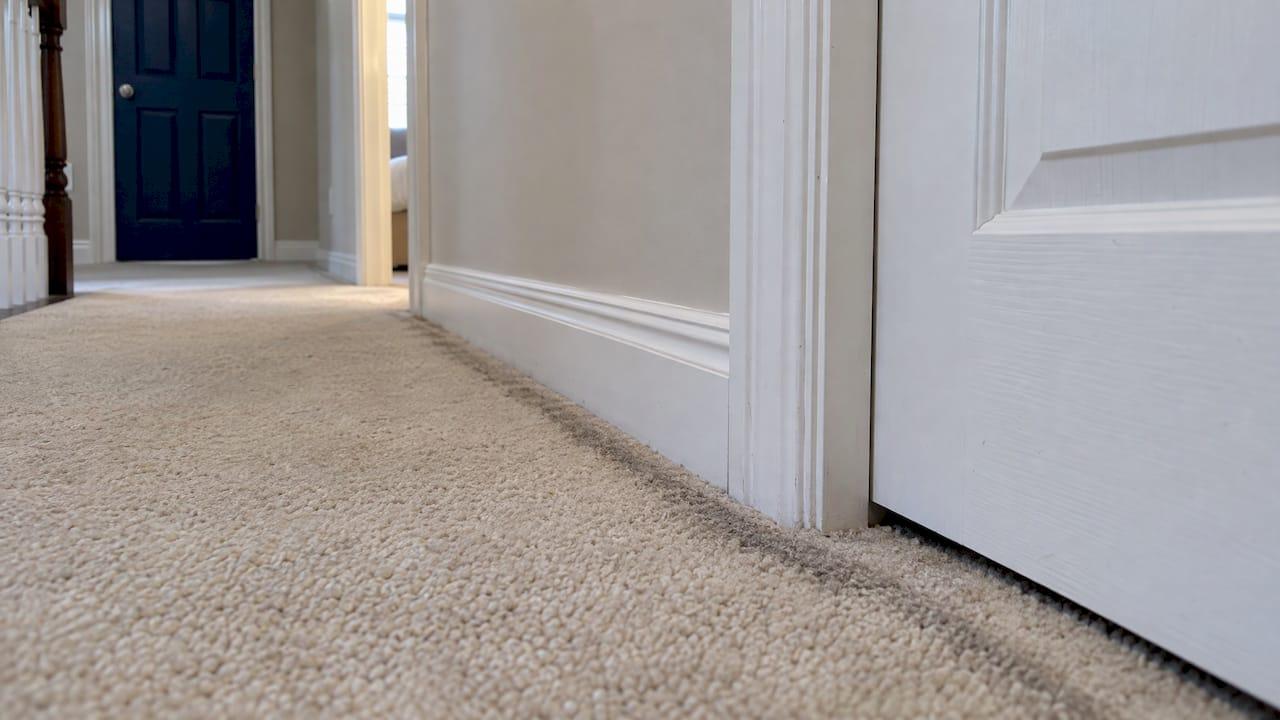
Those dark grey lines along your baseboards, under doors and at the edge of the stairs are filtration lines, and they are not a sign that your carpet is defective or that your home is dirty. They are fine airborne soil that air has pushed through and deposited on the carpet fibres. Prevention starts with airflow, but removal is a professional job: the Carpet and Rug Institute (CRI), the North American industry body for carpet, says these soils call for aggressive chemical solutions and a carpet-cleaning professional. If the lines in your home are already visible, our team at iCleanse cleans carpet across York Region, Durham Region and the wider GTA.
TL;DR
- Filtration lines are airborne soil trapped in carpet where air moves: along baseboards, under doors, at stair edges and near vents.
- The usual cause is air leaving a room through small gaps, often linked to a ventilation system that is out of balance.
- Slow them down by sealing gaps, replacing HVAC filters on schedule, keeping interior doors open while the system runs and using a high-efficiency vacuum bag.
- Removal is not a quick fix: no single technique works in every case, so a professional assessment saves time and fibre damage.
- In larger homes and commercial spaces, the lines return unless the airflow and the maintenance routine are addressed together.
Table of Contents
- What filtration lines are
- What causes them in a Canadian home
- Why the usual home remedies disappoint
- How to slow the lines down
- When commercial spaces need a different approach
- When to have the lines assessed
- What professional cleaning costs for the areas where lines appear
- Our view on filtration lines
- Book the cleaning that fits your home
- Keeping carpet clean longer after the visit
- FAQ
- Sources
What filtration lines are
Filtration soiling is the technical name. The CRI describes it as dark or grayish accumulations of airborne soil on carpet fibres in areas of concentrated airflow. It is a documented, well-known condition, not a manufacturing flaw in most cases.
Think of the carpet as a coarse filter. Air carries very fine particles: smoke and cooking residue, candle soot, dust from outdoors, pet dander, the fine particles that come from the heating system. When that air squeezes through a narrow gap and passes over the pile, the carpet catches some of what the air carries. Over time the catch becomes a visible line.
Where you will see them
The CRI lists the typical spots: around baseboards, under doors, along the edges of stairs and at joints in the subfloor. In a typical Ontario house that translates into a few predictable places:
- along the wall edge of bedrooms and hallways
- in the gap at the bottom of a closed bedroom door
- along the stair edge where the carpet meets the stringer or wall
- near cold-air returns and supply vents
- along the line where the carpet meets a tack strip or a change in subfloor
If your lines trace a pattern that follows the framing of the house, that is the airflow telling you where it escapes.
How fast they form
The CRI notes that lines can develop quickly or over months or years, depending on how much air moves and how many pollutants are in it. A home with a busy kitchen, a fireplace, a lot of candle use or recent renovation dust will usually show lines sooner than a quiet one. Light-coloured carpet shows them first, which is why owners of cream and ivory broadloom in newer luxury builds often notice them within the first couple of seasons.
What causes them in a Canadian home
The cause is air moving where it should not, carrying soil with it. The CRI links the condition to an improperly balanced ventilation system, where excess air looks for an exit through gaps along walls and stairways. Its maintenance bulletin adds that filtration soiling can be associated with systems that bring more air into a room than they remove.
In practical terms, this is what we see discussed most for GTA homes:
- Forced-air heating that runs a lot. Ontario winters mean long furnace cycles. More air movement means more chances to deposit soil at every gap.
- Closed bedroom doors. Supply air enters the room, but with the door shut and no return, the air leaves under the door and across the carpet at the threshold.
- Gaps behind baseboards and at stair edges. These are the escape routes, and they are where the line forms.
- Airborne pollutants indoors. The more soot, smoke, dust and fine particles in the air, the darker the line.
- Old or overdue HVAC filters. A filter that is not doing its job lets more particles pass through the system and into the rooms.
Notice that none of these has to do with how often you vacuum the middle of the floor. A spotless-looking carpet can still have a dark outline.
Why the usual home remedies disappoint
Search results for this topic are full of forum threads from people who tried a crevice tool, a spray, a scrub brush or a cleaner and got uneven results. That is consistent with what the CRI says: no single cleaning technique may work in every filtration-soiling situation, and complete removal can be complicated by the type of contaminant. Oily kitchen soot and dry dust bind to fibres differently.
That is why we suggest you do not start by trying products on the line itself. Rubbing at an edge with a brush can fray the pile, and a product that works on one carpet can leave a halo or a stiff patch on another. The CRI advises contacting a carpet-cleaning professional for filtration soils, and that is also the quickest way to know what you are dealing with before anything touches the fibre.
Vacuuming still matters, but as maintenance. Use it to keep loose dust off the edges, not to try to lift a line that has already bonded to the fibres.

How to slow the lines down
Cleaning removes the line. Prevention stops it from coming back as quickly. The CRI's filtration soiling bulletin recommends a short list that suits Ontario homes well:
| Action | What it does | Where it applies |
|---|---|---|
| Seal cracks in subfloors and gaps under baseboards and stair edges | Removes the narrow exit paths where air is forced across the carpet | Wall edges, stair edges, subfloor joints |
| Reduce indoor pollutants | Gives the air less soil to deposit | Kitchens, fireplaces, candle use, renovation areas |
| Replace high-efficiency HVAC filters regularly | Keeps more fine particles out of the air stream | Furnace and air handler |
| Use high-efficiency vacuum bags | Keeps captured dust from blowing back into the room | Weekly vacuuming |
| Leave interior doors open while the HVAC runs | Lets air circulate back instead of squeezing under the door | Bedrooms, offices, closets |
A few notes for homeowners:
- Doors. If you prefer closed bedroom doors for privacy or sound, the line under the door is the price of a pressure imbalance. Opening doors during HVAC operation is the CRI's suggested fix.
- Filters. Follow the filter manufacturer's schedule and replace on that schedule, not when the filter looks dirty.
- Sealing. Sealing gaps is a carpentry and building-envelope job. If the lines keep coming back in the same spot, ask your HVAC contractor to check how well the system is balanced.
When commercial spaces need a different approach
Offices, clinics, showrooms and rental properties tend to run HVAC all day and sometimes have no choice about closed doors. For commercial carpet, the CRI's CRI 204 maintenance standard sets out what a programme should contain: indoor and outdoor walk-off mats, vacuuming schedules, spot-removal protocols, and planned deep and interim cleaning.

The point for a facility manager is that filtration lines are a scheduled-maintenance issue, not a one-off event. If you manage a building in Markham, Vaughan or Whitby, our guide to commercial carpet cleaning frequency for Canadian facilities walks through how to set the interval, and the office carpet cleaning checklist turns it into a routine. For the business case, see why regular carpet cleaning matters for businesses.
When to have the lines assessed
A professional visit makes sense in these situations:
- The lines are dark enough that they show from standing height, not just when you kneel.
- You have already tried a household product and the line looks lighter in places and darker in others.
- The lines are on stairs, where wear and soil sit together and a wrong move shows quickly.
- The carpet is light-coloured, wool or a wool blend, or a high-value installation you want to protect.
- You are preparing a home for sale, a lease handover or a move-out and need an even finish.
- The lines return within weeks of cleaning, which points to airflow rather than the carpet.
The assessment is also the time to ask what you can change in the house. A good technician reads the pattern: a line only at the bottom of one door tells a different story from a line around the whole perimeter of a room.
What professional cleaning costs for the areas where lines appear
Because filtration lines gather at the edges of rooms, hallways and stairs, most of our residential work for this problem is priced by the area, and the prices are published. These are our rates as listed on the residential cleaning page:
| Area | Price |
|---|---|
| Small hallway | $30 |
| Medium hallway | $60 |
| Large hallway | $80 |
| Regular room | $60 |
| Master bedroom | $70 |
| Living room | $70 |
| Set of stairs | $60 |
| Set of stairs + 1 landing | $70 |
| Set of stairs + 2 landings | $80 |
| Recreation room | $120 |
| Closet | $10 |
Commercial carpet is priced per unit of area: $0.50 for heavy-traffic areas and $0.30 for light-traffic areas, on the commercial cleaning page. Area rugs are priced by fibre, from $0.75 for synthetic and seagrass or jute to $1.50 for wool, oriental and cotton, on the area rug page.
So a typical house with a medium hallway, a set of stairs with one landing and three bedrooms is easy to price before anyone arrives. Repeat customers and owners of larger homes in North and East York Region and Durham can combine areas in one visit rather than book room by room.
Our view on filtration lines
Most homeowners who call us about filtration lines are worried they have damaged the carpet or that the installer did something wrong. Usually neither is true. The carpet did what carpet does: it caught fine soil from moving air.
What matters to us is that the owner understands the reason. If the line sits at the bottom of a door, we tell them about the door. If it follows the stair edge, we tell them about the gap. Understanding the cause is what makes a clean carpet stay clean for longer.
We clean with professional equipment and eco-friendly solutions, and we publish our prices up front so you know the cost before the visit. Our team handles carpet, stairs, hallways, rugs and tile and grout, so one booking can bring the whole home back to the same standard rather than leaving one clean room beside a tired one.
For clients with high-end carpet, we would rather talk through the carpet and the soil before the work starts than surprise you afterwards. That is part of the care we give before and after the visit.
Rob
Book the cleaning that fits your home
If the lines are already there, the fastest route is a booked professional clean of the affected areas. We work throughout Markham, Richmond Hill, Vaughan, Whitchurch-Stouffville, Aurora, King City, Ajax, Whitby, Pickering, Mississauga and Toronto, and we stand behind our work with a satisfaction guarantee.

Pick the areas on our residential cleaning page or request a quote and tell us where the lines are. If you want to understand how the cleaning itself works first, our page on carpet cleaning methods explains the options.
Keeping carpet clean longer after the visit
Once the lines are gone, a short routine keeps them from returning quickly:
- Replace the furnace filter on its schedule and write the date on the filter frame.
- Vacuum the edges weekly with a high-efficiency bag, paying attention to the stair edges and door thresholds.
- Open interior doors while the system runs, at least on the coldest days of winter.
- Cut back on indoor soot sources where you can, such as candles near carpeted rooms.
- Book regular professional cleaning rather than waiting until the line is dark. Frequent cleaning is also one of the better ways to avoid early carpet replacement, and it helps with allergens in GTA homes.
If you want a sense of what else builds up in a carpet besides edge lines, our guide to examples of embedded carpet dirt shows the common types, and the piece on indoor air quality and carpet covers the air side of the story.
FAQ
Are filtration lines a carpet defect?
No. The CRI describes filtration soiling as airborne soil deposited on carpet fibres where air concentrates, and it is not necessarily a defect in the carpet. The root cause is usually how air moves through the house, so the carpet shows what the ventilation is doing.
Can I vacuum filtration lines away?
Vacuuming helps keep loose dust off the edges, but it will not lift soil that has already bonded to the fibres. The CRI says these soils need aggressive chemical solutions and recommends a carpet-cleaning professional. A professional clean of the affected edges is the reliable route.
Will the lines come back after cleaning?
They can, if the airflow that caused them has not changed. Sealing gaps, replacing HVAC filters on schedule, opening interior doors while the system runs and using a high-efficiency vacuum bag all reduce the rate. Regular cleaning keeps lines from building to a dark, hard-to-remove stage.
Where should I look first if I see dark lines in my home?
Check the bottom of closed doors, the edges along baseboards, stair edges and the area near vents. These are the places the CRI lists as typical, and they show where air is escaping. Note which spots are darkest before you call, since the pattern helps us plan the clean.
Sources
- Filtration Soiling Technical Bulletin, Carpet and Rug Institute
- Carpet Maintenance and Troubleshooting Technical Bulletin, Carpet and Rug Institute
- CRI 204 Commercial Carpet Standard for Maintenance, Carpet and Rug Institute