
A musty carpet smell means moisture is trapped somewhere in the carpet, the underpad or the floor beneath it. The odour is the signal. The cause is damp. If the carpet was wet for less than 48 hours and is now dry, a thorough professional cleaning and good airflow usually clear the smell. If it has stayed wet longer, or the smell keeps coming back, you are dealing with mould, and the carpet may need to go.
This guide shows how to tell which situation you are in, what you can safely do today, and when to call a cleaning team or a moisture specialist. It is written for Ontario homes, where damp basements, humid summers and long heating seasons all play a part.
TL;DR
- A musty or mildew odour is a sign of moisture, and possibly mould. Finding and fixing the moisture matters more than masking the smell.
- Mould can start growing in damp areas within 48 hours, so dry wet carpet fast.
- Carpet that has been wet for more than 48 hours should generally be thrown away because it likely contains mould.
- For a dry carpet with only a stale odour, baking soda, HEPA vacuuming, airflow and a professional deep clean are the sensible steps.
- Keep indoor humidity between 30% and 50% to stop the smell returning.
Table of Contents
- Why carpet smells musty or like mildew
- Does a musty smell mean mould?
- Wet for less than 48 hours, or more?
- How to remove a musty smell from dry carpet
- How long does the smell take to go away?
- Stay safe while you deal with it
- When to call a professional
- Perspective: what we see in Toronto-area homes
- Keep the smell from coming back
- Professional carpet cleaning across the GTA
- FAQ
- Sources
Why carpet smells musty or like mildew
Carpet is a sponge with a pile on top. Fibres, backing and especially the underpad can hold water long after the surface feels dry. Once organic dust and skin cells in the carpet get damp, mould and mildew take hold, and the earthy, stale odour you notice comes from what they release. The US EPA explains that microbial volatile organic compounds can be the source of musty odours linked with mould growth.
The moisture itself usually comes from one of a few places:
- A spill, leak or flood that was not fully dried. A washing machine hose, a dishwasher line, a plumbing leak or a sump pump failure can all soak the underpad where you cannot see it.
- A damp basement. CMHC notes that basement moisture sources include high water tables, poor exterior grading, and unvented or leaking appliances. It also indicates that a damp, heated basement can produce far more moisture than all other household sources combined.
- Summer condensation. The Gouvernement du Québec explains that in summer, humidity can result from warm, moist air condensing on cooler basement surfaces. Carpet on a concrete slab sits right in that zone.
- Slow drying after a cleaning. Any wet method leaves moisture behind. If the room is closed up, humid or poorly ventilated, the carpet and pad stay damp longer than they should. Our guide to drying carpets within 24 hours after cleaning covers the airflow steps in detail.
Why it is worse in basements
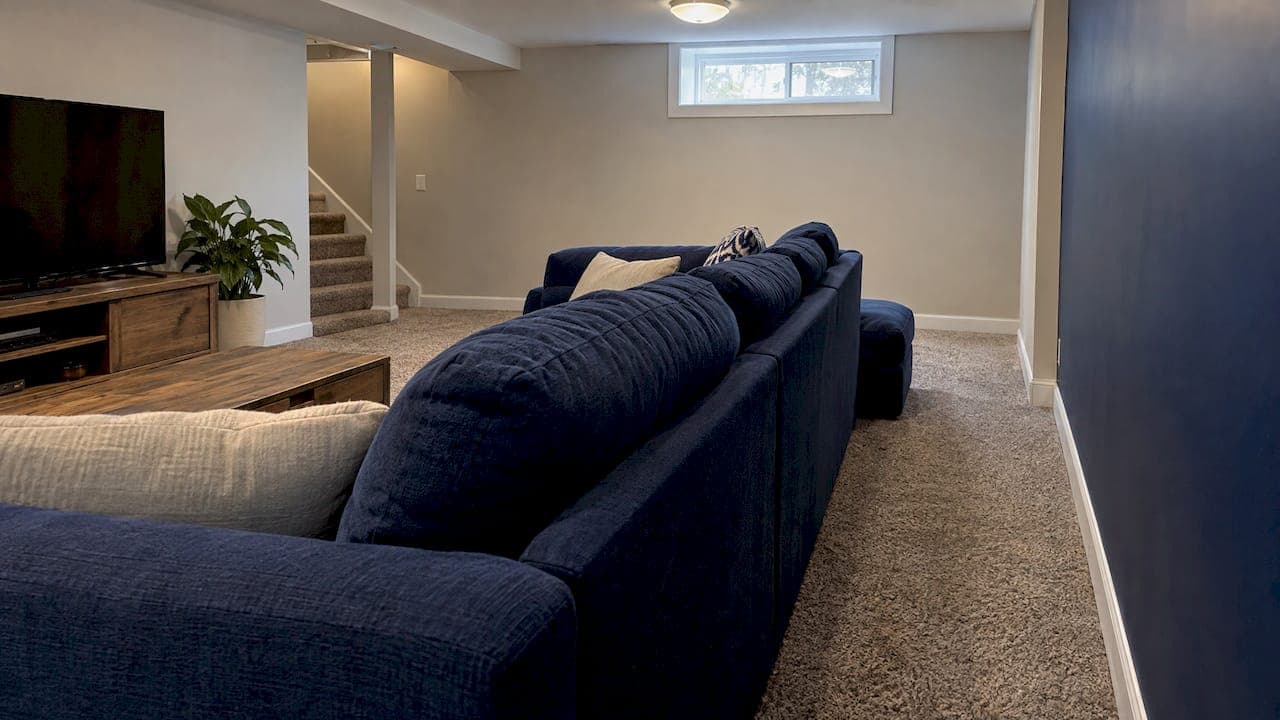
Basement carpet is the usual suspect behind searches for a musty basement smell. The slab is cool, the air is still, and humidity rises in July and August just as families spend more time downstairs. Add a finished rec room with a sofa pushed against an exterior wall, and you have little airflow behind the furniture, which is where the smell tends to start.
Does a musty smell mean mould?
Not always, but treat it as a prompt to check. Health Canada says a musty, earthy odour can be a sign of mould, and it advises looking for stains or discolouration on floors, walls, window panes, fabrics and carpets.
Here is a practical walk-through, based on Health Canada's advice to inspect the home, including basements, crawl spaces and storage areas, when you suspect a moisture problem:
- Find where the smell is strongest. Get down low and sniff along walls, corners and under furniture. A smell concentrated in one patch points to a local leak or spill. A smell across the whole room points to humidity.
- Look at the edges. Lift a corner of the carpet along the tack strip if you can do so easily. Dark spots, discolouration or a damp underside are red flags.
- Check the neighbours. Look at the baseboards, the bottom of the drywall, the window sills and any storage boxes on the floor.
- Follow the water. Look at the laundry area, the water heater, the sump pump, the foundation wall and any nearby plumbing for drips or stains.
- Check the air system. If the odour is strongest near a vent or return, checking air ducts for mould is a sensible next step alongside inspecting the floor.
You do not need to identify the species. Health Canada notes that identifying the specific mould is unnecessary: the priority is finding and fixing the moisture problem causing the growth.
Wet for less than 48 hours, or more?
This is the decision that matters most, and it comes straight from Canadian housing guidance.
| Situation | What to do |
|---|---|
| Carpet got wet and was dried within about 48 hours, no visible mould | Dry it fully, then have it professionally cleaned. See our water damage cleanup guide. |
| Carpet is dry but has a stale, musty odour, no stains | Try baking soda and HEPA vacuuming, improve airflow, then book a deep clean. |
| Carpet stayed wet for more than 48 hours | Plan to remove and replace it. CMHC says such carpet likely contains mould. |
| Visible mould, staining on the pad or wall, or a smell that returns after cleaning | Fix the moisture source first. Mouldy carpet is typically difficult to fully clean and should be removed and discarded. |
That is not a sales pitch for or against cleaning. It is the order of operations: the moisture problem comes first, the carpet second.
How to remove a musty smell from dry carpet
If the carpet is not damp and you see no mould, CMHC's resource guide says you may try sprinkling baking soda overnight and vacuuming well with a HEPA or externally exhausted vacuum. If the odour persists, the same guide says the carpet must be discarded.
A safe sequence looks like this:
- Open the space up. Run the bathroom and kitchen exhaust fans, open windows on dry days and keep the air moving. Health Canada recommends using exhaust fans and air conditioning to reduce indoor moisture.
- Bring humidity down. Health Canada recommends a relative humidity of 30% to 50%, with a dehumidifier as needed. An inexpensive hygrometer tells you where you stand.
- Apply baking soda. Sprinkle it evenly and leave it overnight.
- Vacuum thoroughly with a HEPA filter, or one that exhausts outdoors, so you do not blow fine particles back into the room.
- Book a professional clean if a smell lingers on a carpet that is dry and shows no mould. Deep cleaning lifts the soil, residue and odour sources that sit deep in the pile.
- Dry it fast. Fans, dehumidifier and open air, starting immediately.
What to skip
Bleach is not the answer. CMHC advises that bleach and fungicides are not recommended for cleaning mould, because the procedure involves removing the source. The California Department of Public Health also does not recommend bleach, noting it can be a respiratory hazard and that disinfection is unnecessary after thorough cleaning with soap. Perfumed sprays and plug-in fresheners only cover the odour while the damp continues.
How long does the smell take to go away?
It depends on whether the moisture is gone. When a dry, clean carpet had only surface odour, it often improves within a day or two of cleaning, airflow and dehumidifying. When the smell is tied to a damp pad or hidden mould, no amount of time will fix it. If the odour fades but comes back in humid weather, the carpet is still picking up moisture from somewhere, and the cause needs finding. In practice, a smell that is still present a few days after the carpet is completely dry and cleaned is the point to stop repeating treatments and look at the pad, the subfloor and the room's humidity.

Stay safe while you deal with it
If you suspect mould, protect yourself and the rest of the house. The California Department of Public Health advises that during remediation, unprotected people should avoid exposure and containment is needed so spores do not spread. For you that means:
- Keep children, older adults and anyone with asthma or allergies out of the area while you work. If someone in your home has breathing problems, speak to your doctor or pharmacist before you start.
- Close the door to the room and avoid dry sweeping or shaking the carpet.
- Bag removed carpet and pad in the room before carrying them out.
- If the affected area is large, or the water came from a sewage backup, call a restoration specialist rather than handling it yourself.
When to call a professional
The right professional depends on what you find.
Call a cleaning team when the carpet is dry, you see no mould and the smell is stale: after a spill that was dried promptly, after pets, after a long closed-up winter, or a basement rec room that has gone stuffy. A professional clean removes what a household vacuum cannot reach.
Call a restoration or plumbing specialist when you find an active leak, a damp wall, standing water, a sump failure or mould growth. Cleaning the carpet on top of an active moisture source only buys a few weeks.
Call a flooring installer when the carpet has to be removed. If the underpad is wet or mouldy, replacing carpet without drying the slab only restarts the cycle.

If you are not sure which category you are in, describe the problem to us with a few photos and we will tell you honestly whether cleaning is the right next step.
Perspective: what we see in Toronto-area homes
Most musty carpet calls we get are not mysteries. The carpet has been damp, or the room has, and nobody connected the smell to the moisture.
Our approach is to treat the cause and the carpet together. We use professional equipment and eco-friendly cleaning solutions, and we explain clearly what we find: whether a deep clean will do the job, how to dry the room afterwards, and what to change so the smell does not return. We believe an educated customer has a healthier home, so we would rather you understand your basement humidity than rebook us every spring.
A professional clean is the right move for dry carpet with a stale odour, for carpet that has been dried promptly after a spill, and for the regular upkeep that keeps soil and allergens from building up in the pile. Clear upfront pricing, a satisfaction guarantee and follow-up care after the visit are how we back that up.
Rob
Keep the smell from coming back
Prevention is mostly humidity control and airflow.
- Hold humidity at 30% to 50%. Run a dehumidifier in the basement through summer, and empty it or use a drain hose.
- Move furniture off exterior walls by a few centimetres so air circulates behind it.
- Dry spills straight away. Blot, extract and run a fan. Do not wait to see if it dries on its own, given Health Canada's point that mould can begin in 48 hours.
- Fix the sources. Grading, downspouts, window wells, leaking appliances and unvented dryers all feed basement dampness.
- Ventilate after cleaning. Fans on, windows open when the weather allows, and no heavy furniture back until the carpet is dry.
- Clean on a schedule. Regular professional cleaning keeps soil from building up. Our guide to indoor air quality and carpet explains how.
- Check grout and tile too. Mildew in bathrooms and entries can add to the odour. See our note on cleaning small patches of grout mould.
Professional carpet cleaning across the GTA
We clean carpet, upholstery, rugs, and tile and grout for homes and businesses in Toronto, Markham, Richmond Hill, Vaughan, Aurora, Whitby, Ajax, Pickering, Mississauga and the surrounding communities. We use commercial-grade equipment and eco-friendly solutions, and our pricing is published up front.

For a basement, these are the residential carpet prices people ask about most:
| Area | Price |
|---|---|
| Recreation Room | $120 |
| Living Room | $70 |
| Master Bed Room | $70 |
| Regular Room | $60 |
| Set of Stairs | $60 |
| Large Hallway | $80 |
| Closet | $10 |
For a small basement with a rec room and a staircase, that adds up quickly to a clear, predictable total before we arrive. If the smell sits in a rug, our area rug cleaning covers synthetic, seagrass, jute, viscose, Persian, wool and oriental rugs. Ready to book? Request a quote and tell us where the smell is strongest.
FAQ
Can you get a musty smell out of carpet?
Often, yes, when the carpet is dry and has no mould. Baking soda overnight, HEPA vacuuming, better airflow and a professional deep clean address most stale odours. If the smell persists, Canadian housing guidance says the carpet should be discarded.
Why does my carpet smell musty after cleaning?
Usually the carpet or pad stayed damp too long, or the room was humid and poorly ventilated. Run fans and a dehumidifier, open windows when you can, and keep furniture off until it is completely dry. If the smell lasts after the carpet is dry, check for a hidden moisture source.
Does a smelly carpet mean mould?
Not necessarily, but a musty, earthy odour can be a sign of mould. Look for stains, discolouration and damp edges, and trace any water source. Health Canada says the priority is fixing the moisture, not identifying the species.
How long does a mildew smell take to go away?
If the carpet is clean and dry, the smell usually improves within a day or two with airflow and dehumidifying. If it lingers or returns in humid weather, moisture is still getting in, and no treatment will hold until that is fixed.
Should I replace musty basement carpet?
Replace it if it was wet for more than 48 hours, shows mould, or keeps smelling after being cleaned and dried. For carpet that is dry and only smells stale, cleaning is a sensible first step.
Sources
- Guide to addressing moisture and mould indoors, Health Canada
- Mould, Health Canada
- Basement moisture, Gouvernement du Québec
- Moisture and Air: A Guide for Understanding and Fixing, CMHC
- Mould in Housing: A Resource Guide, CMHC
- What does mold smell like?, US EPA
- Frequently Asked Questions about Mold, California Department of Public Health
- Checking air ducts for mould