
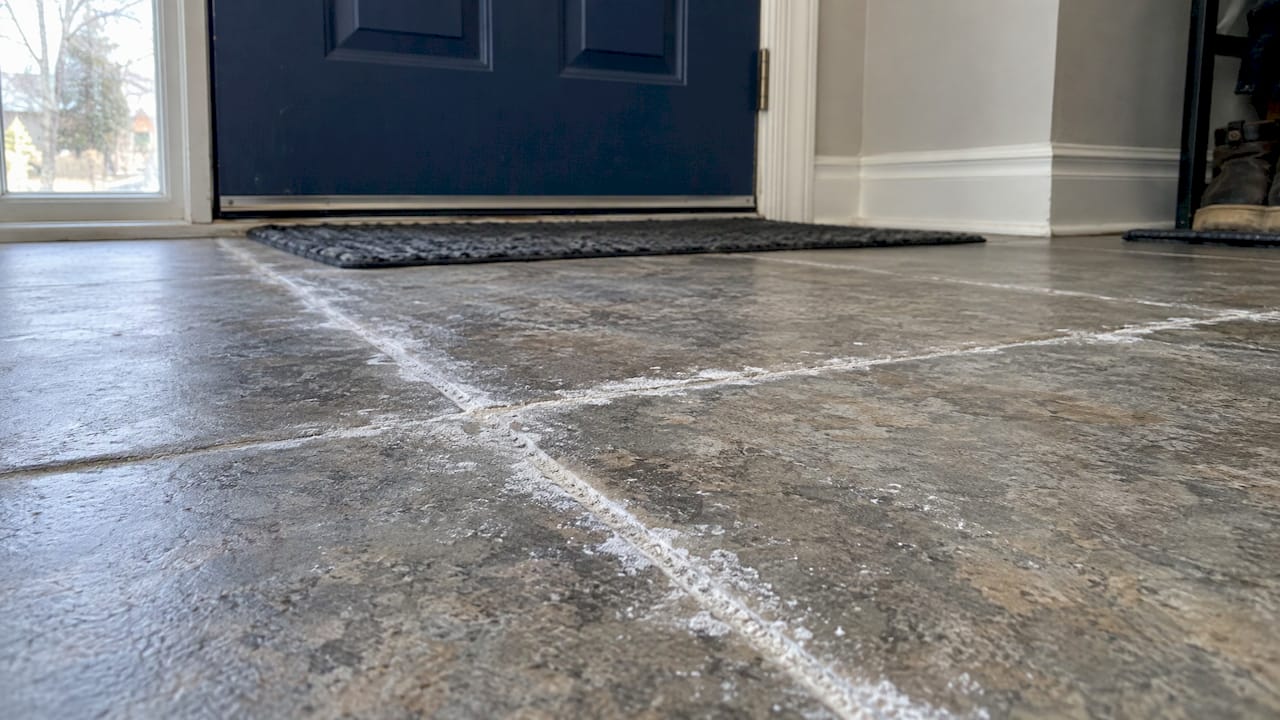
The white powder on your grout lines is efflorescence: mineral salts that moisture has carried to the surface and left behind as it evaporated. It can be brushed and cleaned away, but if it keeps coming back, the powder is only the symptom. Lasting results need two things: a careful removal that does not damage the grout, and a look at where the water is coming from. For homeowners in York Region and Durham with large tiled foyers, ensuites and basements, the right order of work protects both the tile and the investment in it. Our tile and grout team in the GTA handles the cleaning and sealing side.
TL;DR
- Efflorescence is a whitish salt deposit. It comes from water moving through cement-based grout or the slab below, not from dirt or from the water you mop with.
- Start with the gentlest method: a stiff brush, dry or with clean water. Acid-based cleaners are a last resort and must be used strictly as directed.
- Vinegar is acidic. It can etch natural stone and, used regularly, can weaken and discolour grout.
- Powder that keeps returning points to a moisture problem, and removing it alone will not fix that.
- Once the grout is clean and dry, a penetrating sealer helps keep moisture out of the joints.
Table of Contents
- What the white powder on your grout actually is
- Where it shows up in Greater Toronto homes
- How to remove efflorescence from grout, step by step
- What about vinegar?
- Why the powder comes back
- Prevention: keep water out, keep the grout protected
- Perspective
- Professional tile and grout cleaning across York Region and Durham
- FAQ
- Sources
What the white powder on your grout actually is
Efflorescence is a whitish mineral residue. The Tile Council of North America (TCNA) explains that water-soluble minerals, usually from the cement slab or ground below, dissolve in moisture and travel to the grout surface. When the water evaporates, the minerals stay behind.
Three conditions have to be present at once, according to LATICRETE's cement grout FAQ: soluble salts (found in Portland cement products), water to dissolve them, and a force such as evaporation, gravity or capillary action to bring the solution to the surface. Remove any one of the three and efflorescence stops. Once on the surface, the salt reacts with carbon dioxide in the air and turns into an insoluble white powder that can be stubborn to remove. The same source describes efflorescence as a naturally occurring condition, not a product defect.
That last point matters for homeowners. A new tile floor with efflorescence has not necessarily been badly installed, and a clean, well-kept home can still have it.
Is it efflorescence or something else?
Not every white film on grout is efflorescence. TCNA separates it from two look-alikes:
- Latex leaching on polymer-modified grout, where additives rise to the surface.
- Detergent residue, which can leave a sticky film in porous grout joints.
- Haze from a topical sealer. TCNA notes that non-vapour-permeable acrylic sealers can turn white when moisture reacts with them, producing a haze that is not efflorescence.
Some quick clues help. Mapei's technical bulletin, Causes and cures of efflorescence, says efflorescence crystals can often be identified because light reflects off the tiny particles and makes them sparkle. It also says the deposits do not harm the grout itself. If the film is sticky, glossy or sits as a cloudy layer, it is more likely residue or haze. If you suspect a construction-related film, our guide to grout haze removal covers that case.
The Canadian tile association CTASC offers a simple identification test in its expert answer on grout turning white: a slightly acidic solution such as vinegar can be used on a small spot only to verify that the deposit is efflorescence, since latex leaching will not respond to vinegar. Treat that as a spot test, not a cleaning method.
It also helps to know what does not cause it. TCNA says the small amount of minerals in the water you wash a floor with does not produce efflorescence, and thinset does not contain enough soluble salts to cause it either. A thick mortar bed can supply enough salts, but only when moisture is regularly passing through it. So the question is nearly always where the moisture is coming from.
Where it shows up in Greater Toronto homes
The pattern is the same in most houses: tile laid over a concrete slab or a mortar bed, with water reaching it from somewhere. Typical places are basement and ground-floor slabs, shower floors and walls, entrance tile near doors, and exterior patios and steps. Ontario's freeze-and-thaw seasons and spring melt put plenty of water against foundations, and Mapei's bulletin advises checking that exterior flashing, drainage, downspouts and grading carry water away from the building before correcting efflorescence.
For showers, CTASC points to poor drainage in the shower pan or an improperly sloped waterproof membrane as typical causes when efflorescence is excessive.
How to remove efflorescence from grout, step by step
The sequence below follows Mapei's guidance: begin with the least destructive method and only escalate when it fails.
1. Look before you clean
Confirm it is efflorescence using the clues above. Check the tile type. Natural stone such as marble, travertine and limestone reacts to acids, which changes every decision after this. If you are unsure what your tile is, or the surface is glazed ceramic you want to protect, our guide on safe cleaning methods that protect ceramic glaze explains what manufacturers allow.
2. Dry brush, then clean water
Mapei's first step is to scrub with a stiff-bristle brush, dry or with clean water. Dry brushing lifts the loose powder, and a vacuum collects it so it is not simply wetted and pushed back into the joints. Many light cases end here.
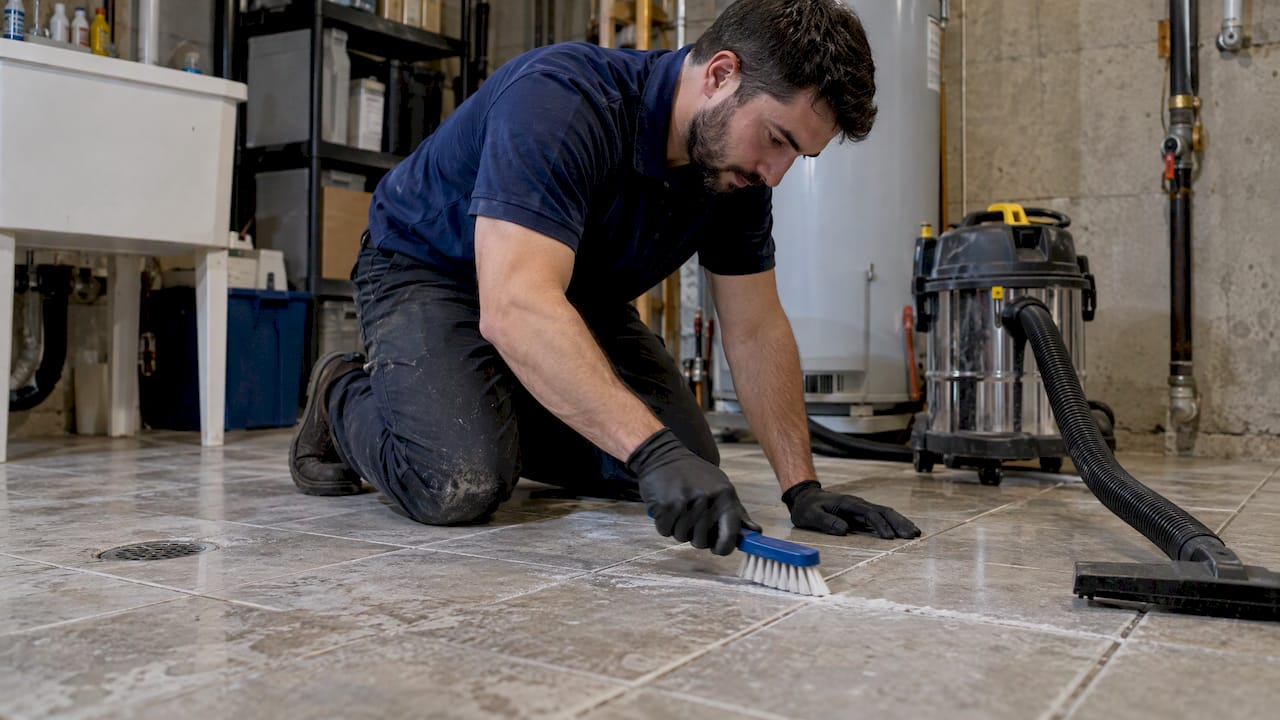
3. Only for stubborn deposits: a tile and grout acid cleaner, used as directed
When brushing is not enough, Mapei says an acid-based heavy-duty tile and grout cleaner can be used according to its instructions. The precautions it lists are the ones that prevent damage:
- Protect nearby surfaces.
- Soak the area with clean water first, so the grout does not absorb the acid.
- Test an inconspicuous area.
- Rinse thoroughly afterwards.
Severe cases can take several applications. Wear gloves and eye protection and ventilate the room, as the product label directs. Mapei is clear that acids should never be part of everyday cleaning: they work by eroding a thin top layer of the grout and can damage sensitive tiles and stones.
4. Rinse, dry and check the shade
Cleaning can leave slight shading in the grout. According to Mapei, that can be reduced over time with a neutral cleaner or re-coloured with a grout colour refresher. Allow the joints to dry fully and look at them again in a few days. That is the real test: if powder reappears, moisture is still moving through.
5. Seal once the grout is clean and dry
Mapei notes that a penetrating sealer can help keep some moisture away from the grout after removal. TCNA adds that a penetrating, vapour-permeable sealer may retard evaporation, which is what you want, rather than a topical coating that can trap moisture and cloud. Be realistic about what sealing does: the Ceramic Tile Foundation says a breathable sealer only slows moisture travel, it does not solve it. Our tile and grout maintenance schedule explains how often grout in homes is typically resealed.
What about vinegar?
Vinegar is the most common home suggestion, and the question comes up constantly. Mapei Canada states that vinegar is acidic and can etch marble, travertine and limestone. Occasional use on porcelain or ceramic tile with cement-based grout should not cause damage, but frequent or regular use can discolour and weaken grout, so it should not be part of routine maintenance.
In practice, keep vinegar to the one-spot identification test, and keep it off stone entirely. For a high-end home with natural stone, marble entrances or a travertine ensuite, that is the difference between a cleaned floor and a permanently dulled one.
Why the powder comes back
This is the part most guides skip. LATICRETE notes that until the salts are completely removed from the system, efflorescence can reoccur, so ongoing inspection and cleaning may be necessary. CTASC is more direct: excessive efflorescence is a symptom of an excessive moisture problem, and removing it does not solve the problem, so it will likely return.
The Ceramic Tile Foundation's case study on efflorescence shows it well. White powder kept returning after each cleaning. The cause turned out to be defective roof flashing letting water travel through the thin-set to the grout joints. Once the roofer repaired the flashing and the salts were washed away, the efflorescence disappeared. The lesson from the author, a forensic tile installer, is that finding and fixing the moisture source is the real fix.
Use this quick guide to decide what you are dealing with:
| What you see | Likely meaning | What to do |
|---|---|---|
| Light powder, appears once, in a new installation | Normal salts drying out | Dry brush, clean, monitor |
| Powder returns within weeks after cleaning | Ongoing moisture passing through | Trace the water source before cleaning again |
| Powder in a shower, at the base of walls | Possible drainage or membrane issue | Have the shower assembly assessed |
| Powder on exterior steps or patio, or on a basement slab | Water from grading, drainage or flashing | Correct the water path, then clean and seal |
| Sticky or cloudy film, no sparkle | Residue, latex leaching or sealer haze | Not efflorescence: clean as for residue |
If the powder is recurring and you suspect something structural, the Ceramic Tile Foundation advises contacting the grout manufacturer so the issue can be physically inspected and a solution recommended before you do anything more. A roofer, plumber or waterproofing contractor is the right call when the water source itself is the problem. The cleaning and sealing afterwards is where we come in.
Prevention: keep water out, keep the grout protected
- Deal with the water first. Fix leaks, flashing, drainage and grading as Mapei's bulletin describes, before any cleaning.
- Plan for it at installation. TCNA says that before tiling, remedial steps or a vapour-equalization membrane can be considered if regular vapour migration is detected.
- Seal with the right type. A penetrating, vapour-permeable sealer after the grout has cured and dried, not a topical film.
- Clean gently and routinely. Use a neutral cleaner for regular upkeep and keep acids for the rare stubborn deposit.
- Inspect. A quick look at the grout lines in basements, showers and entrances each season catches powder early.
Textured and porous tile hold residue more tightly, so see our notes on textured tile cleaning and porcelain tile cleaning if your floors are either type.
Perspective
Homeowners call us after they have tried a brush, then vinegar, then a store-bought acid, and the grout is now blotchy as well as white. Our view is simple: efflorescence is a moisture message, and the cleaning should respect the tile and the grout while that message is being dealt with.
We build our approach around safe, eco-friendly cleaning solutions, commercial-grade equipment and clear upfront pricing. For a large tiled home, the point is to restore the floor without eroding the grout or dulling the tile, and then to protect it. That is why our tile and grout service comes in three forms: cleaning only, cleaning with a protector, and cleaning with a sealer.
Our team also takes an educational approach. We would rather you understand why white powder appears and what keeps it away than clean the same joints every spring.
Rob
Professional tile and grout cleaning across York Region and Durham
We clean ceramic tile and grout for homeowners, landlords and businesses across the Greater Toronto Area, including Markham, Richmond Hill, Vaughan, Aurora, Whitby, Ajax and Pickering. Our tile and grout cleaning service is listed in three options: tile and grout cleaning only at $0.80, tile and grout with protector at $1.00, and tile and grout cleaning with sealer at $1.30. The service page shows the unit each price applies to.

If your grout has been cleaned and the white powder keeps returning, or you want it cleaned and sealed once the moisture source is dealt with, you can request a quote and we will come to you. We also back our work with a satisfaction guarantee and follow up after the service.
FAQ
Is the white powder on grout harmful?
Efflorescence is a mineral deposit, and Mapei's bulletin says it has no detrimental effect on the grout itself. It is mainly a cosmetic issue, but it signals that moisture is moving through the tile system. If it keeps returning, treat the water source, not just the powder.
Will vinegar dissolve efflorescence on grout?
A mild acid can react with it, which is why CTASC uses vinegar as a spot test. For cleaning, Mapei Canada warns that vinegar can etch marble, travertine and limestone, and that regular use can discolour and weaken cement-based grout. Dry brushing with clean water is the gentler first step.
Why does efflorescence keep coming back after I clean it?
Because the salts and the moisture are still there. LATICRETE says it can reoccur until the salts are completely removed from the system, and CTASC says the cause is typically excessive moisture. Fixing leaks, drainage or a poorly sloped shower base is what stops it.
Can sealing grout stop efflorescence?
A penetrating, vapour-permeable sealer can slow evaporation and help keep moisture out of the joints, according to TCNA and Mapei. It does not remove a moisture source, so seal after the grout is clean and dry and the water problem has been addressed.
Sources
- White Residue, Tile Council of North America
- Cement Grouts FAQ, LATICRETE
- Causes and cures of efflorescence, Mapei technical bulletin
- UltraCare Acidic Tile & Grout Cleaner, Mapei Canada
- Why did my grout turn white, CTASC
- Understanding Efflorescence, Ceramic Tile Foundation