
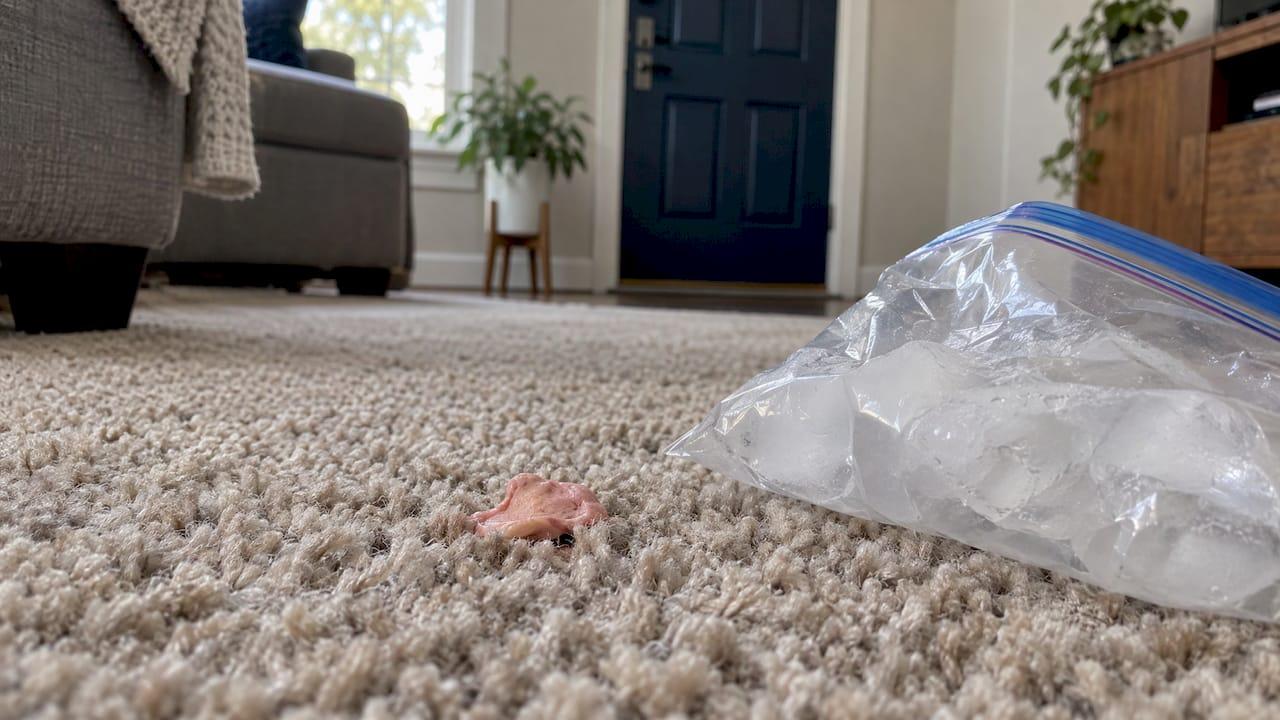
The safest way to remove gum from carpet is to harden it, lift off the solid, treat the residue with a pretested, carpet-safe solvent on a white cloth, then rinse lightly and blot dry. Tar follows the same logic with a different solvent. Fresh, small gum on a durable synthetic carpet is a ten-minute job. Old gum, tar, wool, silk or a pale luxury carpet is where a wrong move turns a small spot into a permanent mark, and where a professional team pays for itself.
This guide gives you the full method, the mistakes that cause damage, and a clear line for when to stop and book a visit.
TL;DR
- Harden the gum first, then lift it. Never pull warm gum, because it spreads deeper into the pile.
- For residue, use a non-flammable spot remover or dry-cleaning-type solvent, applied to a white cloth, never poured on the carpet.
- Tar needs a different solvent (mineral spirits is listed for wool) and a blot-and-lift approach, not rubbing.
- Keep liquids away from the carpet backing and never overwet. Overwetting causes watermarks and backing damage.
- Wool, antique, high-value or old set-in stains are best left to a professional. We clean carpets across York Region, Durham Region and the wider GTA.
Table of Contents
- Why gum and tar are harder than they look
- Before you start: three checks that prevent damage
- How to remove chewing gum from carpet, step by step
- What about WD-40, Goo Gone, vinegar and peanut butter?
- How to remove tar from a carpet
- Old gum and set-in tar
- When to stop and book a professional
- Gum and tar in shared and commercial spaces
- Our point of view
- What a professional visit looks like and what it costs
- Book gum or tar removal with us
- Keeping gum and tar off your carpet
- FAQ
- Sources
Why gum and tar are harder than they look
Gum is a sticky polymer. When it is warm and soft, it wraps itself around individual carpet fibres. Every tug stretches it deeper into the pile and pulls fibres out of the backing. Tar is worse: it is dark, oily and stains as it spreads.
That is why the most common home mistakes are the same ones. People pull at the gum, scrub the leftover with a wet cloth, or pour a solvent straight on the spot. The Carpet and Rug Institute, the carpet industry's technical body, warns against pouring solvent onto carpet and says it must not reach the backing, so its chewing gum guidance tells you to apply a small amount to a white cloth instead.
If your home has a good carpet, a children's room, a rec room or a staircase that is visible from the front door, you want the gum gone without a halo, a bleached patch or a stiff, sticky ring left behind.
Before you start: three checks that prevent damage
1. Know your fibre. Wool, silk, viscose and natural-fibre rugs (jute, seagrass) react to water and solvents differently from nylon or polyester. A wool carpet should never be rubbed, brushed or massaged while damp or wet, and the Nature's Carpet wool care guide warns that too much water can cause watermarks or damage the backing. If you are not sure what you have, treat it as delicate.
2. Pretest every product. Apply a small amount of whatever you plan to use in an inconspicuous spot, such as inside a closet or under a sofa. If you see colour transfer or damage, choose another solution. This is the Carpet and Rug Institute's own advice, and it applies to everything in your cupboard.
3. Use white cloths. A white cloth shows you immediately whether dye is lifting from the carpet, which a coloured cloth hides.
How to remove chewing gum from carpet, step by step

Step 1: Harden the gum
Place ice in a plastic bag and hold it on the gum until it is stiff. The wool care guides from the International Wool Textile Organisation and Nature's Carpet both list freezing with an ice bag as the first move. The bag matters: loose ice melts into the carpet and adds the moisture you are trying to avoid.
Where it goes wrong: peeling the gum while it is still soft. It will string out and spread.
Step 2: Lift the solid
Use a rounded spoon or a blunt scraper to lift the gum away from the surface. The Carpet and Rug Institute suggests scraping semi-solid gum gently with a rounded spoon, and breaking up solid gum and vacuuming the pieces. Work from the outside of the gum inward, so you do not smear it into clean fibre.
Where it goes wrong: cutting the gum out with scissors. You remove the pile with it, and on a cut-pile or plush carpet the bald patch is visible for years.
Step 3: Treat the residue
There is nearly always a thin tacky film left. For this, the Carpet and Rug Institute prefers a non-flammable spot-removal solution or a dry-cleaning-type solvent. Put a small amount on a white cloth, then work gently from the edges of the residue toward the centre. Do not rub. Rubbing frays the pile and pushes the residue down.
Where it goes wrong: pouring. The solvent runs down to the backing and the latex that holds the carpet together, and the damage there is not visible until the carpet starts to ripple or smell.
Step 4: Rinse and blot
Rinse with a small amount of cold water and blot dry with a clean white cloth. The Carpet and Rug Institute notes that several rinses with lukewarm water may be needed to take out solvent residue. If you leave residue, it attracts dirt and the spot re-soils quickly, so a clean-looking patch turns grey within weeks.
The wool guides add that you should use small amounts of liquid, avoid overwetting, and blot rather than rub. Open a window or run a fan on the area so it dries completely. Our guide to drying carpets within 24 hours explains why slow drying is a risk in Ontario homes, especially in basements and humid summers.
Step 5: Check the result in daylight
Look at the spot from a standing position and from the side. A sticky patch catches light differently. If the fibres feel stiff or the colour looks lighter than the surrounding area, stop. More solvent will make it worse.
What about WD-40, Goo Gone, vinegar and peanut butter?
These are the products that fill the top search results, and they are what people reach for first. The same logic applies to every one of them: they are oils or solvents, and they behave like any other spot remover.
- Pretest first, in a hidden spot, for colour change.
- Apply to a cloth, not the carpet, so none of it reaches the backing.
- Expect residue. Oily products leave their own stain and need to be removed after the gum, which means more rinsing and more moisture in the pile.
- Skip them on wool, silk and natural fibres, where the extra liquid and residue are the bigger risk.
The approach that carpet-industry guidance supports is simpler: harden, scrape, then a non-flammable spot remover or dry-cleaning-type solvent on a white cloth. Every extra product adds another step you have to clean up.
How to remove tar from a carpet
Tar is a different job. It is dark, it smears and it stains the fibre if it is pushed around. For wool carpet, the IWTO wool care guide lists this order:
- Blot or scoop up the excess tar. Do not spread it.
- Apply mineral spirits to a cloth and blot the tar, repeating if needed.
- Dry with a white cloth.
The Nature's Carpet guide lists mineral turpentine followed by a dry stain remover, and both guides include seeking professional help as a listed step. Mineral spirits are flammable, so ventilate the room, keep them away from heat and flame, and keep children and pets out of the area while you work.
Tar usually arrives on shoes from driveways, sealed asphalt or road work, so it often appears in a trail from the front door. A trail is a bigger job than a spot: each footprint is a place where a solvent can overwet the carpet or the dye can shift. If you see more than one or two marks, treat it as a professional job.
Old gum and set-in tar
Gum that has been in the carpet for weeks, or that has been through a vacuum or a steam cleaner, is harder. Heat from a previous clean can soften it, spread it and bond it to the fibre. The same goes for tar that has been walked into a pile.
The Carpet and Rug Institute says professionals can use more aggressive solutions and equipment for stubborn spills. The wool guides go further: for extensive or old stains on wool, consult a professional with wool experience, and restorative cleaning should only be done by an experienced professional.
When to stop and book a professional
Stop and book when any of these is true:
- The carpet is wool, silk, viscose or a natural-fibre rug.
- The gum or tar is old, has been walked on, or covers more than a small area.
- You have tried a solvent and see colour transfer, a halo or a stiff patch.
- The carpet is expensive, a rental you are responsible for, or in a room that guests see first.
- The area is a stair run, hallway or rec room where one spot usually means several.
At that point, more home treatment costs you more than it saves. A professional cleaning also deals with what the spot treatment leaves behind: the solvent residue, the dull patch, and the soil that collects around it. Our signs your carpet needs professional cleaning guide covers the other indicators worth watching.
Gum and tar in shared and commercial spaces
For landlords, property managers and offices, gum and tar are a recurring cost. They appear in entrances, lobbies, corridors and meeting rooms, usually alongside other spills. Having body fluid clean up supplies on hand for the unpleasant incidents lets staff contain a mess quickly so that the carpet can then be cleaned properly, rather than treated with improvised products.
For offices, a regular schedule matters more than reacting to individual spots. Our office carpet cleaning checklist sets out what to cover and how often, and our page on why regular carpet cleaning matters for businesses explains the long-term case.
Our point of view
We see gum and tar as a fibre problem first and a stain problem second. The spot is small, but the carpet around it is what you live with, so the goal is a patch that matches the rest, not just a patch that is gone.
That is why we work with commercial-grade equipment and eco-friendly cleaning solutions, and why we explain what we are doing and what to expect. A carpet that has been cleaned well should dry properly, feel soft and stay clean, and that is what we aim for in every home and business we visit across the GTA.
If a spot has already had a few rounds of home treatment, tell us what you used. It helps us choose the right approach for your carpet.
Rob
What a professional visit looks like and what it costs
Our residential carpet cleaning is priced by area, and the prices are published on our site. For example, a regular room is $60, a living room or master bedroom is $70, a medium hallway is $60, a small hallway is $30, a set of stairs is $60 (with one landing $70, with two landings $80), a recreation room is $120 and a closet is $10. Wool, Persian, oriental and other specialty area rugs have their own rates on our area rug cleaning page.
If you have a spot in one room, that room's cleaning takes care of the carpet around it, so the treated patch does not stand out against the rest. For a staircase with several marks, or a basement rec room that has seen years of use, cleaning the full area gives a uniform finish.
We also offer a satisfaction guarantee, clear upfront pricing and care after the service. For how the cleaning itself is done, see our overview of carpet cleaning methods. If the carpet is wool, our wool carpet care guide explains how to keep it in good condition between cleans.

Book gum or tar removal with us
We serve homeowners, tenants, landlords and businesses in Markham, Richmond Hill, Vaughan, Aurora, King City, Whitchurch-Stouffville, Ajax, Whitby, Pickering, Mississauga and Toronto. See the residential carpet cleaning prices for your rooms, or request a quote and tell us about the gum or tar so we can plan the visit.
If you are preparing a rental for a move-out, or a home for guests, book before the stain has a chance to set. Fresh gum and tar are always easier to deal with than old ones.
Keeping gum and tar off your carpet
A few habits cut the number of incidents:
- Shoes off at the door, with a mat inside and outside, to stop tar and grit at the entrance.
- A no-gum rule for carpeted rooms, especially bedrooms and rec rooms where children play.
- Quick action on spills. Blot rather than rub, and do not overwet.
- Regular professional cleaning, which removes the soil that makes a spot harder to treat. Our guide on preventing carpet stains from kids has practical ideas for family homes.
FAQ
Does WD-40 remove gum from carpet?
It can loosen gum, but it is an oil that leaves its own residue, which then needs removing from the pile. Pretest it in a hidden spot and apply it to a cloth rather than the carpet. On wool, silk or a high-value carpet, a professional treatment avoids the extra residue.
What dissolves old gum in carpet?
The Carpet and Rug Institute prefers a non-flammable spot-removal solution or a dry-cleaning-type solvent, used in small amounts on a white cloth and never poured on the carpet. Old gum often needs repeated, careful treatment and several rinses to remove residue. If it has been in the carpet for weeks, a professional visit is the safer route.
Can I use the freezing method on any carpet?
Yes, hardening gum with ice in a plastic bag is a standard first step, and it is listed in wool and general carpet guidance. Keep the ice in the bag so no extra water gets into the carpet. The step after freezing, solvent treatment, is where the fibre type matters.
How do I get tar out of a carpet?
Blot or scoop up the excess, then apply a solvent such as mineral spirits to a cloth and blot, as the IWTO wool guide describes. Use small amounts, work from the edge inward and dry with a white cloth. Ventilate the room because mineral spirits are flammable. Old or widespread tar should be treated by a professional.
How much does professional carpet cleaning cost in the GTA with iCleanse?
Our published residential prices include $60 for a regular room, $70 for a living room or master bedroom, and $60 for a set of stairs. Request a quote if you want the visit planned around a specific stain.
Sources
- Chewing Gum, The Carpet and Rug Institute
- Wool Carpet Care Guide, International Wool Textile Organisation (2024)
- Wool Carpet Care & Maintenance Guide, Nature's Carpet (2025)