
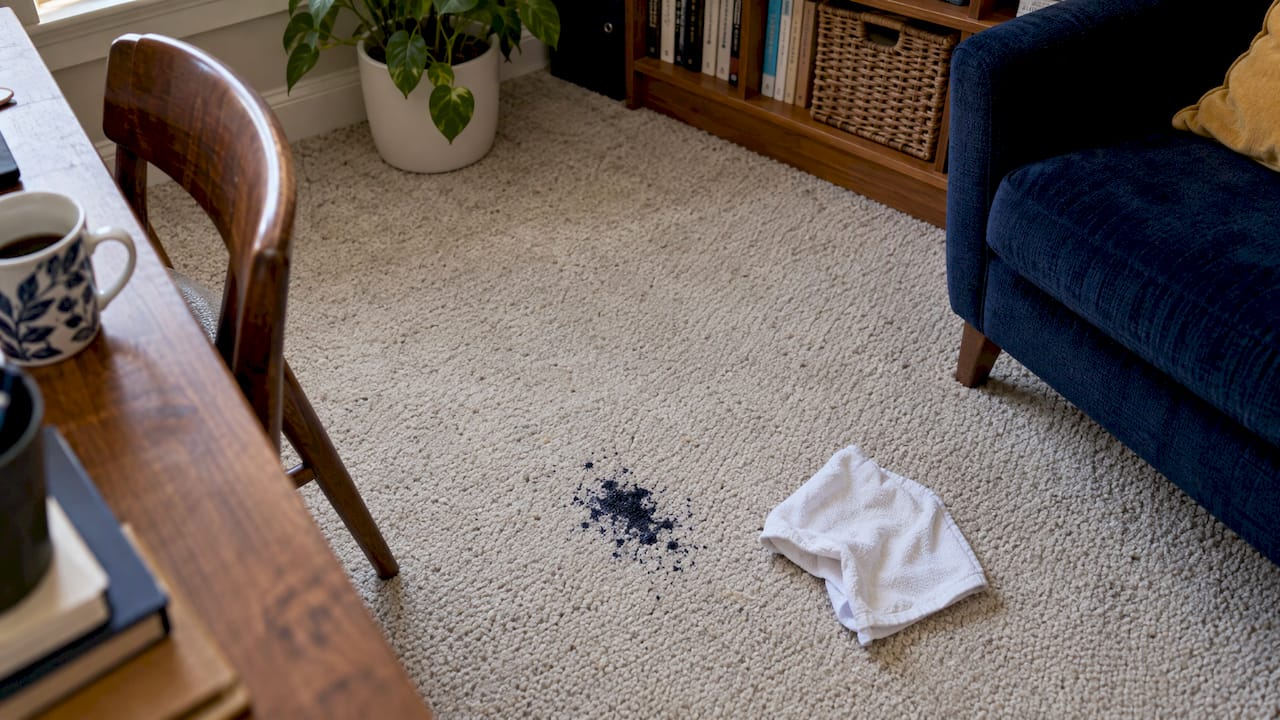
Most ink stains on carpet can be lifted if you act quickly, blot instead of rub, and match the method to the type of ink. Ballpoint and washable marker usually respond to careful spot treatment. Permanent marker, Sharpie, printer ink and anything that has dried into wool or delicate fibres are where a professional clean saves the carpet. Below you will find the first-aid steps, a guide to each ink type, the products to avoid, and a clear point at which to stop and book help.
TL;DR
- Blot the ink with a dry white cloth or paper towel straight away. Never rub, and never pour liquid onto the stain.
- Test any solution on a hidden patch of carpet first, and keep solvents away from the backing.
- Ballpoint, washable marker, permanent marker and printer ink each need a different approach.
- Rinse several times with lukewarm water and blot dry, because leftover residue attracts new dirt.
- Permanent inks, wool, silk, rugs and old stains are best handed to a professional team before you make them worse.
Table of Contents
- What to do in the first five minutes
- Why ink is harder than most spills
- Match the method to the ink
- Removing ballpoint pen ink
- Marker and Sharpie stains
- Printer ink and toner
- Can old or dried ink be removed?
- Household products people reach for
- Rinse, then rinse again
- Your carpet's fibre changes everything
- Stain protection and warranty
- Perspective
- When to book a professional
- Preventing the next ink stain
- FAQ
- Sources
What to do in the first five minutes
Speed matters more than any product. The Carpet and Rug Institute, the industry's technical body, warns that delaying treatment may make an ink spill permanent. So start with what you already have at home.
- Remove the source. Move the pen, marker or cartridge away so you do not add more ink.
- Scrape up anything solid. Use the edge of a spoon to lift wet blobs gently, working from the outside toward the middle.
- Blot, do not rub. Press a dry, white absorbent cloth or paper towels onto the spot. The same institute recommends white cloth because coloured fabric can transfer its own dye. Rubbing pushes ink deeper into the pile and spreads it wider.
- Switch to a clean section each time. Once the cloth shows ink, fold it to a fresh area. Reusing a dirty patch puts the ink straight back.
- Pause before you reach for a spray. Check the next sections for your ink type before you wet the carpet.
If you hold off for a day, the stain is not lost, but the odds shift. We cover older stains further down.
Why ink is harder than most spills
Ink is designed to stay put. It is made of dyes or pigments carried in a liquid, and carpet fibres, especially nylon and wool, accept dye readily. Water alone will not dissolve many inks, which is why the stain can sit there looking unchanged after you have scrubbed it.
That is also why the right solvent matters. A solution that dissolves one ink can set another, and one that lifts ink can also strip the carpet's own colour. The aim is always the same: dissolve the ink into a clean cloth, not into the carpet.
Match the method to the ink
| Ink type | Usual first step | Watch out for |
|---|---|---|
| Ballpoint pen | Dab with rubbing alcohol or a dry-cleaning solvent on a white cloth | Alcohol can dissolve carpet dye and harm some fibres |
| Washable marker | Blot with a sponge dampened with rubbing alcohol, then shampoo | Over-wetting the carpet |
| Permanent marker or Sharpie | Dab alcohol with a cotton ball and blot at once | Often only partly removable, so stop if it is not shifting |
| Fountain pen | Non-flammable spot solution or dry-cleaning solvent | Solvent reaching the backing |
| Printer ink (liquid) | Blot outside-in, then treat with a mild detergent solution | Wicking back up as the carpet dries |
| Toner (powder) | Do not wet it, call a professional | Fine particles spread and stain easily |
Removing ballpoint pen ink
Ballpoint is the most common culprit and the most forgiving. The Carpet and Rug Institute's guidance for ink points to a mild detergent solution of one quarter teaspoon of liquid dishwashing detergent per cup of lukewarm water. It also says never to use a stronger mix, laundry detergent (which can contain optical brighteners that dye the fibre) or automatic dishwasher detergent (which can contain bleaching agents).
A sensible sequence for ballpoint:
- Blot up any wet ink as described above.
- Dampen a white cloth with a little rubbing alcohol. Do not pour it onto the carpet. Press the cloth onto the ink, lift, and repeat with a fresh part of the cloth.
- Work from the edge of the stain toward the centre so the ink does not creep outward.
- Continue only while ink is still transferring to the cloth.
- Follow with the weak dishwashing solution, blot, then rinse.
The University of Georgia's extension service describes a similar approach for ballpoint: sponge with a commercial dry-cleaning solvent while ink keeps coming out, and keep the solvent from soaking into the backing. The same page notes that alcohol will damage acetate, triacetate, modacrylic and acrylic fibres, and that ammonia damages silk and wool. If you do not know your carpet's fibre, that is a reason to test first, or to ask us.
Why you never pour solvent on the stain
Carpet is a layered product. The tufts are held in place by latex that bonds the primary and secondary backings together. Solvent that soaks through can weaken that bond, and a flooded spot can carry ink outward and downward. The Institute specifically cautions against letting solvent reach the backing. Apply it to the cloth, then touch the cloth to the carpet.

Marker and Sharpie stains
Washable markers
Children's washable markers are the easy case. Crayola's own stain guidance says to dampen a sponge with rubbing alcohol and blot to absorb the stain, changing the sponge as often as needed. It then suggests applying upholstery or rug shampoo following the label directions. Blotting is the key word again. If your child has also coloured the sofa, our guide on how to prevent carpet stains from kids in your home covers the habits that keep it from happening twice.
Permanent marker and Sharpie
Permanent markers are built to resist exactly what you are about to try. The Georgia extension service states plainly that permanent inks are almost impossible to remove from carpet, and repeats the rule not to rub.
If you want to try before calling anyone, The Spruce suggests dabbing rubbing alcohol on the mark with a cotton ball and blotting immediately with a clean, dry cloth, continuing only until no more ink transfers. As soon as the mark stops moving, stop. Repeated attempts on the same spot thin out the carpet dye and can leave a pale patch that looks worse than the original mark.
Printer ink and toner
Two very different things get called printer ink.
Liquid inkjet ink behaves like other water-based or dye-based inks. Blot the bulk straight down with a white towel, working from the outside in, then treat with the mild detergent solution and rinse. Dry the area quickly. When a damp spot dries slowly, dissolved ink can wick back up through the fibres and leave a faint shadow where you thought you had finished.
Toner from a laser printer or copier is a fine powder, not a liquid. Wetting it can turn a light dusting into a smear, and a regular household vacuum can blow the particles back into the air. If you have toner on carpet, avoid water and standard vacuuming, keep the area undisturbed, and call us.
Because printer inks often contain dye combinations, a pale colour ghost is common after the first treatment. Removing that last tint is the point where fibre-appropriate treatments matter, and where guessing can bleach or change the carpet's own colour.

Can old or dried ink be removed?
Sometimes, but your expectations should change. Dried ink has bonded with the fibre, so a household cloth treatment is less likely to finish the job, and each extra round of alcohol or solvent adds risk to the dye and backing.
What changes when an ink stain is no longer fresh:
- There is nothing left to blot. You are dissolving ink out of the fibre, not lifting liquid from the surface.
- More repetition, more risk. Every pass with solvent is a pass over the carpet's colour as well.
- Residue and halos appear. Under-rinsing leaves a sticky ring that attracts soil and darkens over time.
- The fibre and the ink type matter more. A year-old ballpoint line on synthetic carpet is a very different job from a dried Sharpie on wool.
If a stain has been there for days or weeks, do one thing: stop treating it yourself and photograph it. A professional can identify the fibre, test the dye, and choose a method before the carpet is changed. Our article on why acting within 15 minutes matters for deep carpet stains in GTA homes explains how stains set the longer they sit.
Household products people reach for
WD-40
It is a common search, and a common impulse. WD-40 is an oily lubricant, and oil left in carpet creates a new stain that attracts dirt. If ink is the problem, an oil-based product usually trades one mark for another. We would not use it on carpet.
Hairspray, acetone and nail polish remover
Hairspray used to be the folk remedy, but formulas vary widely and many leave resins, fragrance or oils behind. Acetone and nail polish remover are harsher still on dyes, fibres and backing. A plain alcohol-dampened cloth is easier to control than any of them.
Heat
Do not use a steam cleaner, iron or hair dryer on an ink stain you are still treating. Heat can set what has not yet been lifted.
Bleach and strong oxidisers
Bleach destroys carpet dye along with the ink. Hydrogen peroxide is sometimes mentioned as a last resort on red ink, and the Georgia extension service places it at the end of its sequence. Peroxide should never go on wool. If you are not sure of your fibre, leave this step alone.
Rinse, then rinse again
The step people skip is the one that causes the second stain. The Carpet and Rug Institute notes that many spot solutions leave residues that attract soil. It recommends rinsing the area several times with lukewarm tap water using a mist-type sprayer to avoid over-wetting, blotting with paper towels and patting dry after each rinse.
When you finish, lay a pad of white paper towels over the damp spot, weigh it down with something clean and flat, and let it absorb until dry. Keep foot traffic off the area. Good airflow helps, and our note on drying carpets within 24 hours to prevent mould in Ontario applies to any damp carpet, not just after a professional clean.
Your carpet's fibre changes everything
The same alcohol can be fine on one carpet and damaging on another. In general:
- Nylon and polyester tolerate careful spot treatment best.
- Acetate, triacetate, acrylic and modacrylic can be damaged by alcohol.
- Wool and silk are damaged by ammonia and are vulnerable to dye loss and backing problems. Our wool carpet care guide explains how to look after them.
- Rugs may combine delicate fibres, natural dyes and non-colourfast materials.
If a spot treatment makes colour appear on your cloth that is not ink, stop. That is your carpet's dye. Colour movement is a risk we explain in more detail in how colour bleeding occurs during carpet cleaning. If colour has already been lost, professional carpet colour restoration is a separate process worth knowing about.
Stain protection and warranty
If your carpet came with a stain-resistance warranty, read its terms before you treat anything. Some manufacturers require you to contact them first, and an unapproved product may affect coverage. Landlords and property managers should also check lease and flooring documentation before tenants attempt their own repairs.
Perspective
Every week we see the same pattern in Toronto, York Region and Durham homes. Someone does the right thing for the first minute, blots the ink, and then gets a second wave of enthusiasm: a bit more alcohol, a bit of scrubbing, maybe a second product on top. That is when a small mark becomes a pale halo or a ring that comes back after drying.
Our approach is built around the opposite instinct. We identify the fibre, we treat the ink with solutions chosen for it, and we rinse thoroughly so nothing is left behind to attract dirt. Our team works with commercial-grade equipment and eco-friendly cleaning solutions, and we stand behind the work with a satisfaction guarantee and clear upfront pricing.
If you have done the first-aid steps above and the stain is still there, that is the right moment to call. The earlier we see it, the more options we have.
Rob
When to book a professional
Handle the stain yourself if it is fresh ballpoint or washable marker on a synthetic carpet and it is lifting with every blot. Call a professional when:
- the stain is permanent marker, Sharpie, toner or fountain pen ink;
- the carpet is wool, silk or a mixed-fibre rug;
- the ink has dried for days or longer;
- your first attempt did not shift it, or colour is coming onto your cloth;
- the stain is on a large area, a staircase or a high-visibility room;
- it is a rental unit, a move-out, or an office where appearance counts.
We clean carpet, upholstery, rugs and tile and grout across the Greater Toronto Area, including Markham, Richmond Hill, Vaughan, Aurora, Whitby, Ajax, Pickering, Mississauga and Toronto. Our published residential prices are listed per area: a Regular Room is $60, a Living Room or Master Bed Room is $70, a Small Hallway is $30, a Set of Stairs is $60 and a Closet is $10. You can see the full list on our residential carpet cleaning page, or send us a photo of the stain through our quote request form.

Businesses with ink on office or commercial carpet can see our commercial carpet cleaning options, and facility teams will find a useful schedule in our office carpet cleaning checklist.
Preventing the next ink stain
- Keep pens, markers and printer cartridges off floors and away from play areas.
- Store permanent markers with caps on, in a box, up high.
- Place a small mat or tray under home-office printers.
- Teach children that colouring happens at a table.
- Schedule regular professional cleans so that dirt does not make future stains harder to lift. For more on how we approach different methods, see our carpet cleaning methods page.
FAQ
Can ink stains be removed from carpet?
Often, yes, particularly when they are fresh and you blot rather than rub. Ballpoint and washable marker are the most treatable. Permanent inks are much harder, and the Georgia extension service describes them as almost impossible to remove, so a professional assessment is worth it.
Can WD-40 be used to remove ink from carpet?
We would not use it. WD-40 is oil-based, and oil left in the pile creates a new mark that attracts soil. A cloth dampened with rubbing alcohol, tested on a hidden spot first, is easier to control on most synthetic carpets.
Can old ink stains be removed?
Some can, but the odds drop the longer the ink sits, and repeated home attempts risk dye loss and backing damage. If the stain is days or weeks old, or the carpet is wool or silk, have a professional assess it before you try anything stronger.
What is the best carpet cleaner for ink stains?
There is no single product, because the best choice depends on the ink and the fibre. Start with a mild solution of dishwashing detergent and lukewarm water as the Carpet and Rug Institute describes, and use solvents only on a cloth. A professional can match the product to the fibre.
How do I get a Sharpie or marker stain out of carpet?
Washable markers lift with an alcohol-dampened sponge, blotted. For Sharpie, dab alcohol with a cotton ball and blot, and stop once nothing more is transferring. If a mark remains, book a professional clean rather than repeating the treatment.
Sources
- Ink, The Carpet and Rug Institute
- Ink, Fountain Pen, The Carpet and Rug Institute
- Remove Stains From Ink, University of Georgia Extension
- Washable Markers on Carpet, Crayola
- How to Remove Permanent Marker From Any and Every Surface, The Spruce