
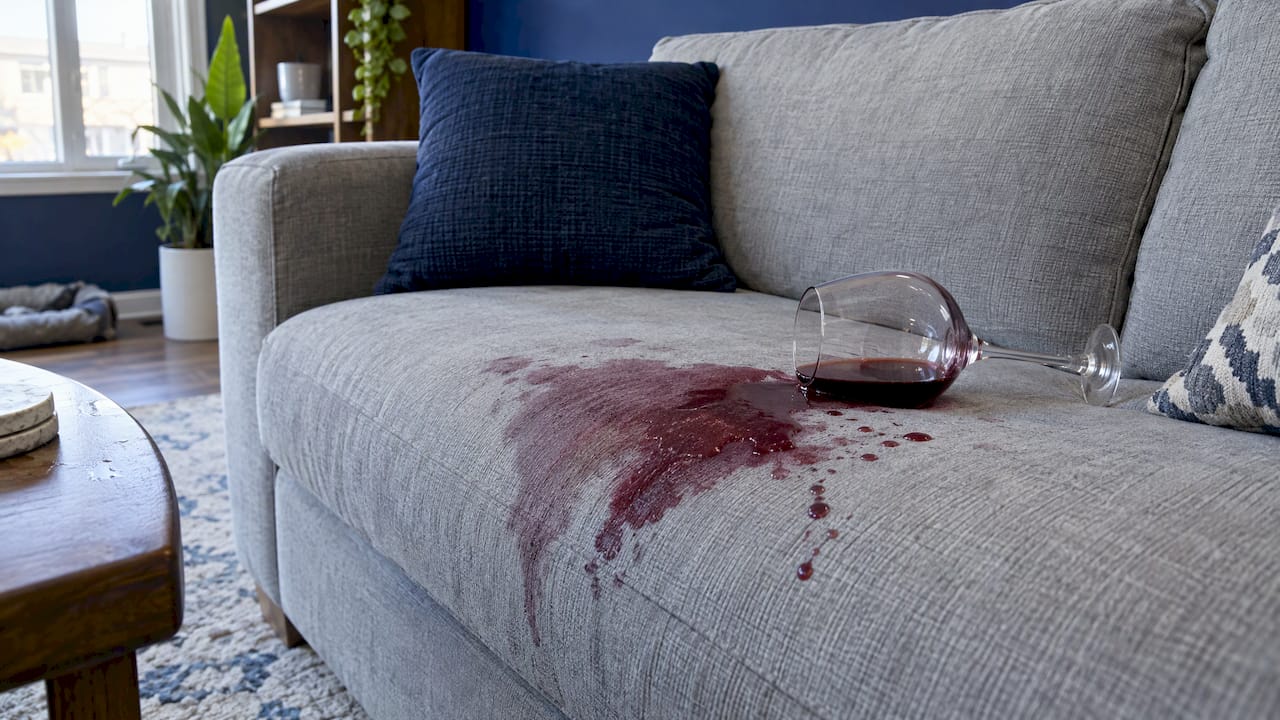
Blot the spill straight away with a clean, white, absorbent cloth, press from the outside toward the centre, and do not rub. Then check your couch's care code before you put any cleaner on it. That order protects the fabric and gives you the best chance of lifting the stain. If the wine has dried, the fabric is delicate or the sofa is an expensive one, a professional upholstery clean is the safer route, and we do it across York Region, Durham Region and the wider GTA.
This guide covers the first-aid steps, what to do with a dried or stubborn stain, which shortcuts put the fabric at risk and how to decide when a spill has become a job for a specialist.
TL;DR
- Blot, never rub. Absorb as much wine as you can with white paper towels or a clean white cloth before you add any liquid.
- Find the care code on the couch label (W, S, W-S or X) first. It tells you whether water-based or solvent-based products are safe.
- Test every cleaner on a hidden spot and let it dry before you treat the visible stain.
- Keep the fabric from getting soaked. Too much water can leave a ring that looks worse than the original spill.
- For dried wine, delicate fabrics, velvet, silk or a high-value sofa, book a professional clean rather than experimenting.
Table of Contents
- Why red wine on a couch is more urgent than it looks
- Step 1: Blot the spill straight away
- Step 2: Read the care code before you touch a cleaner
- Step 3: Test, then treat, based on the code
- What to do when the wine has already dried
- Home remedies that put the fabric at risk
- Does red wine leave a permanent stain on a couch?
- When to call a professional
- A holiday-season note for GTA hosts
- Our view on wine and upholstery
- Get the couch cleaned by a professional
- Aftercare once the stain is out
- FAQ
- Sources
Why red wine on a couch is more urgent than it looks
Red wine carries pigment and a liquid that soaks quickly into upholstery foam and backing cloth. A carpet is a surface you can flush. A couch is built from fabric, padding and often a frame, and you cannot rinse any of it. Every drop of liquid you add has to be removed again, and the more liquid you push through the fabric, the further the wine travels.
That is why the first ten minutes matter more than the product you choose. Absorbing wine before it dries leaves the fabric with far less to release later. It is also why many couch stains that start as a small spill become a large, faded patch after a few rounds of home treatment.
The good news: a red wine stain on a couch is not automatically permanent. Fresh spills handled calmly often come out. Dried ones and ones that have been scrubbed take more care, and that is where professional equipment earns its fee.

Step 1: Blot the spill straight away
Grab white paper towels or a clean white cloth. Coloured towels can transfer dye onto wet upholstery, so white is the safe choice. Press down firmly onto the wet area, lift, and move to a clean part of the cloth. Repeat until the cloth comes up almost dry.
A few rules make this step work:
- Press, do not rub. Rubbing pushes wine deeper and roughens the fibres, which can leave a visible worn patch.
- Work from the outside in. Start at the edge of the spill and move toward the centre so the stain does not spread. CB2 Canada gives this same direction of travel in its fabric care guide when it describes spot treatment.
- Stand cushions on their edge if they come off, so that wine does not run into the foam.
- Keep going until you are lifting very little colour. Many people stop too soon.
If the wine has pooled on a removable cushion cover, check the label before you consider washing it. Many couch covers are not made to go in a machine.
Step 2: Read the care code before you touch a cleaner
Most couches have a tag under a cushion or along the frame with a letter code. The professional upholstery cleaning standard, IICRC S300, defines the codes this way:
| Code | What it means |
|---|---|
| W | Water-based spotters and cleaners are safe |
| S | Dry solvent-based cleaners only |
| W-S | Either water-based or solvent-based |
| X | Brushing or dry vacuuming only, no liquid cleaning |
The same standard stresses that you should test the fabric before treating it, whatever the code says. Treat the code as a starting point, not a guarantee. Delicate constructions such as pile weaves and knits also need limited agitation, which is another reason to avoid vigorous scrubbing.
If your tag says X, stop at blotting and vacuuming and call a professional. If there is no tag, treat the fabric as unknown and test even more carefully. Our guide to delicate upholstery fabrics explains how to recognise the ones that need extra care.
Step 3: Test, then treat, based on the code
University of Georgia Extension, which publishes textile care guidance, tells readers to read the care label and to pretest each cleaning agent on an inconspicuous area for colourfastness. Under a cushion, on the back panel or along the skirt works well. Apply a little, blot it, let it dry fully and check for colour transfer, rings or a change in texture. Only then move to the visible stain.

If the code is W or W-S
The UGA Extension recipe for blended, natural and synthetic upholstery fibres works like this:
- Mix 1 teaspoon of neutral detergent into a cup of lukewarm water.
- Blot the stain with it. Do not rub and do not soak.
- Blot with a mixture of 1/3 cup white vinegar and 2/3 cup water.
- Repeat the detergent step.
- Sponge with clear water, taking care not to wet the backing.
- Dry as quickly as you can.
UGA notes that sizing rings can appear when fabric gets too wet, and that on cotton or linen the vinegar should be diluted further, to 2 parts water to 1 part vinegar. Fans, open windows and a dry towel pressed on the area all help speed drying. Provide ventilation too, the Extension adds, whenever you use strong or flammable products.
If the code is S
Water-based products are out. CB2 Canada advises using only a water-free dry-cleaning solvent made for upholstery. Pretest it on a small hidden area and let that dry completely. Apply it sparingly without saturating, work from the outside of the stain toward the centre, and air dry fully.
If the code is X
Do not apply liquid. Blot what you can, vacuum or brush lightly once dry and arrange a professional assessment.
What to do when the wine has already dried
Dried wine has bonded with the fibres, and it is a different job. CB2 Canada's fabric care guide gives a gentle approach for stains dried into fabric: dampen a cloth with warm water, add a drop of professional wool and silk detergent, and blot while rotating the cloth surface so you are always using a clean area. Then blot away the detergent residue with a clean damp cloth and let the fabric air dry.
The key word is gentle. Repeating a strong treatment again and again is how people end up with a bleached halo, a stiff patch or a water ring. If one careful round does not shift the colour, that is the signal to stop, not to escalate.
Home remedies that put the fabric at risk
Search results for this problem are full of pantry fixes: salt, club soda, baking soda, pouring white wine on red, hydrogen peroxide and boiling water. You will see them recommended with great confidence. We would not rank any of them above the tested approach above, for three reasons.
- They are rarely tested on your fabric. The standard tells you to test before treating, whatever the code. A remedy that suits a cotton blend can mark a viscose or velvet.
- They add liquid or residue. Anything wet that goes into the fabric has to come out again, and powders can be hard to remove completely from textured weaves.
- Boiling water and strong agents are hard to control. Heat and harsh chemicals can set or lighten dye in the fabric itself, which then looks like a permanent mark of its own.
If you do use any product, the rules do not change: pretest, apply sparingly, blot, and dry thoroughly.
Does red wine leave a permanent stain on a couch?
It can, but it usually does not have to. Outcomes depend on how fast you blotted, how absorbent the fabric is, what the care code allows and how much treatment has been tried. Fresh wine on a tightly woven synthetic often lifts well. Dried wine on a light, natural or delicate fabric is harder, and each failed attempt at home makes professional recovery less certain, because the fibres may be damaged or the dye disturbed.
The practical rule: one careful, tested round at home, then stop and get the couch assessed if colour remains.
When to call a professional
We recommend booking a clean instead of treating the stain yourself in these situations:
- The care tag says X, or the sofa is silk, velvet, a delicate weave or has no tag at all.
- The wine has dried, or a first gentle treatment did not shift it.
- The couch is leather or part leather. Wine on leather is its own problem, covered in our leather sofa care guide.
- The sofa is a high-value piece, a family heirloom or a set you are hosting on this weekend.
- The spill has soaked into the cushion foam, or you can smell it.
- You are a landlord or tenant who needs the furniture back to presentable condition.
A professional starts with the same question you should: what is this fabric and what does it tolerate? Then they use equipment that applies and removes moisture in a controlled way, which is the part a home attempt cannot copy.
A holiday-season note for GTA hosts
The weeks between November and January are when many couch wine spills happen: dinner parties, open houses and family gatherings across Markham, Richmond Hill, Vaughan, Aurora, Whitby and Ajax. If you are hosting, put a stack of white cloths within reach of the seating area, know where your couch's care tag is, and decide in advance that a spill gets blotted first and discussed later. It is much easier to stay calm when the plan is already in your head.
After a busy season, a full upholstery clean also deals with what you cannot see: food and cooking odours, body oils and dust in the fabric. Our guides on cooking odours in sofa fabric and on how often to clean a sofa will help you plan.
Our view on wine and upholstery
At iCleanse, the most common mistake we hear about is not the spill. It is what happened in the hour afterwards: rubbing, soaking the cushion, then trying a second and third product when the first did not work.
Upholstery is forgiving of a fast, gentle response and unforgiving of an aggressive one. Blot, check the care code, test a hidden spot, and stop if the stain does not move. That is the advice we would give a friend, and it matches what the cleaning standard and textile specialists say.
When a client calls us, we want to know the fabric, the care code and how long the wine has been there. Our approach is built around safe, eco-friendly cleaning solutions and professional equipment, so that the couch is cleaned thoroughly without being drenched. We stand behind our work with a satisfaction guarantee and we are clear about pricing before the job starts.
A couch is a major purchase, and a wine stain does not have to be the end of it. Early attention, and the right help when you need it, usually makes the difference.
Rob
Get the couch cleaned by a professional
If the stain has dried, the fabric is delicate or you would simply rather not gamble with your sofa, we can take it from here. iCleanse Carpet & Upholstery Cleaning serves homeowners, tenants, landlords and businesses across York Region, Durham Region and the rest of the Greater Toronto Area, using commercial-grade equipment and eco-friendly cleaning solutions. Tell us about the fabric and the spill and we will give you clear, upfront pricing.

Wine rarely lands only on the couch. If a glass also tipped onto the carpet beneath it, our room prices are published: a living room is $70, a master bedroom is $70 and a regular room is $60, with the full list on our residential cleaning page. For the sofa itself, request a quote and we will confirm the details with you.
Aftercare once the stain is out
Whether you treated it yourself or had it professionally cleaned, the fabric needs to dry completely before it is used again. Keep the room ventilated and avoid putting cushions back until they feel dry through the core. Damp upholstery can pick up smells, and a cushion that is dry on top may still be wet inside.
Once the couch is dry, vacuum it lightly to lift the pile. Then check the area in daylight. Wine residue sometimes looks gone under lamps and reappears as a pale ring or faint tint by the window. If that happens, avoid more rounds of treatment at home. Our upholstery cleaning tips cover routine care that keeps fabric in good shape between professional cleans.
If you have pets, the same advice applies to accidents on the sofa: blot early and treat gently. Our guides on pet odour in upholstery and pet dander explain the next steps.
FAQ
How do you get red wine out of a couch quickly?
Blot immediately with white paper towels or a clean white cloth, pressing from the outside of the spill toward the centre. Do not rub. Once you have absorbed what you can, check the care tag and test any cleaner on a hidden area before you treat the visible stain.
Does baking soda remove red wine from a couch?
Popular guides suggest it, but it is not part of the tested textile guidance we rely on, and powders can be hard to remove from textured weaves. A better first step is blotting followed by the care-code-appropriate method, tested on a hidden spot. If the stain remains, a professional clean is safer than repeated home attempts.
Can I use water on any couch?
No. Couches coded S need a water-free dry-cleaning solvent, and X-coded fabrics should only be brushed or dry vacuumed. Check the care tag under a cushion first, and test on a hidden area even if the code allows water.
Why did a ring appear after I cleaned the stain?
Rings often form when fabric gets too wet and dries unevenly. University of Georgia Extension warns about this and advises dampening carefully and drying quickly. A professional clean can even out the area using controlled moisture and proper drying.
When is it time to call a professional upholstery cleaner?
Call when the wine has dried, one careful treatment has not worked, the fabric is delicate or coded X, or the sofa is valuable. Booking early avoids repeated home attempts that can set the stain or disturb the dye.
Sources
- IICRC S300 Standard for Professional Upholstery Cleaning, 2024 public-review draft
- Fabric Care Guide, CB2 Canada
- Remove Stains From Alcoholic Beverages, Beer, Wine, University of Georgia Extension